环氧复合材料表面电位衰减与直流电导特性
1
2018
... 酸酐固化双酚-A环氧树脂由于其优异的绝缘、热学以及力学性能,被广泛应用于电力设备的支撑、绝缘和密封等关键部件[1 -2 ] .在气体绝缘金属封闭线路(Gas insulated transmission line,GIL)和气体绝缘金属密封开关(Gas insulated switchgear,GIS)中,以环氧树脂、酸酐、氧化铝为主要原料,通过浇注工艺制成的盆形绝缘子或三柱形绝缘子在支撑和绝缘方面发挥着重要作用,是GIL/GIS基础单元的关键组件[3 -4 ] .纤维增强型环氧树脂复合材料由于其良好的拉伸强度和断裂强度,制成了复合绝缘子及绝缘拉杆的主要功能结构[5 ⇓ -7 ] .通过用皱纹纸绕包导体并用环氧树脂真空压力注胶固化而成的环氧树脂浸渍纸(Resin impregnated paper,RIP)绝缘芯子是整个套管的关键结构,它承担设备的主要散热、机械负载和接地绝缘[8 -9 ] .高频变压器采用环氧树脂复合材料实现设备整体绝缘,可有效减少设备体积,提高功率密度[10 ] .可以看出,酸酐固化双酚-A环氧树脂作为承担主要绝缘功能的电气材料已广泛应用于高端电力设备. ...
Surface potential decay and DC conductivity characteristics of epoxy composites
1
2018
... 酸酐固化双酚-A环氧树脂由于其优异的绝缘、热学以及力学性能,被广泛应用于电力设备的支撑、绝缘和密封等关键部件[1 -2 ] .在气体绝缘金属封闭线路(Gas insulated transmission line,GIL)和气体绝缘金属密封开关(Gas insulated switchgear,GIS)中,以环氧树脂、酸酐、氧化铝为主要原料,通过浇注工艺制成的盆形绝缘子或三柱形绝缘子在支撑和绝缘方面发挥着重要作用,是GIL/GIS基础单元的关键组件[3 -4 ] .纤维增强型环氧树脂复合材料由于其良好的拉伸强度和断裂强度,制成了复合绝缘子及绝缘拉杆的主要功能结构[5 ⇓ -7 ] .通过用皱纹纸绕包导体并用环氧树脂真空压力注胶固化而成的环氧树脂浸渍纸(Resin impregnated paper,RIP)绝缘芯子是整个套管的关键结构,它承担设备的主要散热、机械负载和接地绝缘[8 -9 ] .高频变压器采用环氧树脂复合材料实现设备整体绝缘,可有效减少设备体积,提高功率密度[10 ] .可以看出,酸酐固化双酚-A环氧树脂作为承担主要绝缘功能的电气材料已广泛应用于高端电力设备. ...
电工环氧绝缘件缺陷无损检测方法研究进展
1
2021
... 酸酐固化双酚-A环氧树脂由于其优异的绝缘、热学以及力学性能,被广泛应用于电力设备的支撑、绝缘和密封等关键部件[1 -2 ] .在气体绝缘金属封闭线路(Gas insulated transmission line,GIL)和气体绝缘金属密封开关(Gas insulated switchgear,GIS)中,以环氧树脂、酸酐、氧化铝为主要原料,通过浇注工艺制成的盆形绝缘子或三柱形绝缘子在支撑和绝缘方面发挥着重要作用,是GIL/GIS基础单元的关键组件[3 -4 ] .纤维增强型环氧树脂复合材料由于其良好的拉伸强度和断裂强度,制成了复合绝缘子及绝缘拉杆的主要功能结构[5 ⇓ -7 ] .通过用皱纹纸绕包导体并用环氧树脂真空压力注胶固化而成的环氧树脂浸渍纸(Resin impregnated paper,RIP)绝缘芯子是整个套管的关键结构,它承担设备的主要散热、机械负载和接地绝缘[8 -9 ] .高频变压器采用环氧树脂复合材料实现设备整体绝缘,可有效减少设备体积,提高功率密度[10 ] .可以看出,酸酐固化双酚-A环氧树脂作为承担主要绝缘功能的电气材料已广泛应用于高端电力设备. ...
Research progress of nondestructive detection methods for defects of electrical epoxy insulators
1
2021
... 酸酐固化双酚-A环氧树脂由于其优异的绝缘、热学以及力学性能,被广泛应用于电力设备的支撑、绝缘和密封等关键部件[1 -2 ] .在气体绝缘金属封闭线路(Gas insulated transmission line,GIL)和气体绝缘金属密封开关(Gas insulated switchgear,GIS)中,以环氧树脂、酸酐、氧化铝为主要原料,通过浇注工艺制成的盆形绝缘子或三柱形绝缘子在支撑和绝缘方面发挥着重要作用,是GIL/GIS基础单元的关键组件[3 -4 ] .纤维增强型环氧树脂复合材料由于其良好的拉伸强度和断裂强度,制成了复合绝缘子及绝缘拉杆的主要功能结构[5 ⇓ -7 ] .通过用皱纹纸绕包导体并用环氧树脂真空压力注胶固化而成的环氧树脂浸渍纸(Resin impregnated paper,RIP)绝缘芯子是整个套管的关键结构,它承担设备的主要散热、机械负载和接地绝缘[8 -9 ] .高频变压器采用环氧树脂复合材料实现设备整体绝缘,可有效减少设备体积,提高功率密度[10 ] .可以看出,酸酐固化双酚-A环氧树脂作为承担主要绝缘功能的电气材料已广泛应用于高端电力设备. ...
特高压气体绝缘金属封闭开关设备用盆式绝缘子的质量控制
1
2014
... 酸酐固化双酚-A环氧树脂由于其优异的绝缘、热学以及力学性能,被广泛应用于电力设备的支撑、绝缘和密封等关键部件[1 -2 ] .在气体绝缘金属封闭线路(Gas insulated transmission line,GIL)和气体绝缘金属密封开关(Gas insulated switchgear,GIS)中,以环氧树脂、酸酐、氧化铝为主要原料,通过浇注工艺制成的盆形绝缘子或三柱形绝缘子在支撑和绝缘方面发挥着重要作用,是GIL/GIS基础单元的关键组件[3 -4 ] .纤维增强型环氧树脂复合材料由于其良好的拉伸强度和断裂强度,制成了复合绝缘子及绝缘拉杆的主要功能结构[5 ⇓ -7 ] .通过用皱纹纸绕包导体并用环氧树脂真空压力注胶固化而成的环氧树脂浸渍纸(Resin impregnated paper,RIP)绝缘芯子是整个套管的关键结构,它承担设备的主要散热、机械负载和接地绝缘[8 -9 ] .高频变压器采用环氧树脂复合材料实现设备整体绝缘,可有效减少设备体积,提高功率密度[10 ] .可以看出,酸酐固化双酚-A环氧树脂作为承担主要绝缘功能的电气材料已广泛应用于高端电力设备. ...
Quality control for basin insulator used in gas insulated metal enclosed switchgear of ultra high voltage
1
2014
... 酸酐固化双酚-A环氧树脂由于其优异的绝缘、热学以及力学性能,被广泛应用于电力设备的支撑、绝缘和密封等关键部件[1 -2 ] .在气体绝缘金属封闭线路(Gas insulated transmission line,GIL)和气体绝缘金属密封开关(Gas insulated switchgear,GIS)中,以环氧树脂、酸酐、氧化铝为主要原料,通过浇注工艺制成的盆形绝缘子或三柱形绝缘子在支撑和绝缘方面发挥着重要作用,是GIL/GIS基础单元的关键组件[3 -4 ] .纤维增强型环氧树脂复合材料由于其良好的拉伸强度和断裂强度,制成了复合绝缘子及绝缘拉杆的主要功能结构[5 ⇓ -7 ] .通过用皱纹纸绕包导体并用环氧树脂真空压力注胶固化而成的环氧树脂浸渍纸(Resin impregnated paper,RIP)绝缘芯子是整个套管的关键结构,它承担设备的主要散热、机械负载和接地绝缘[8 -9 ] .高频变压器采用环氧树脂复合材料实现设备整体绝缘,可有效减少设备体积,提高功率密度[10 ] .可以看出,酸酐固化双酚-A环氧树脂作为承担主要绝缘功能的电气材料已广泛应用于高端电力设备. ...
抛光方式对交流电压下盆式绝缘子表面电荷分布和沿面闪络特性的影响
1
2022
... 酸酐固化双酚-A环氧树脂由于其优异的绝缘、热学以及力学性能,被广泛应用于电力设备的支撑、绝缘和密封等关键部件[1 -2 ] .在气体绝缘金属封闭线路(Gas insulated transmission line,GIL)和气体绝缘金属密封开关(Gas insulated switchgear,GIS)中,以环氧树脂、酸酐、氧化铝为主要原料,通过浇注工艺制成的盆形绝缘子或三柱形绝缘子在支撑和绝缘方面发挥着重要作用,是GIL/GIS基础单元的关键组件[3 -4 ] .纤维增强型环氧树脂复合材料由于其良好的拉伸强度和断裂强度,制成了复合绝缘子及绝缘拉杆的主要功能结构[5 ⇓ -7 ] .通过用皱纹纸绕包导体并用环氧树脂真空压力注胶固化而成的环氧树脂浸渍纸(Resin impregnated paper,RIP)绝缘芯子是整个套管的关键结构,它承担设备的主要散热、机械负载和接地绝缘[8 -9 ] .高频变压器采用环氧树脂复合材料实现设备整体绝缘,可有效减少设备体积,提高功率密度[10 ] .可以看出,酸酐固化双酚-A环氧树脂作为承担主要绝缘功能的电气材料已广泛应用于高端电力设备. ...
Influence of polishing treatments on surface charge distribution and flashover characteristics of basin spacer under AC voltage
1
2022
... 酸酐固化双酚-A环氧树脂由于其优异的绝缘、热学以及力学性能,被广泛应用于电力设备的支撑、绝缘和密封等关键部件[1 -2 ] .在气体绝缘金属封闭线路(Gas insulated transmission line,GIL)和气体绝缘金属密封开关(Gas insulated switchgear,GIS)中,以环氧树脂、酸酐、氧化铝为主要原料,通过浇注工艺制成的盆形绝缘子或三柱形绝缘子在支撑和绝缘方面发挥着重要作用,是GIL/GIS基础单元的关键组件[3 -4 ] .纤维增强型环氧树脂复合材料由于其良好的拉伸强度和断裂强度,制成了复合绝缘子及绝缘拉杆的主要功能结构[5 ⇓ -7 ] .通过用皱纹纸绕包导体并用环氧树脂真空压力注胶固化而成的环氧树脂浸渍纸(Resin impregnated paper,RIP)绝缘芯子是整个套管的关键结构,它承担设备的主要散热、机械负载和接地绝缘[8 -9 ] .高频变压器采用环氧树脂复合材料实现设备整体绝缘,可有效减少设备体积,提高功率密度[10 ] .可以看出,酸酐固化双酚-A环氧树脂作为承担主要绝缘功能的电气材料已广泛应用于高端电力设备. ...
断路器绝缘拉杆动态性能模拟试验
1
2021
... 酸酐固化双酚-A环氧树脂由于其优异的绝缘、热学以及力学性能,被广泛应用于电力设备的支撑、绝缘和密封等关键部件[1 -2 ] .在气体绝缘金属封闭线路(Gas insulated transmission line,GIL)和气体绝缘金属密封开关(Gas insulated switchgear,GIS)中,以环氧树脂、酸酐、氧化铝为主要原料,通过浇注工艺制成的盆形绝缘子或三柱形绝缘子在支撑和绝缘方面发挥着重要作用,是GIL/GIS基础单元的关键组件[3 -4 ] .纤维增强型环氧树脂复合材料由于其良好的拉伸强度和断裂强度,制成了复合绝缘子及绝缘拉杆的主要功能结构[5 ⇓ -7 ] .通过用皱纹纸绕包导体并用环氧树脂真空压力注胶固化而成的环氧树脂浸渍纸(Resin impregnated paper,RIP)绝缘芯子是整个套管的关键结构,它承担设备的主要散热、机械负载和接地绝缘[8 -9 ] .高频变压器采用环氧树脂复合材料实现设备整体绝缘,可有效减少设备体积,提高功率密度[10 ] .可以看出,酸酐固化双酚-A环氧树脂作为承担主要绝缘功能的电气材料已广泛应用于高端电力设备. ...
Dynamic characteristics test of insulation pull rod for circuit breaker
1
2021
... 酸酐固化双酚-A环氧树脂由于其优异的绝缘、热学以及力学性能,被广泛应用于电力设备的支撑、绝缘和密封等关键部件[1 -2 ] .在气体绝缘金属封闭线路(Gas insulated transmission line,GIL)和气体绝缘金属密封开关(Gas insulated switchgear,GIS)中,以环氧树脂、酸酐、氧化铝为主要原料,通过浇注工艺制成的盆形绝缘子或三柱形绝缘子在支撑和绝缘方面发挥着重要作用,是GIL/GIS基础单元的关键组件[3 -4 ] .纤维增强型环氧树脂复合材料由于其良好的拉伸强度和断裂强度,制成了复合绝缘子及绝缘拉杆的主要功能结构[5 ⇓ -7 ] .通过用皱纹纸绕包导体并用环氧树脂真空压力注胶固化而成的环氧树脂浸渍纸(Resin impregnated paper,RIP)绝缘芯子是整个套管的关键结构,它承担设备的主要散热、机械负载和接地绝缘[8 -9 ] .高频变压器采用环氧树脂复合材料实现设备整体绝缘,可有效减少设备体积,提高功率密度[10 ] .可以看出,酸酐固化双酚-A环氧树脂作为承担主要绝缘功能的电气材料已广泛应用于高端电力设备. ...
基于声弹效应的芳纶增强环氧复合绝缘材料残余应力检测技术研究
1
2023
... 酸酐固化双酚-A环氧树脂由于其优异的绝缘、热学以及力学性能,被广泛应用于电力设备的支撑、绝缘和密封等关键部件[1 -2 ] .在气体绝缘金属封闭线路(Gas insulated transmission line,GIL)和气体绝缘金属密封开关(Gas insulated switchgear,GIS)中,以环氧树脂、酸酐、氧化铝为主要原料,通过浇注工艺制成的盆形绝缘子或三柱形绝缘子在支撑和绝缘方面发挥着重要作用,是GIL/GIS基础单元的关键组件[3 -4 ] .纤维增强型环氧树脂复合材料由于其良好的拉伸强度和断裂强度,制成了复合绝缘子及绝缘拉杆的主要功能结构[5 ⇓ -7 ] .通过用皱纹纸绕包导体并用环氧树脂真空压力注胶固化而成的环氧树脂浸渍纸(Resin impregnated paper,RIP)绝缘芯子是整个套管的关键结构,它承担设备的主要散热、机械负载和接地绝缘[8 -9 ] .高频变压器采用环氧树脂复合材料实现设备整体绝缘,可有效减少设备体积,提高功率密度[10 ] .可以看出,酸酐固化双酚-A环氧树脂作为承担主要绝缘功能的电气材料已广泛应用于高端电力设备. ...
Residual stress detection technology for aramid fiber reinforced epoxy composites based on acoustic-elastic effect
1
2023
... 酸酐固化双酚-A环氧树脂由于其优异的绝缘、热学以及力学性能,被广泛应用于电力设备的支撑、绝缘和密封等关键部件[1 -2 ] .在气体绝缘金属封闭线路(Gas insulated transmission line,GIL)和气体绝缘金属密封开关(Gas insulated switchgear,GIS)中,以环氧树脂、酸酐、氧化铝为主要原料,通过浇注工艺制成的盆形绝缘子或三柱形绝缘子在支撑和绝缘方面发挥着重要作用,是GIL/GIS基础单元的关键组件[3 -4 ] .纤维增强型环氧树脂复合材料由于其良好的拉伸强度和断裂强度,制成了复合绝缘子及绝缘拉杆的主要功能结构[5 ⇓ -7 ] .通过用皱纹纸绕包导体并用环氧树脂真空压力注胶固化而成的环氧树脂浸渍纸(Resin impregnated paper,RIP)绝缘芯子是整个套管的关键结构,它承担设备的主要散热、机械负载和接地绝缘[8 -9 ] .高频变压器采用环氧树脂复合材料实现设备整体绝缘,可有效减少设备体积,提高功率密度[10 ] .可以看出,酸酐固化双酚-A环氧树脂作为承担主要绝缘功能的电气材料已广泛应用于高端电力设备. ...
水分含量影响玻璃纤维增强环氧树脂电树枝生长特性研究
1
2023
... 酸酐固化双酚-A环氧树脂由于其优异的绝缘、热学以及力学性能,被广泛应用于电力设备的支撑、绝缘和密封等关键部件[1 -2 ] .在气体绝缘金属封闭线路(Gas insulated transmission line,GIL)和气体绝缘金属密封开关(Gas insulated switchgear,GIS)中,以环氧树脂、酸酐、氧化铝为主要原料,通过浇注工艺制成的盆形绝缘子或三柱形绝缘子在支撑和绝缘方面发挥着重要作用,是GIL/GIS基础单元的关键组件[3 -4 ] .纤维增强型环氧树脂复合材料由于其良好的拉伸强度和断裂强度,制成了复合绝缘子及绝缘拉杆的主要功能结构[5 ⇓ -7 ] .通过用皱纹纸绕包导体并用环氧树脂真空压力注胶固化而成的环氧树脂浸渍纸(Resin impregnated paper,RIP)绝缘芯子是整个套管的关键结构,它承担设备的主要散热、机械负载和接地绝缘[8 -9 ] .高频变压器采用环氧树脂复合材料实现设备整体绝缘,可有效减少设备体积,提高功率密度[10 ] .可以看出,酸酐固化双酚-A环氧树脂作为承担主要绝缘功能的电气材料已广泛应用于高端电力设备. ...
Effects of moisture contents on electrical treeing process in GFRP
1
2023
... 酸酐固化双酚-A环氧树脂由于其优异的绝缘、热学以及力学性能,被广泛应用于电力设备的支撑、绝缘和密封等关键部件[1 -2 ] .在气体绝缘金属封闭线路(Gas insulated transmission line,GIL)和气体绝缘金属密封开关(Gas insulated switchgear,GIS)中,以环氧树脂、酸酐、氧化铝为主要原料,通过浇注工艺制成的盆形绝缘子或三柱形绝缘子在支撑和绝缘方面发挥着重要作用,是GIL/GIS基础单元的关键组件[3 -4 ] .纤维增强型环氧树脂复合材料由于其良好的拉伸强度和断裂强度,制成了复合绝缘子及绝缘拉杆的主要功能结构[5 ⇓ -7 ] .通过用皱纹纸绕包导体并用环氧树脂真空压力注胶固化而成的环氧树脂浸渍纸(Resin impregnated paper,RIP)绝缘芯子是整个套管的关键结构,它承担设备的主要散热、机械负载和接地绝缘[8 -9 ] .高频变压器采用环氧树脂复合材料实现设备整体绝缘,可有效减少设备体积,提高功率密度[10 ] .可以看出,酸酐固化双酚-A环氧树脂作为承担主要绝缘功能的电气材料已广泛应用于高端电力设备. ...
特高压直流干式套管用环氧及环氧/皱纹纸复合材料介电特性研究
1
2015
... 酸酐固化双酚-A环氧树脂由于其优异的绝缘、热学以及力学性能,被广泛应用于电力设备的支撑、绝缘和密封等关键部件[1 -2 ] .在气体绝缘金属封闭线路(Gas insulated transmission line,GIL)和气体绝缘金属密封开关(Gas insulated switchgear,GIS)中,以环氧树脂、酸酐、氧化铝为主要原料,通过浇注工艺制成的盆形绝缘子或三柱形绝缘子在支撑和绝缘方面发挥着重要作用,是GIL/GIS基础单元的关键组件[3 -4 ] .纤维增强型环氧树脂复合材料由于其良好的拉伸强度和断裂强度,制成了复合绝缘子及绝缘拉杆的主要功能结构[5 ⇓ -7 ] .通过用皱纹纸绕包导体并用环氧树脂真空压力注胶固化而成的环氧树脂浸渍纸(Resin impregnated paper,RIP)绝缘芯子是整个套管的关键结构,它承担设备的主要散热、机械负载和接地绝缘[8 -9 ] .高频变压器采用环氧树脂复合材料实现设备整体绝缘,可有效减少设备体积,提高功率密度[10 ] .可以看出,酸酐固化双酚-A环氧树脂作为承担主要绝缘功能的电气材料已广泛应用于高端电力设备. ...
Dielectric properties of epoxy resin and epoxy/crepe paper composites used in the ultra high voltage direct current dry-type bushing
1
2015
... 酸酐固化双酚-A环氧树脂由于其优异的绝缘、热学以及力学性能,被广泛应用于电力设备的支撑、绝缘和密封等关键部件[1 -2 ] .在气体绝缘金属封闭线路(Gas insulated transmission line,GIL)和气体绝缘金属密封开关(Gas insulated switchgear,GIS)中,以环氧树脂、酸酐、氧化铝为主要原料,通过浇注工艺制成的盆形绝缘子或三柱形绝缘子在支撑和绝缘方面发挥着重要作用,是GIL/GIS基础单元的关键组件[3 -4 ] .纤维增强型环氧树脂复合材料由于其良好的拉伸强度和断裂强度,制成了复合绝缘子及绝缘拉杆的主要功能结构[5 ⇓ -7 ] .通过用皱纹纸绕包导体并用环氧树脂真空压力注胶固化而成的环氧树脂浸渍纸(Resin impregnated paper,RIP)绝缘芯子是整个套管的关键结构,它承担设备的主要散热、机械负载和接地绝缘[8 -9 ] .高频变压器采用环氧树脂复合材料实现设备整体绝缘,可有效减少设备体积,提高功率密度[10 ] .可以看出,酸酐固化双酚-A环氧树脂作为承担主要绝缘功能的电气材料已广泛应用于高端电力设备. ...
Temperature-dependent electric field distribution in ±800 kV valve-side bushing insulation for a converter transformer
1
2021
... 酸酐固化双酚-A环氧树脂由于其优异的绝缘、热学以及力学性能,被广泛应用于电力设备的支撑、绝缘和密封等关键部件[1 -2 ] .在气体绝缘金属封闭线路(Gas insulated transmission line,GIL)和气体绝缘金属密封开关(Gas insulated switchgear,GIS)中,以环氧树脂、酸酐、氧化铝为主要原料,通过浇注工艺制成的盆形绝缘子或三柱形绝缘子在支撑和绝缘方面发挥着重要作用,是GIL/GIS基础单元的关键组件[3 -4 ] .纤维增强型环氧树脂复合材料由于其良好的拉伸强度和断裂强度,制成了复合绝缘子及绝缘拉杆的主要功能结构[5 ⇓ -7 ] .通过用皱纹纸绕包导体并用环氧树脂真空压力注胶固化而成的环氧树脂浸渍纸(Resin impregnated paper,RIP)绝缘芯子是整个套管的关键结构,它承担设备的主要散热、机械负载和接地绝缘[8 -9 ] .高频变压器采用环氧树脂复合材料实现设备整体绝缘,可有效减少设备体积,提高功率密度[10 ] .可以看出,酸酐固化双酚-A环氧树脂作为承担主要绝缘功能的电气材料已广泛应用于高端电力设备. ...
高压大容量电力电子变压器中高频变压器研究现状和发展趋势
1
2020
... 酸酐固化双酚-A环氧树脂由于其优异的绝缘、热学以及力学性能,被广泛应用于电力设备的支撑、绝缘和密封等关键部件[1 -2 ] .在气体绝缘金属封闭线路(Gas insulated transmission line,GIL)和气体绝缘金属密封开关(Gas insulated switchgear,GIS)中,以环氧树脂、酸酐、氧化铝为主要原料,通过浇注工艺制成的盆形绝缘子或三柱形绝缘子在支撑和绝缘方面发挥着重要作用,是GIL/GIS基础单元的关键组件[3 -4 ] .纤维增强型环氧树脂复合材料由于其良好的拉伸强度和断裂强度,制成了复合绝缘子及绝缘拉杆的主要功能结构[5 ⇓ -7 ] .通过用皱纹纸绕包导体并用环氧树脂真空压力注胶固化而成的环氧树脂浸渍纸(Resin impregnated paper,RIP)绝缘芯子是整个套管的关键结构,它承担设备的主要散热、机械负载和接地绝缘[8 -9 ] .高频变压器采用环氧树脂复合材料实现设备整体绝缘,可有效减少设备体积,提高功率密度[10 ] .可以看出,酸酐固化双酚-A环氧树脂作为承担主要绝缘功能的电气材料已广泛应用于高端电力设备. ...
Research status and development of high frequency transformer used in high voltage and large capacity power electronic transformer
1
2020
... 酸酐固化双酚-A环氧树脂由于其优异的绝缘、热学以及力学性能,被广泛应用于电力设备的支撑、绝缘和密封等关键部件[1 -2 ] .在气体绝缘金属封闭线路(Gas insulated transmission line,GIL)和气体绝缘金属密封开关(Gas insulated switchgear,GIS)中,以环氧树脂、酸酐、氧化铝为主要原料,通过浇注工艺制成的盆形绝缘子或三柱形绝缘子在支撑和绝缘方面发挥着重要作用,是GIL/GIS基础单元的关键组件[3 -4 ] .纤维增强型环氧树脂复合材料由于其良好的拉伸强度和断裂强度,制成了复合绝缘子及绝缘拉杆的主要功能结构[5 ⇓ -7 ] .通过用皱纹纸绕包导体并用环氧树脂真空压力注胶固化而成的环氧树脂浸渍纸(Resin impregnated paper,RIP)绝缘芯子是整个套管的关键结构,它承担设备的主要散热、机械负载和接地绝缘[8 -9 ] .高频变压器采用环氧树脂复合材料实现设备整体绝缘,可有效减少设备体积,提高功率密度[10 ] .可以看出,酸酐固化双酚-A环氧树脂作为承担主要绝缘功能的电气材料已广泛应用于高端电力设备. ...
特高压电气设备用高性能复合绝缘材料配方的研制
1
2020
... 但目前国产高压电工环氧材料总体规模较小,缺乏高压电工装备领域的应用开发经验,其核心技术主要被陶氏化学、亨斯迈、瀚森等国外公司掌握,高压电工装备用电工级环氧树脂材料90%以上依赖进口[11 ] .国家科技部和电网公司在高端电工装备及电工环氧材料领域投入了大量的研发支持,已经逐步从聚焦高端装备绝缘成型制造及系统集成,向高端电工装备绝缘用基础专用树脂、固化剂以及助剂等原料开发转型[12 -13 ] .这一过程中面临前端环氧材料厂家不了解电网终端应用的需求,下游设备制造单位工艺参数优化无据可依,导致上下游之间脱节,缺乏环氧材料定制化开发经验以及相应的性能数据支撑,致使产业链无法打通,迫切需要开展相关基础应用研究工作,实现高端电工环氧材料的全面国产化[14 ] . ...
Development of high performance composite insulating material formula for UHV electrical equipment
1
2020
... 但目前国产高压电工环氧材料总体规模较小,缺乏高压电工装备领域的应用开发经验,其核心技术主要被陶氏化学、亨斯迈、瀚森等国外公司掌握,高压电工装备用电工级环氧树脂材料90%以上依赖进口[11 ] .国家科技部和电网公司在高端电工装备及电工环氧材料领域投入了大量的研发支持,已经逐步从聚焦高端装备绝缘成型制造及系统集成,向高端电工装备绝缘用基础专用树脂、固化剂以及助剂等原料开发转型[12 -13 ] .这一过程中面临前端环氧材料厂家不了解电网终端应用的需求,下游设备制造单位工艺参数优化无据可依,导致上下游之间脱节,缺乏环氧材料定制化开发经验以及相应的性能数据支撑,致使产业链无法打通,迫切需要开展相关基础应用研究工作,实现高端电工环氧材料的全面国产化[14 ] . ...
复配固化剂对环氧树脂体系特性影响的分子动力学模拟
1
2021
... 但目前国产高压电工环氧材料总体规模较小,缺乏高压电工装备领域的应用开发经验,其核心技术主要被陶氏化学、亨斯迈、瀚森等国外公司掌握,高压电工装备用电工级环氧树脂材料90%以上依赖进口[11 ] .国家科技部和电网公司在高端电工装备及电工环氧材料领域投入了大量的研发支持,已经逐步从聚焦高端装备绝缘成型制造及系统集成,向高端电工装备绝缘用基础专用树脂、固化剂以及助剂等原料开发转型[12 -13 ] .这一过程中面临前端环氧材料厂家不了解电网终端应用的需求,下游设备制造单位工艺参数优化无据可依,导致上下游之间脱节,缺乏环氧材料定制化开发经验以及相应的性能数据支撑,致使产业链无法打通,迫切需要开展相关基础应用研究工作,实现高端电工环氧材料的全面国产化[14 ] . ...
Molecular dynamics simulation on effect of compound curing agent on properties of epoxy resin system
1
2021
... 但目前国产高压电工环氧材料总体规模较小,缺乏高压电工装备领域的应用开发经验,其核心技术主要被陶氏化学、亨斯迈、瀚森等国外公司掌握,高压电工装备用电工级环氧树脂材料90%以上依赖进口[11 ] .国家科技部和电网公司在高端电工装备及电工环氧材料领域投入了大量的研发支持,已经逐步从聚焦高端装备绝缘成型制造及系统集成,向高端电工装备绝缘用基础专用树脂、固化剂以及助剂等原料开发转型[12 -13 ] .这一过程中面临前端环氧材料厂家不了解电网终端应用的需求,下游设备制造单位工艺参数优化无据可依,导致上下游之间脱节,缺乏环氧材料定制化开发经验以及相应的性能数据支撑,致使产业链无法打通,迫切需要开展相关基础应用研究工作,实现高端电工环氧材料的全面国产化[14 ] . ...
低黏度双酚A型环氧树脂的制备
1
2022
... 但目前国产高压电工环氧材料总体规模较小,缺乏高压电工装备领域的应用开发经验,其核心技术主要被陶氏化学、亨斯迈、瀚森等国外公司掌握,高压电工装备用电工级环氧树脂材料90%以上依赖进口[11 ] .国家科技部和电网公司在高端电工装备及电工环氧材料领域投入了大量的研发支持,已经逐步从聚焦高端装备绝缘成型制造及系统集成,向高端电工装备绝缘用基础专用树脂、固化剂以及助剂等原料开发转型[12 -13 ] .这一过程中面临前端环氧材料厂家不了解电网终端应用的需求,下游设备制造单位工艺参数优化无据可依,导致上下游之间脱节,缺乏环氧材料定制化开发经验以及相应的性能数据支撑,致使产业链无法打通,迫切需要开展相关基础应用研究工作,实现高端电工环氧材料的全面国产化[14 ] . ...
Preparation of bisphenol A epoxy resin with low viscosity
1
2022
... 但目前国产高压电工环氧材料总体规模较小,缺乏高压电工装备领域的应用开发经验,其核心技术主要被陶氏化学、亨斯迈、瀚森等国外公司掌握,高压电工装备用电工级环氧树脂材料90%以上依赖进口[11 ] .国家科技部和电网公司在高端电工装备及电工环氧材料领域投入了大量的研发支持,已经逐步从聚焦高端装备绝缘成型制造及系统集成,向高端电工装备绝缘用基础专用树脂、固化剂以及助剂等原料开发转型[12 -13 ] .这一过程中面临前端环氧材料厂家不了解电网终端应用的需求,下游设备制造单位工艺参数优化无据可依,导致上下游之间脱节,缺乏环氧材料定制化开发经验以及相应的性能数据支撑,致使产业链无法打通,迫切需要开展相关基础应用研究工作,实现高端电工环氧材料的全面国产化[14 ] . ...
11
2022
... 但目前国产高压电工环氧材料总体规模较小,缺乏高压电工装备领域的应用开发经验,其核心技术主要被陶氏化学、亨斯迈、瀚森等国外公司掌握,高压电工装备用电工级环氧树脂材料90%以上依赖进口[11 ] .国家科技部和电网公司在高端电工装备及电工环氧材料领域投入了大量的研发支持,已经逐步从聚焦高端装备绝缘成型制造及系统集成,向高端电工装备绝缘用基础专用树脂、固化剂以及助剂等原料开发转型[12 -13 ] .这一过程中面临前端环氧材料厂家不了解电网终端应用的需求,下游设备制造单位工艺参数优化无据可依,导致上下游之间脱节,缺乏环氧材料定制化开发经验以及相应的性能数据支撑,致使产业链无法打通,迫切需要开展相关基础应用研究工作,实现高端电工环氧材料的全面国产化[14 ] . ...
... 除了必需的环氧树脂基体与固化剂,针对不同的应用场景与性能要求,助剂也同样不可或缺,如促进剂、稀释剂、偶联剂等.促进剂常常与高温下才能发生反应的固化剂混合使用,目的是提升反应活性,降低固化温度,缩短反应时间[37 ] .酸酐固化剂与环氧树脂基体常温下反应活性极低,通常在200 ℃以上才会发生反应[38 ] .几乎所有的酸酐固化过程都需要配合促进剂使用.促进剂根据催化原理可分为亲核型促进剂、亲电型促进剂和金属羧酸盐促进剂.亲核型促进剂一般为路易斯碱,对环氧/酸酐固化体系具有双重的催化作用,既可以催化环氧交联,又可以催化酸酐开环.其过程为一般先生成烷氧阴离子与酸酐反应,接着生成羧基阴离子与环氧反应,进而生成新的烷氧阴离子,反应交替进行最终形成聚酯交联结构.路易斯碱的碱性越强,取代基的空间位阻越小,催化活性越大.亲电型促进剂一般为路易斯酸及其络合物.这类有机酸、醇或酚的催化原理为先经过络合态进而形成固化交联结构.有些路易斯酸在室温下与环氧树脂和固化剂结合性质稳定,在高温下才会加速反应,起到催化作用,具备潜伏型促进剂的特点.金属羧酸盐中的金属离子在反应前期有空轨道,能与环氧基形成络合物实现催化聚合反应;后期随着反应的放热效应,金属羧酸盐解离成羧酸阴离子实现催化聚合反应.两种不同的催化机理使得固化产物中既有酯基又有醚键.促进剂与环氧/酸酐体系的匹配对于提升环氧树脂的产物性能具有重要意义[14 ] . ...
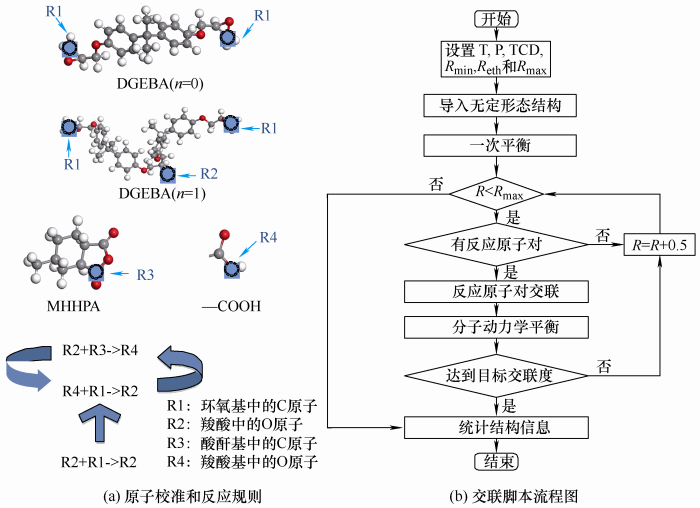
... 考虑环氧树脂与酸酐反应中酯化与醚化的竞争过程,借助Materials Studio软件实现环氧树脂-酸酐体系交联结构的模拟,其构建过程如
图3 所示.
10.11985/2024.01.039.F0003 图3 环氧树脂交联过程模拟<sup>[<xref ref-type="bibr" rid="b14">14</xref>]</sup> ![]()
第一步:构建单体结构. ...
... 式中,α 表示转换率(固化度);t 表示反应时间;A 表示频率因子;E a 表示反应活化能;R 表示摩尔气体常量;T p 为峰值温度;T 为绝对温度[14 ] .固化动力学分析按是否依赖动力学方程而分成两类:模型拟合法与非模型拟合法. ...
... DGEBA/MHHPA/DMP30体系固化过程拟合结果显示,转化率在60%以前n 级反应模型拟合效果较好,而之后反应进程出现一定程度的偏差,这是因为反应后段体系受扩散控制,浓度不再是影响反应进程的主要因素,相比而言,转化率在60%之后Kamal模型拟合效果较好[14 ] . ...
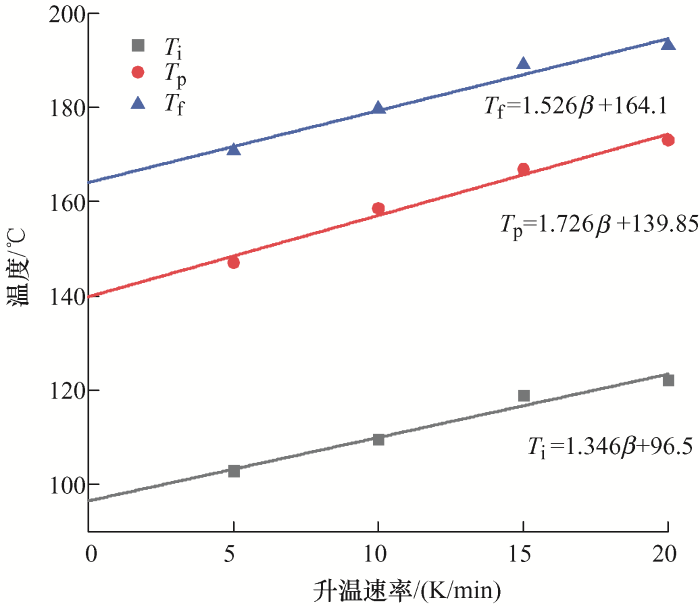
... 通过DSC测试得到的热流曲线能够反映热流速率随时间的变化关系(dH /dt -t ),进一步分析可以获得环氧树脂/酸酐体系的固化特征温度,包括峰始温度、峰值温度和峰终温度.一般认为,峰始温度对应体系开始发生反应的温度,峰值温度对应反应最为剧烈的温度.在实际固化工艺流程中,为了防止初始反应太快,反应放热太剧烈引起局部温度集中和明显的热应力,固化方案先采用较低温度固化一段时间,而后提高温度使反应加快以完成固化[61 ] .两段固化成为通用的环氧树脂固化方案,前固化温度一般在初始反应温度附近选择,后固化温度一般选择峰值温度.在实际的固化过程中,环氧树脂在特定的温度下进行固化,即升温速度为0 K/min.因此,对不同升温速率下反应的特征温度进行线性拟合,可以外推获得升温速率为0 K/min时的特征温度,即温度外推法.图4 为根据DGEBA/MHHPA/ DMP30体系不同升温速率下DSC热流曲线特征温度的外推拟合结果,可以确定该体系前固化温度为100 ℃,后固化温度为140 ℃[14 ] . ...
... [
14 ]
![]()
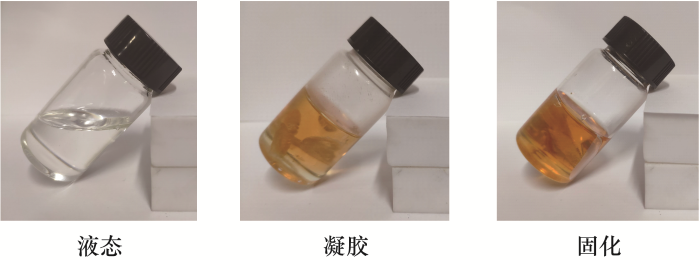
固化度通常定义为环氧树脂中已交联的环氧基与所有的环氧基之比,也可以定义为反应已经释放的热量与反应总的放热量之比,它是衡量环氧树脂反应进程的重要指标[45 ,62 ] .环氧树脂交联过程中体系形态的变化大致可划分为液态-凝胶-固态的不同阶段,如图5 所示.在凝胶点之前,环氧树脂体系大致呈液体状态,流动性较强,体系各处的分子均可以发生有效碰撞引发交联反应,反应主要受体系浓度控制,在这一过程中要完成关键部件的浸渍、灌封等,因此要准确获取这个阶段所能够持续的时间;凝胶点之后,环氧树脂体系呈凝胶状态,流动性减弱,之前浓度较高的部分反应完全,浓度较低的部分需要高浓度处剩余的未反应物扩散到低浓度处才能发生反应,交联反应取决于未反应部分的流动能力,反应主要受体系扩散控制,这一过程是完成预定固化度的关键期,也是预防填料沉降、提高耐热、优化强度与韧性的关键期[14 ] . ...
... 固化度通常定义为环氧树脂中已交联的环氧基与所有的环氧基之比,也可以定义为反应已经释放的热量与反应总的放热量之比,它是衡量环氧树脂反应进程的重要指标[45 ,62 ] .环氧树脂交联过程中体系形态的变化大致可划分为液态-凝胶-固态的不同阶段,如图5 所示.在凝胶点之前,环氧树脂体系大致呈液体状态,流动性较强,体系各处的分子均可以发生有效碰撞引发交联反应,反应主要受体系浓度控制,在这一过程中要完成关键部件的浸渍、灌封等,因此要准确获取这个阶段所能够持续的时间;凝胶点之后,环氧树脂体系呈凝胶状态,流动性减弱,之前浓度较高的部分反应完全,浓度较低的部分需要高浓度处剩余的未反应物扩散到低浓度处才能发生反应,交联反应取决于未反应部分的流动能力,反应主要受体系扩散控制,这一过程是完成预定固化度的关键期,也是预防填料沉降、提高耐热、优化强度与韧性的关键期[14 ] . ...
... [
14 ]
![]()
根据固化动力学方程获得等温条件下转化率α 与时间t α 的方程 ...
... 由式(11)可计算不同促进剂含量下体系在不同温度达到预设固化度所需时间,也可以确定体系达到凝胶点所需时间.为验证该推测,配制了不同促进剂含量的DGEBA/MHHPA/DMP30体系,放入真空烘箱中100 ℃加热,观察环氧树脂的变化过程,结果表明计算与试验凝胶时间误差均在10%以内[14 ] . ...
... 第3.2节提到两段固化已成为通用的环氧树脂固化方案.LI等[39 ] 基于DEBGA/MHHPA/DMP30体系,设定了80%和90%的预固化处理(100 ℃下80 min或123 min),在此基础上分别进行140 ℃后固化1 h、2 h、4 h和8 h,以研究后固化对绝缘性能的影响.发现90%固化度基础上后固化的环氧树脂绝缘性能普遍优于80%固化度基础上的后固化产物,且后固化时间的影响存在饱和效应.综合绝缘性能进行评估,最终优选出最佳固化制度为0.5% DMP-30+100 ℃固化123 min+140 ℃后固化4 h[14 ] .综上,固化时间对环氧树脂结构的形成影响复杂,并不是固化时间越长性能越好,分段固化温度与时间的组合可根据试验结果确定最优的生产工艺条件. ...
11
2022
... 但目前国产高压电工环氧材料总体规模较小,缺乏高压电工装备领域的应用开发经验,其核心技术主要被陶氏化学、亨斯迈、瀚森等国外公司掌握,高压电工装备用电工级环氧树脂材料90%以上依赖进口[11 ] .国家科技部和电网公司在高端电工装备及电工环氧材料领域投入了大量的研发支持,已经逐步从聚焦高端装备绝缘成型制造及系统集成,向高端电工装备绝缘用基础专用树脂、固化剂以及助剂等原料开发转型[12 -13 ] .这一过程中面临前端环氧材料厂家不了解电网终端应用的需求,下游设备制造单位工艺参数优化无据可依,导致上下游之间脱节,缺乏环氧材料定制化开发经验以及相应的性能数据支撑,致使产业链无法打通,迫切需要开展相关基础应用研究工作,实现高端电工环氧材料的全面国产化[14 ] . ...
... 除了必需的环氧树脂基体与固化剂,针对不同的应用场景与性能要求,助剂也同样不可或缺,如促进剂、稀释剂、偶联剂等.促进剂常常与高温下才能发生反应的固化剂混合使用,目的是提升反应活性,降低固化温度,缩短反应时间[37 ] .酸酐固化剂与环氧树脂基体常温下反应活性极低,通常在200 ℃以上才会发生反应[38 ] .几乎所有的酸酐固化过程都需要配合促进剂使用.促进剂根据催化原理可分为亲核型促进剂、亲电型促进剂和金属羧酸盐促进剂.亲核型促进剂一般为路易斯碱,对环氧/酸酐固化体系具有双重的催化作用,既可以催化环氧交联,又可以催化酸酐开环.其过程为一般先生成烷氧阴离子与酸酐反应,接着生成羧基阴离子与环氧反应,进而生成新的烷氧阴离子,反应交替进行最终形成聚酯交联结构.路易斯碱的碱性越强,取代基的空间位阻越小,催化活性越大.亲电型促进剂一般为路易斯酸及其络合物.这类有机酸、醇或酚的催化原理为先经过络合态进而形成固化交联结构.有些路易斯酸在室温下与环氧树脂和固化剂结合性质稳定,在高温下才会加速反应,起到催化作用,具备潜伏型促进剂的特点.金属羧酸盐中的金属离子在反应前期有空轨道,能与环氧基形成络合物实现催化聚合反应;后期随着反应的放热效应,金属羧酸盐解离成羧酸阴离子实现催化聚合反应.两种不同的催化机理使得固化产物中既有酯基又有醚键.促进剂与环氧/酸酐体系的匹配对于提升环氧树脂的产物性能具有重要意义[14 ] . ...
... 考虑环氧树脂与酸酐反应中酯化与醚化的竞争过程,借助Materials Studio软件实现环氧树脂-酸酐体系交联结构的模拟,其构建过程如
图3 所示.
10.11985/2024.01.039.F0003 图3 环氧树脂交联过程模拟<sup>[<xref ref-type="bibr" rid="b14">14</xref>]</sup> ![]()
第一步:构建单体结构. ...
... 式中,α 表示转换率(固化度);t 表示反应时间;A 表示频率因子;E a 表示反应活化能;R 表示摩尔气体常量;T p 为峰值温度;T 为绝对温度[14 ] .固化动力学分析按是否依赖动力学方程而分成两类:模型拟合法与非模型拟合法. ...
... DGEBA/MHHPA/DMP30体系固化过程拟合结果显示,转化率在60%以前n 级反应模型拟合效果较好,而之后反应进程出现一定程度的偏差,这是因为反应后段体系受扩散控制,浓度不再是影响反应进程的主要因素,相比而言,转化率在60%之后Kamal模型拟合效果较好[14 ] . ...
... 通过DSC测试得到的热流曲线能够反映热流速率随时间的变化关系(dH /dt -t ),进一步分析可以获得环氧树脂/酸酐体系的固化特征温度,包括峰始温度、峰值温度和峰终温度.一般认为,峰始温度对应体系开始发生反应的温度,峰值温度对应反应最为剧烈的温度.在实际固化工艺流程中,为了防止初始反应太快,反应放热太剧烈引起局部温度集中和明显的热应力,固化方案先采用较低温度固化一段时间,而后提高温度使反应加快以完成固化[61 ] .两段固化成为通用的环氧树脂固化方案,前固化温度一般在初始反应温度附近选择,后固化温度一般选择峰值温度.在实际的固化过程中,环氧树脂在特定的温度下进行固化,即升温速度为0 K/min.因此,对不同升温速率下反应的特征温度进行线性拟合,可以外推获得升温速率为0 K/min时的特征温度,即温度外推法.图4 为根据DGEBA/MHHPA/ DMP30体系不同升温速率下DSC热流曲线特征温度的外推拟合结果,可以确定该体系前固化温度为100 ℃,后固化温度为140 ℃[14 ] . ...
... [
14 ]
![]()
固化度通常定义为环氧树脂中已交联的环氧基与所有的环氧基之比,也可以定义为反应已经释放的热量与反应总的放热量之比,它是衡量环氧树脂反应进程的重要指标[45 ,62 ] .环氧树脂交联过程中体系形态的变化大致可划分为液态-凝胶-固态的不同阶段,如图5 所示.在凝胶点之前,环氧树脂体系大致呈液体状态,流动性较强,体系各处的分子均可以发生有效碰撞引发交联反应,反应主要受体系浓度控制,在这一过程中要完成关键部件的浸渍、灌封等,因此要准确获取这个阶段所能够持续的时间;凝胶点之后,环氧树脂体系呈凝胶状态,流动性减弱,之前浓度较高的部分反应完全,浓度较低的部分需要高浓度处剩余的未反应物扩散到低浓度处才能发生反应,交联反应取决于未反应部分的流动能力,反应主要受体系扩散控制,这一过程是完成预定固化度的关键期,也是预防填料沉降、提高耐热、优化强度与韧性的关键期[14 ] . ...
... 固化度通常定义为环氧树脂中已交联的环氧基与所有的环氧基之比,也可以定义为反应已经释放的热量与反应总的放热量之比,它是衡量环氧树脂反应进程的重要指标[45 ,62 ] .环氧树脂交联过程中体系形态的变化大致可划分为液态-凝胶-固态的不同阶段,如图5 所示.在凝胶点之前,环氧树脂体系大致呈液体状态,流动性较强,体系各处的分子均可以发生有效碰撞引发交联反应,反应主要受体系浓度控制,在这一过程中要完成关键部件的浸渍、灌封等,因此要准确获取这个阶段所能够持续的时间;凝胶点之后,环氧树脂体系呈凝胶状态,流动性减弱,之前浓度较高的部分反应完全,浓度较低的部分需要高浓度处剩余的未反应物扩散到低浓度处才能发生反应,交联反应取决于未反应部分的流动能力,反应主要受体系扩散控制,这一过程是完成预定固化度的关键期,也是预防填料沉降、提高耐热、优化强度与韧性的关键期[14 ] . ...
... [
14 ]
![]()
根据固化动力学方程获得等温条件下转化率α 与时间t α 的方程 ...
... 由式(11)可计算不同促进剂含量下体系在不同温度达到预设固化度所需时间,也可以确定体系达到凝胶点所需时间.为验证该推测,配制了不同促进剂含量的DGEBA/MHHPA/DMP30体系,放入真空烘箱中100 ℃加热,观察环氧树脂的变化过程,结果表明计算与试验凝胶时间误差均在10%以内[14 ] . ...
... 第3.2节提到两段固化已成为通用的环氧树脂固化方案.LI等[39 ] 基于DEBGA/MHHPA/DMP30体系,设定了80%和90%的预固化处理(100 ℃下80 min或123 min),在此基础上分别进行140 ℃后固化1 h、2 h、4 h和8 h,以研究后固化对绝缘性能的影响.发现90%固化度基础上后固化的环氧树脂绝缘性能普遍优于80%固化度基础上的后固化产物,且后固化时间的影响存在饱和效应.综合绝缘性能进行评估,最终优选出最佳固化制度为0.5% DMP-30+100 ℃固化123 min+140 ℃后固化4 h[14 ] .综上,固化时间对环氧树脂结构的形成影响复杂,并不是固化时间越长性能越好,分段固化温度与时间的组合可根据试验结果确定最优的生产工艺条件. ...
气体绝缘直流设备气固界面电场分布特性与调控方法研究进展
1
2019
... 同时极端多样运行环境以及电工装备紧凑化发展带来的高温、强电场、多电压波形以及机械载荷等严苛工况给环氧树脂材料绝缘、耐热、机械等性能提出了更高要求[15 ⇓ -17 ] .相关容许载荷下的热力学计算表明,变压器干式套管环氧浸渍纸绝缘芯体承载的最高温度可达107 ℃,并存在55 ℃的温度梯度[18 ] ,研究表明环氧树脂的电导率随温度升高呈指数关系上升,100 ℃下的电导率相比室温可升高近三个数量级,高温下介电损耗也会骤增,短时击穿场强由室温到150 ℃可降低61.39%,长时恒定电压下的击穿时间在高温下也显著降低[19 ⇓ -21 ] .大容量高频变压器、电机等设备绝缘需要承受包含高频谐波的复杂电压波形,谐波存在条件下环氧树脂的介电损耗增大,并伴随复杂的绝缘劣化行为,大大增加绝缘击穿风险[22 ⇓ -24 ] .因此高性能环氧树脂绝缘成为支撑高端电工装备可靠运行的关键. ...
Progress in electrical field distribution along gas-solid interface in compact gas insulated system and its regulation methods
1
2019
... 同时极端多样运行环境以及电工装备紧凑化发展带来的高温、强电场、多电压波形以及机械载荷等严苛工况给环氧树脂材料绝缘、耐热、机械等性能提出了更高要求[15 ⇓ -17 ] .相关容许载荷下的热力学计算表明,变压器干式套管环氧浸渍纸绝缘芯体承载的最高温度可达107 ℃,并存在55 ℃的温度梯度[18 ] ,研究表明环氧树脂的电导率随温度升高呈指数关系上升,100 ℃下的电导率相比室温可升高近三个数量级,高温下介电损耗也会骤增,短时击穿场强由室温到150 ℃可降低61.39%,长时恒定电压下的击穿时间在高温下也显著降低[19 ⇓ -21 ] .大容量高频变压器、电机等设备绝缘需要承受包含高频谐波的复杂电压波形,谐波存在条件下环氧树脂的介电损耗增大,并伴随复杂的绝缘劣化行为,大大增加绝缘击穿风险[22 ⇓ -24 ] .因此高性能环氧树脂绝缘成为支撑高端电工装备可靠运行的关键. ...
Solidification dynamics of silicone oil and electric field distribution within outdoor cable terminations subjected to cold environments
1
2022
... 同时极端多样运行环境以及电工装备紧凑化发展带来的高温、强电场、多电压波形以及机械载荷等严苛工况给环氧树脂材料绝缘、耐热、机械等性能提出了更高要求[15 ⇓ -17 ] .相关容许载荷下的热力学计算表明,变压器干式套管环氧浸渍纸绝缘芯体承载的最高温度可达107 ℃,并存在55 ℃的温度梯度[18 ] ,研究表明环氧树脂的电导率随温度升高呈指数关系上升,100 ℃下的电导率相比室温可升高近三个数量级,高温下介电损耗也会骤增,短时击穿场强由室温到150 ℃可降低61.39%,长时恒定电压下的击穿时间在高温下也显著降低[19 ⇓ -21 ] .大容量高频变压器、电机等设备绝缘需要承受包含高频谐波的复杂电压波形,谐波存在条件下环氧树脂的介电损耗增大,并伴随复杂的绝缘劣化行为,大大增加绝缘击穿风险[22 ⇓ -24 ] .因此高性能环氧树脂绝缘成为支撑高端电工装备可靠运行的关键. ...
Study on non-uniformity and dynamic fracture characteristics of GIL tri-post insulators considering Al2 O3 sedimentation
1
2023
... 同时极端多样运行环境以及电工装备紧凑化发展带来的高温、强电场、多电压波形以及机械载荷等严苛工况给环氧树脂材料绝缘、耐热、机械等性能提出了更高要求[15 ⇓ -17 ] .相关容许载荷下的热力学计算表明,变压器干式套管环氧浸渍纸绝缘芯体承载的最高温度可达107 ℃,并存在55 ℃的温度梯度[18 ] ,研究表明环氧树脂的电导率随温度升高呈指数关系上升,100 ℃下的电导率相比室温可升高近三个数量级,高温下介电损耗也会骤增,短时击穿场强由室温到150 ℃可降低61.39%,长时恒定电压下的击穿时间在高温下也显著降低[19 ⇓ -21 ] .大容量高频变压器、电机等设备绝缘需要承受包含高频谐波的复杂电压波形,谐波存在条件下环氧树脂的介电损耗增大,并伴随复杂的绝缘劣化行为,大大增加绝缘击穿风险[22 ⇓ -24 ] .因此高性能环氧树脂绝缘成为支撑高端电工装备可靠运行的关键. ...
Temperature distribution in resin impregnated paper insulation for transformer bushings
1
2010
... 同时极端多样运行环境以及电工装备紧凑化发展带来的高温、强电场、多电压波形以及机械载荷等严苛工况给环氧树脂材料绝缘、耐热、机械等性能提出了更高要求[15 ⇓ -17 ] .相关容许载荷下的热力学计算表明,变压器干式套管环氧浸渍纸绝缘芯体承载的最高温度可达107 ℃,并存在55 ℃的温度梯度[18 ] ,研究表明环氧树脂的电导率随温度升高呈指数关系上升,100 ℃下的电导率相比室温可升高近三个数量级,高温下介电损耗也会骤增,短时击穿场强由室温到150 ℃可降低61.39%,长时恒定电压下的击穿时间在高温下也显著降低[19 ⇓ -21 ] .大容量高频变压器、电机等设备绝缘需要承受包含高频谐波的复杂电压波形,谐波存在条件下环氧树脂的介电损耗增大,并伴随复杂的绝缘劣化行为,大大增加绝缘击穿风险[22 ⇓ -24 ] .因此高性能环氧树脂绝缘成为支撑高端电工装备可靠运行的关键. ...
Regulation of temperature resistivity characteristics of insulating epoxy composite by incorporating positive temperature coefficient material
1
2020
... 同时极端多样运行环境以及电工装备紧凑化发展带来的高温、强电场、多电压波形以及机械载荷等严苛工况给环氧树脂材料绝缘、耐热、机械等性能提出了更高要求[15 ⇓ -17 ] .相关容许载荷下的热力学计算表明,变压器干式套管环氧浸渍纸绝缘芯体承载的最高温度可达107 ℃,并存在55 ℃的温度梯度[18 ] ,研究表明环氧树脂的电导率随温度升高呈指数关系上升,100 ℃下的电导率相比室温可升高近三个数量级,高温下介电损耗也会骤增,短时击穿场强由室温到150 ℃可降低61.39%,长时恒定电压下的击穿时间在高温下也显著降低[19 ⇓ -21 ] .大容量高频变压器、电机等设备绝缘需要承受包含高频谐波的复杂电压波形,谐波存在条件下环氧树脂的介电损耗增大,并伴随复杂的绝缘劣化行为,大大增加绝缘击穿风险[22 ⇓ -24 ] .因此高性能环氧树脂绝缘成为支撑高端电工装备可靠运行的关键. ...
Temperature effects on the dielectric properties and breakdown performance of h-BN/epoxy composites
1
2019
... 同时极端多样运行环境以及电工装备紧凑化发展带来的高温、强电场、多电压波形以及机械载荷等严苛工况给环氧树脂材料绝缘、耐热、机械等性能提出了更高要求[15 ⇓ -17 ] .相关容许载荷下的热力学计算表明,变压器干式套管环氧浸渍纸绝缘芯体承载的最高温度可达107 ℃,并存在55 ℃的温度梯度[18 ] ,研究表明环氧树脂的电导率随温度升高呈指数关系上升,100 ℃下的电导率相比室温可升高近三个数量级,高温下介电损耗也会骤增,短时击穿场强由室温到150 ℃可降低61.39%,长时恒定电压下的击穿时间在高温下也显著降低[19 ⇓ -21 ] .大容量高频变压器、电机等设备绝缘需要承受包含高频谐波的复杂电压波形,谐波存在条件下环氧树脂的介电损耗增大,并伴随复杂的绝缘劣化行为,大大增加绝缘击穿风险[22 ⇓ -24 ] .因此高性能环氧树脂绝缘成为支撑高端电工装备可靠运行的关键. ...
Influence of temperature on mechanical and insulation properties of epoxy-layered silicate nanocomposite
1
2006
... 同时极端多样运行环境以及电工装备紧凑化发展带来的高温、强电场、多电压波形以及机械载荷等严苛工况给环氧树脂材料绝缘、耐热、机械等性能提出了更高要求[15 ⇓ -17 ] .相关容许载荷下的热力学计算表明,变压器干式套管环氧浸渍纸绝缘芯体承载的最高温度可达107 ℃,并存在55 ℃的温度梯度[18 ] ,研究表明环氧树脂的电导率随温度升高呈指数关系上升,100 ℃下的电导率相比室温可升高近三个数量级,高温下介电损耗也会骤增,短时击穿场强由室温到150 ℃可降低61.39%,长时恒定电压下的击穿时间在高温下也显著降低[19 ⇓ -21 ] .大容量高频变压器、电机等设备绝缘需要承受包含高频谐波的复杂电压波形,谐波存在条件下环氧树脂的介电损耗增大,并伴随复杂的绝缘劣化行为,大大增加绝缘击穿风险[22 ⇓ -24 ] .因此高性能环氧树脂绝缘成为支撑高端电工装备可靠运行的关键. ...
Repetitive fast voltage stresses-causes and effects
1
2009
... 同时极端多样运行环境以及电工装备紧凑化发展带来的高温、强电场、多电压波形以及机械载荷等严苛工况给环氧树脂材料绝缘、耐热、机械等性能提出了更高要求[15 ⇓ -17 ] .相关容许载荷下的热力学计算表明,变压器干式套管环氧浸渍纸绝缘芯体承载的最高温度可达107 ℃,并存在55 ℃的温度梯度[18 ] ,研究表明环氧树脂的电导率随温度升高呈指数关系上升,100 ℃下的电导率相比室温可升高近三个数量级,高温下介电损耗也会骤增,短时击穿场强由室温到150 ℃可降低61.39%,长时恒定电压下的击穿时间在高温下也显著降低[19 ⇓ -21 ] .大容量高频变压器、电机等设备绝缘需要承受包含高频谐波的复杂电压波形,谐波存在条件下环氧树脂的介电损耗增大,并伴随复杂的绝缘劣化行为,大大增加绝缘击穿风险[22 ⇓ -24 ] .因此高性能环氧树脂绝缘成为支撑高端电工装备可靠运行的关键. ...
环氧树脂绝缘高频电热联合老化中局部放电特性分析
1
2015
... 同时极端多样运行环境以及电工装备紧凑化发展带来的高温、强电场、多电压波形以及机械载荷等严苛工况给环氧树脂材料绝缘、耐热、机械等性能提出了更高要求[15 ⇓ -17 ] .相关容许载荷下的热力学计算表明,变压器干式套管环氧浸渍纸绝缘芯体承载的最高温度可达107 ℃,并存在55 ℃的温度梯度[18 ] ,研究表明环氧树脂的电导率随温度升高呈指数关系上升,100 ℃下的电导率相比室温可升高近三个数量级,高温下介电损耗也会骤增,短时击穿场强由室温到150 ℃可降低61.39%,长时恒定电压下的击穿时间在高温下也显著降低[19 ⇓ -21 ] .大容量高频变压器、电机等设备绝缘需要承受包含高频谐波的复杂电压波形,谐波存在条件下环氧树脂的介电损耗增大,并伴随复杂的绝缘劣化行为,大大增加绝缘击穿风险[22 ⇓ -24 ] .因此高性能环氧树脂绝缘成为支撑高端电工装备可靠运行的关键. ...
Analysis on partial discharge characteristics of epoxy resin insulation during high-frequency electrical-thermal aging
1
2015
... 同时极端多样运行环境以及电工装备紧凑化发展带来的高温、强电场、多电压波形以及机械载荷等严苛工况给环氧树脂材料绝缘、耐热、机械等性能提出了更高要求[15 ⇓ -17 ] .相关容许载荷下的热力学计算表明,变压器干式套管环氧浸渍纸绝缘芯体承载的最高温度可达107 ℃,并存在55 ℃的温度梯度[18 ] ,研究表明环氧树脂的电导率随温度升高呈指数关系上升,100 ℃下的电导率相比室温可升高近三个数量级,高温下介电损耗也会骤增,短时击穿场强由室温到150 ℃可降低61.39%,长时恒定电压下的击穿时间在高温下也显著降低[19 ⇓ -21 ] .大容量高频变压器、电机等设备绝缘需要承受包含高频谐波的复杂电压波形,谐波存在条件下环氧树脂的介电损耗增大,并伴随复杂的绝缘劣化行为,大大增加绝缘击穿风险[22 ⇓ -24 ] .因此高性能环氧树脂绝缘成为支撑高端电工装备可靠运行的关键. ...
环氧树脂绝缘电树枝劣化研究进展
1
2022
... 同时极端多样运行环境以及电工装备紧凑化发展带来的高温、强电场、多电压波形以及机械载荷等严苛工况给环氧树脂材料绝缘、耐热、机械等性能提出了更高要求[15 ⇓ -17 ] .相关容许载荷下的热力学计算表明,变压器干式套管环氧浸渍纸绝缘芯体承载的最高温度可达107 ℃,并存在55 ℃的温度梯度[18 ] ,研究表明环氧树脂的电导率随温度升高呈指数关系上升,100 ℃下的电导率相比室温可升高近三个数量级,高温下介电损耗也会骤增,短时击穿场强由室温到150 ℃可降低61.39%,长时恒定电压下的击穿时间在高温下也显著降低[19 ⇓ -21 ] .大容量高频变压器、电机等设备绝缘需要承受包含高频谐波的复杂电压波形,谐波存在条件下环氧树脂的介电损耗增大,并伴随复杂的绝缘劣化行为,大大增加绝缘击穿风险[22 ⇓ -24 ] .因此高性能环氧树脂绝缘成为支撑高端电工装备可靠运行的关键. ...
Research progress on electrical tree in epoxy resin insulation
1
2022
... 同时极端多样运行环境以及电工装备紧凑化发展带来的高温、强电场、多电压波形以及机械载荷等严苛工况给环氧树脂材料绝缘、耐热、机械等性能提出了更高要求[15 ⇓ -17 ] .相关容许载荷下的热力学计算表明,变压器干式套管环氧浸渍纸绝缘芯体承载的最高温度可达107 ℃,并存在55 ℃的温度梯度[18 ] ,研究表明环氧树脂的电导率随温度升高呈指数关系上升,100 ℃下的电导率相比室温可升高近三个数量级,高温下介电损耗也会骤增,短时击穿场强由室温到150 ℃可降低61.39%,长时恒定电压下的击穿时间在高温下也显著降低[19 ⇓ -21 ] .大容量高频变压器、电机等设备绝缘需要承受包含高频谐波的复杂电压波形,谐波存在条件下环氧树脂的介电损耗增大,并伴随复杂的绝缘劣化行为,大大增加绝缘击穿风险[22 ⇓ -24 ] .因此高性能环氧树脂绝缘成为支撑高端电工装备可靠运行的关键. ...
Curing regime-modulating insulation performance of anhydride-cured epoxy resin:A review
1
2023
... 环氧树脂固化产物由环氧树脂基体与固化剂在添加相关助剂和特定环境温度的条件下长时间固化形成,在这过程中环氧树脂体系由液态混合物交联形成三维网状结构,其微观结构决定着固化物宏观综合性能以及工作环境下的运行状态[25 ] .固化度、交联密度、自由体积等指标可以反映环氧树脂的结构特性.相关研究表明,随着固化度的提升,环氧树脂网络尺寸逐渐增大,自由离子的迁移率降低,偶极弛豫的影响增大,导致介电性能发生变化[26 ] .交联密度的降低表明环氧交联网络中存在更多的侧链和支链,导致介电常数的增大,也会造成热稳定性的下降[27 ] .自由体积影响着环氧树脂的介电性能和击穿特性.自由体积的增大为极性基团的活动提供了更充分的空间,使偶极子更容易跟随外电场变化,通常会导致介电常数的增大[28 ] .同时自由体积的增大会导致电子在电场作用下的平均自由程增大,积累的能量增多,更容易破坏分子链而导致击穿[29 ] .为提升环氧树脂的综合性能,在原有的体系中添加辅助填料成为重点研究方向,包括增韧、高耐热、高导热、耐电性能提升,以适应不同情境下的需求[30 ⇓ ⇓ -33 ] .然而,环氧树脂的微观结构与宏观性能不仅与其体系组分相关,也与其固化时的工艺条件相关[34 ] .在合理科学的固化制度下形成的环氧树脂固化产物,其本体构成物质的良好性能得以更充分地体现,也是提升环氧树脂性能的有效技术手段.但环氧树脂固化制度的研究内容相比填料改性较少,且较少关注固化制度对绝缘性能的影响. ...
Dielectric changes during the curing of epoxy resin based on the diglycidyl ether of bisphenol A (DGEBA) with diamine
1
1999
... 环氧树脂固化产物由环氧树脂基体与固化剂在添加相关助剂和特定环境温度的条件下长时间固化形成,在这过程中环氧树脂体系由液态混合物交联形成三维网状结构,其微观结构决定着固化物宏观综合性能以及工作环境下的运行状态[25 ] .固化度、交联密度、自由体积等指标可以反映环氧树脂的结构特性.相关研究表明,随着固化度的提升,环氧树脂网络尺寸逐渐增大,自由离子的迁移率降低,偶极弛豫的影响增大,导致介电性能发生变化[26 ] .交联密度的降低表明环氧交联网络中存在更多的侧链和支链,导致介电常数的增大,也会造成热稳定性的下降[27 ] .自由体积影响着环氧树脂的介电性能和击穿特性.自由体积的增大为极性基团的活动提供了更充分的空间,使偶极子更容易跟随外电场变化,通常会导致介电常数的增大[28 ] .同时自由体积的增大会导致电子在电场作用下的平均自由程增大,积累的能量增多,更容易破坏分子链而导致击穿[29 ] .为提升环氧树脂的综合性能,在原有的体系中添加辅助填料成为重点研究方向,包括增韧、高耐热、高导热、耐电性能提升,以适应不同情境下的需求[30 ⇓ ⇓ -33 ] .然而,环氧树脂的微观结构与宏观性能不仅与其体系组分相关,也与其固化时的工艺条件相关[34 ] .在合理科学的固化制度下形成的环氧树脂固化产物,其本体构成物质的良好性能得以更充分地体现,也是提升环氧树脂性能的有效技术手段.但环氧树脂固化制度的研究内容相比填料改性较少,且较少关注固化制度对绝缘性能的影响. ...
Polymer chain dynamics in epoxy based composites as investigated by broadband dielectric spectroscopy
1
2016
... 环氧树脂固化产物由环氧树脂基体与固化剂在添加相关助剂和特定环境温度的条件下长时间固化形成,在这过程中环氧树脂体系由液态混合物交联形成三维网状结构,其微观结构决定着固化物宏观综合性能以及工作环境下的运行状态[25 ] .固化度、交联密度、自由体积等指标可以反映环氧树脂的结构特性.相关研究表明,随着固化度的提升,环氧树脂网络尺寸逐渐增大,自由离子的迁移率降低,偶极弛豫的影响增大,导致介电性能发生变化[26 ] .交联密度的降低表明环氧交联网络中存在更多的侧链和支链,导致介电常数的增大,也会造成热稳定性的下降[27 ] .自由体积影响着环氧树脂的介电性能和击穿特性.自由体积的增大为极性基团的活动提供了更充分的空间,使偶极子更容易跟随外电场变化,通常会导致介电常数的增大[28 ] .同时自由体积的增大会导致电子在电场作用下的平均自由程增大,积累的能量增多,更容易破坏分子链而导致击穿[29 ] .为提升环氧树脂的综合性能,在原有的体系中添加辅助填料成为重点研究方向,包括增韧、高耐热、高导热、耐电性能提升,以适应不同情境下的需求[30 ⇓ ⇓ -33 ] .然而,环氧树脂的微观结构与宏观性能不仅与其体系组分相关,也与其固化时的工艺条件相关[34 ] .在合理科学的固化制度下形成的环氧树脂固化产物,其本体构成物质的良好性能得以更充分地体现,也是提升环氧树脂性能的有效技术手段.但环氧树脂固化制度的研究内容相比填料改性较少,且较少关注固化制度对绝缘性能的影响. ...
Optimizing nanostructure to achieve high dielectric response with low loss in strongly dipolar polymers
1
2015
... 环氧树脂固化产物由环氧树脂基体与固化剂在添加相关助剂和特定环境温度的条件下长时间固化形成,在这过程中环氧树脂体系由液态混合物交联形成三维网状结构,其微观结构决定着固化物宏观综合性能以及工作环境下的运行状态[25 ] .固化度、交联密度、自由体积等指标可以反映环氧树脂的结构特性.相关研究表明,随着固化度的提升,环氧树脂网络尺寸逐渐增大,自由离子的迁移率降低,偶极弛豫的影响增大,导致介电性能发生变化[26 ] .交联密度的降低表明环氧交联网络中存在更多的侧链和支链,导致介电常数的增大,也会造成热稳定性的下降[27 ] .自由体积影响着环氧树脂的介电性能和击穿特性.自由体积的增大为极性基团的活动提供了更充分的空间,使偶极子更容易跟随外电场变化,通常会导致介电常数的增大[28 ] .同时自由体积的增大会导致电子在电场作用下的平均自由程增大,积累的能量增多,更容易破坏分子链而导致击穿[29 ] .为提升环氧树脂的综合性能,在原有的体系中添加辅助填料成为重点研究方向,包括增韧、高耐热、高导热、耐电性能提升,以适应不同情境下的需求[30 ⇓ ⇓ -33 ] .然而,环氧树脂的微观结构与宏观性能不仅与其体系组分相关,也与其固化时的工艺条件相关[34 ] .在合理科学的固化制度下形成的环氧树脂固化产物,其本体构成物质的良好性能得以更充分地体现,也是提升环氧树脂性能的有效技术手段.但环氧树脂固化制度的研究内容相比填料改性较少,且较少关注固化制度对绝缘性能的影响. ...
聚酰亚胺复合电介质材料绝缘击穿特性研究进展
1
2022
... 环氧树脂固化产物由环氧树脂基体与固化剂在添加相关助剂和特定环境温度的条件下长时间固化形成,在这过程中环氧树脂体系由液态混合物交联形成三维网状结构,其微观结构决定着固化物宏观综合性能以及工作环境下的运行状态[25 ] .固化度、交联密度、自由体积等指标可以反映环氧树脂的结构特性.相关研究表明,随着固化度的提升,环氧树脂网络尺寸逐渐增大,自由离子的迁移率降低,偶极弛豫的影响增大,导致介电性能发生变化[26 ] .交联密度的降低表明环氧交联网络中存在更多的侧链和支链,导致介电常数的增大,也会造成热稳定性的下降[27 ] .自由体积影响着环氧树脂的介电性能和击穿特性.自由体积的增大为极性基团的活动提供了更充分的空间,使偶极子更容易跟随外电场变化,通常会导致介电常数的增大[28 ] .同时自由体积的增大会导致电子在电场作用下的平均自由程增大,积累的能量增多,更容易破坏分子链而导致击穿[29 ] .为提升环氧树脂的综合性能,在原有的体系中添加辅助填料成为重点研究方向,包括增韧、高耐热、高导热、耐电性能提升,以适应不同情境下的需求[30 ⇓ ⇓ -33 ] .然而,环氧树脂的微观结构与宏观性能不仅与其体系组分相关,也与其固化时的工艺条件相关[34 ] .在合理科学的固化制度下形成的环氧树脂固化产物,其本体构成物质的良好性能得以更充分地体现,也是提升环氧树脂性能的有效技术手段.但环氧树脂固化制度的研究内容相比填料改性较少,且较少关注固化制度对绝缘性能的影响. ...
Research progress in insulation breakdown characteristics of polyimide composite dielectrics
1
2022
... 环氧树脂固化产物由环氧树脂基体与固化剂在添加相关助剂和特定环境温度的条件下长时间固化形成,在这过程中环氧树脂体系由液态混合物交联形成三维网状结构,其微观结构决定着固化物宏观综合性能以及工作环境下的运行状态[25 ] .固化度、交联密度、自由体积等指标可以反映环氧树脂的结构特性.相关研究表明,随着固化度的提升,环氧树脂网络尺寸逐渐增大,自由离子的迁移率降低,偶极弛豫的影响增大,导致介电性能发生变化[26 ] .交联密度的降低表明环氧交联网络中存在更多的侧链和支链,导致介电常数的增大,也会造成热稳定性的下降[27 ] .自由体积影响着环氧树脂的介电性能和击穿特性.自由体积的增大为极性基团的活动提供了更充分的空间,使偶极子更容易跟随外电场变化,通常会导致介电常数的增大[28 ] .同时自由体积的增大会导致电子在电场作用下的平均自由程增大,积累的能量增多,更容易破坏分子链而导致击穿[29 ] .为提升环氧树脂的综合性能,在原有的体系中添加辅助填料成为重点研究方向,包括增韧、高耐热、高导热、耐电性能提升,以适应不同情境下的需求[30 ⇓ ⇓ -33 ] .然而,环氧树脂的微观结构与宏观性能不仅与其体系组分相关,也与其固化时的工艺条件相关[34 ] .在合理科学的固化制度下形成的环氧树脂固化产物,其本体构成物质的良好性能得以更充分地体现,也是提升环氧树脂性能的有效技术手段.但环氧树脂固化制度的研究内容相比填料改性较少,且较少关注固化制度对绝缘性能的影响. ...
高压电工装备用环氧树脂绝缘材料改性研究进展
1
2019
... 环氧树脂固化产物由环氧树脂基体与固化剂在添加相关助剂和特定环境温度的条件下长时间固化形成,在这过程中环氧树脂体系由液态混合物交联形成三维网状结构,其微观结构决定着固化物宏观综合性能以及工作环境下的运行状态[25 ] .固化度、交联密度、自由体积等指标可以反映环氧树脂的结构特性.相关研究表明,随着固化度的提升,环氧树脂网络尺寸逐渐增大,自由离子的迁移率降低,偶极弛豫的影响增大,导致介电性能发生变化[26 ] .交联密度的降低表明环氧交联网络中存在更多的侧链和支链,导致介电常数的增大,也会造成热稳定性的下降[27 ] .自由体积影响着环氧树脂的介电性能和击穿特性.自由体积的增大为极性基团的活动提供了更充分的空间,使偶极子更容易跟随外电场变化,通常会导致介电常数的增大[28 ] .同时自由体积的增大会导致电子在电场作用下的平均自由程增大,积累的能量增多,更容易破坏分子链而导致击穿[29 ] .为提升环氧树脂的综合性能,在原有的体系中添加辅助填料成为重点研究方向,包括增韧、高耐热、高导热、耐电性能提升,以适应不同情境下的需求[30 ⇓ ⇓ -33 ] .然而,环氧树脂的微观结构与宏观性能不仅与其体系组分相关,也与其固化时的工艺条件相关[34 ] .在合理科学的固化制度下形成的环氧树脂固化产物,其本体构成物质的良好性能得以更充分地体现,也是提升环氧树脂性能的有效技术手段.但环氧树脂固化制度的研究内容相比填料改性较少,且较少关注固化制度对绝缘性能的影响. ...
Modification research progress of epoxy resin insulation materials for high voltage electrical apparatus
1
2019
... 环氧树脂固化产物由环氧树脂基体与固化剂在添加相关助剂和特定环境温度的条件下长时间固化形成,在这过程中环氧树脂体系由液态混合物交联形成三维网状结构,其微观结构决定着固化物宏观综合性能以及工作环境下的运行状态[25 ] .固化度、交联密度、自由体积等指标可以反映环氧树脂的结构特性.相关研究表明,随着固化度的提升,环氧树脂网络尺寸逐渐增大,自由离子的迁移率降低,偶极弛豫的影响增大,导致介电性能发生变化[26 ] .交联密度的降低表明环氧交联网络中存在更多的侧链和支链,导致介电常数的增大,也会造成热稳定性的下降[27 ] .自由体积影响着环氧树脂的介电性能和击穿特性.自由体积的增大为极性基团的活动提供了更充分的空间,使偶极子更容易跟随外电场变化,通常会导致介电常数的增大[28 ] .同时自由体积的增大会导致电子在电场作用下的平均自由程增大,积累的能量增多,更容易破坏分子链而导致击穿[29 ] .为提升环氧树脂的综合性能,在原有的体系中添加辅助填料成为重点研究方向,包括增韧、高耐热、高导热、耐电性能提升,以适应不同情境下的需求[30 ⇓ ⇓ -33 ] .然而,环氧树脂的微观结构与宏观性能不仅与其体系组分相关,也与其固化时的工艺条件相关[34 ] .在合理科学的固化制度下形成的环氧树脂固化产物,其本体构成物质的良好性能得以更充分地体现,也是提升环氧树脂性能的有效技术手段.但环氧树脂固化制度的研究内容相比填料改性较少,且较少关注固化制度对绝缘性能的影响. ...
EHTPB液体橡胶改性环氧树脂研究
1
2020
... 环氧树脂固化产物由环氧树脂基体与固化剂在添加相关助剂和特定环境温度的条件下长时间固化形成,在这过程中环氧树脂体系由液态混合物交联形成三维网状结构,其微观结构决定着固化物宏观综合性能以及工作环境下的运行状态[25 ] .固化度、交联密度、自由体积等指标可以反映环氧树脂的结构特性.相关研究表明,随着固化度的提升,环氧树脂网络尺寸逐渐增大,自由离子的迁移率降低,偶极弛豫的影响增大,导致介电性能发生变化[26 ] .交联密度的降低表明环氧交联网络中存在更多的侧链和支链,导致介电常数的增大,也会造成热稳定性的下降[27 ] .自由体积影响着环氧树脂的介电性能和击穿特性.自由体积的增大为极性基团的活动提供了更充分的空间,使偶极子更容易跟随外电场变化,通常会导致介电常数的增大[28 ] .同时自由体积的增大会导致电子在电场作用下的平均自由程增大,积累的能量增多,更容易破坏分子链而导致击穿[29 ] .为提升环氧树脂的综合性能,在原有的体系中添加辅助填料成为重点研究方向,包括增韧、高耐热、高导热、耐电性能提升,以适应不同情境下的需求[30 ⇓ ⇓ -33 ] .然而,环氧树脂的微观结构与宏观性能不仅与其体系组分相关,也与其固化时的工艺条件相关[34 ] .在合理科学的固化制度下形成的环氧树脂固化产物,其本体构成物质的良好性能得以更充分地体现,也是提升环氧树脂性能的有效技术手段.但环氧树脂固化制度的研究内容相比填料改性较少,且较少关注固化制度对绝缘性能的影响. ...
Modification of epoxy resin with epoxidized hydroxyl terminated polybutadiene liquid rubber
1
2020
... 环氧树脂固化产物由环氧树脂基体与固化剂在添加相关助剂和特定环境温度的条件下长时间固化形成,在这过程中环氧树脂体系由液态混合物交联形成三维网状结构,其微观结构决定着固化物宏观综合性能以及工作环境下的运行状态[25 ] .固化度、交联密度、自由体积等指标可以反映环氧树脂的结构特性.相关研究表明,随着固化度的提升,环氧树脂网络尺寸逐渐增大,自由离子的迁移率降低,偶极弛豫的影响增大,导致介电性能发生变化[26 ] .交联密度的降低表明环氧交联网络中存在更多的侧链和支链,导致介电常数的增大,也会造成热稳定性的下降[27 ] .自由体积影响着环氧树脂的介电性能和击穿特性.自由体积的增大为极性基团的活动提供了更充分的空间,使偶极子更容易跟随外电场变化,通常会导致介电常数的增大[28 ] .同时自由体积的增大会导致电子在电场作用下的平均自由程增大,积累的能量增多,更容易破坏分子链而导致击穿[29 ] .为提升环氧树脂的综合性能,在原有的体系中添加辅助填料成为重点研究方向,包括增韧、高耐热、高导热、耐电性能提升,以适应不同情境下的需求[30 ⇓ ⇓ -33 ] .然而,环氧树脂的微观结构与宏观性能不仅与其体系组分相关,也与其固化时的工艺条件相关[34 ] .在合理科学的固化制度下形成的环氧树脂固化产物,其本体构成物质的良好性能得以更充分地体现,也是提升环氧树脂性能的有效技术手段.但环氧树脂固化制度的研究内容相比填料改性较少,且较少关注固化制度对绝缘性能的影响. ...
Enhancement of thermal conductivity of BN/epoxy composite through surface modification with silane coupling agents
1
2017
... 环氧树脂固化产物由环氧树脂基体与固化剂在添加相关助剂和特定环境温度的条件下长时间固化形成,在这过程中环氧树脂体系由液态混合物交联形成三维网状结构,其微观结构决定着固化物宏观综合性能以及工作环境下的运行状态[25 ] .固化度、交联密度、自由体积等指标可以反映环氧树脂的结构特性.相关研究表明,随着固化度的提升,环氧树脂网络尺寸逐渐增大,自由离子的迁移率降低,偶极弛豫的影响增大,导致介电性能发生变化[26 ] .交联密度的降低表明环氧交联网络中存在更多的侧链和支链,导致介电常数的增大,也会造成热稳定性的下降[27 ] .自由体积影响着环氧树脂的介电性能和击穿特性.自由体积的增大为极性基团的活动提供了更充分的空间,使偶极子更容易跟随外电场变化,通常会导致介电常数的增大[28 ] .同时自由体积的增大会导致电子在电场作用下的平均自由程增大,积累的能量增多,更容易破坏分子链而导致击穿[29 ] .为提升环氧树脂的综合性能,在原有的体系中添加辅助填料成为重点研究方向,包括增韧、高耐热、高导热、耐电性能提升,以适应不同情境下的需求[30 ⇓ ⇓ -33 ] .然而,环氧树脂的微观结构与宏观性能不仅与其体系组分相关,也与其固化时的工艺条件相关[34 ] .在合理科学的固化制度下形成的环氧树脂固化产物,其本体构成物质的良好性能得以更充分地体现,也是提升环氧树脂性能的有效技术手段.但环氧树脂固化制度的研究内容相比填料改性较少,且较少关注固化制度对绝缘性能的影响. ...
Dielectric properties of silica hollow spheres/epoxy nanocomposites
1
... 环氧树脂固化产物由环氧树脂基体与固化剂在添加相关助剂和特定环境温度的条件下长时间固化形成,在这过程中环氧树脂体系由液态混合物交联形成三维网状结构,其微观结构决定着固化物宏观综合性能以及工作环境下的运行状态[25 ] .固化度、交联密度、自由体积等指标可以反映环氧树脂的结构特性.相关研究表明,随着固化度的提升,环氧树脂网络尺寸逐渐增大,自由离子的迁移率降低,偶极弛豫的影响增大,导致介电性能发生变化[26 ] .交联密度的降低表明环氧交联网络中存在更多的侧链和支链,导致介电常数的增大,也会造成热稳定性的下降[27 ] .自由体积影响着环氧树脂的介电性能和击穿特性.自由体积的增大为极性基团的活动提供了更充分的空间,使偶极子更容易跟随外电场变化,通常会导致介电常数的增大[28 ] .同时自由体积的增大会导致电子在电场作用下的平均自由程增大,积累的能量增多,更容易破坏分子链而导致击穿[29 ] .为提升环氧树脂的综合性能,在原有的体系中添加辅助填料成为重点研究方向,包括增韧、高耐热、高导热、耐电性能提升,以适应不同情境下的需求[30 ⇓ ⇓ -33 ] .然而,环氧树脂的微观结构与宏观性能不仅与其体系组分相关,也与其固化时的工艺条件相关[34 ] .在合理科学的固化制度下形成的环氧树脂固化产物,其本体构成物质的良好性能得以更充分地体现,也是提升环氧树脂性能的有效技术手段.但环氧树脂固化制度的研究内容相比填料改性较少,且较少关注固化制度对绝缘性能的影响. ...
1
2017
... 环氧树脂固化产物由环氧树脂基体与固化剂在添加相关助剂和特定环境温度的条件下长时间固化形成,在这过程中环氧树脂体系由液态混合物交联形成三维网状结构,其微观结构决定着固化物宏观综合性能以及工作环境下的运行状态[25 ] .固化度、交联密度、自由体积等指标可以反映环氧树脂的结构特性.相关研究表明,随着固化度的提升,环氧树脂网络尺寸逐渐增大,自由离子的迁移率降低,偶极弛豫的影响增大,导致介电性能发生变化[26 ] .交联密度的降低表明环氧交联网络中存在更多的侧链和支链,导致介电常数的增大,也会造成热稳定性的下降[27 ] .自由体积影响着环氧树脂的介电性能和击穿特性.自由体积的增大为极性基团的活动提供了更充分的空间,使偶极子更容易跟随外电场变化,通常会导致介电常数的增大[28 ] .同时自由体积的增大会导致电子在电场作用下的平均自由程增大,积累的能量增多,更容易破坏分子链而导致击穿[29 ] .为提升环氧树脂的综合性能,在原有的体系中添加辅助填料成为重点研究方向,包括增韧、高耐热、高导热、耐电性能提升,以适应不同情境下的需求[30 ⇓ ⇓ -33 ] .然而,环氧树脂的微观结构与宏观性能不仅与其体系组分相关,也与其固化时的工艺条件相关[34 ] .在合理科学的固化制度下形成的环氧树脂固化产物,其本体构成物质的良好性能得以更充分地体现,也是提升环氧树脂性能的有效技术手段.但环氧树脂固化制度的研究内容相比填料改性较少,且较少关注固化制度对绝缘性能的影响. ...
1
2017
... 环氧树脂固化产物由环氧树脂基体与固化剂在添加相关助剂和特定环境温度的条件下长时间固化形成,在这过程中环氧树脂体系由液态混合物交联形成三维网状结构,其微观结构决定着固化物宏观综合性能以及工作环境下的运行状态[25 ] .固化度、交联密度、自由体积等指标可以反映环氧树脂的结构特性.相关研究表明,随着固化度的提升,环氧树脂网络尺寸逐渐增大,自由离子的迁移率降低,偶极弛豫的影响增大,导致介电性能发生变化[26 ] .交联密度的降低表明环氧交联网络中存在更多的侧链和支链,导致介电常数的增大,也会造成热稳定性的下降[27 ] .自由体积影响着环氧树脂的介电性能和击穿特性.自由体积的增大为极性基团的活动提供了更充分的空间,使偶极子更容易跟随外电场变化,通常会导致介电常数的增大[28 ] .同时自由体积的增大会导致电子在电场作用下的平均自由程增大,积累的能量增多,更容易破坏分子链而导致击穿[29 ] .为提升环氧树脂的综合性能,在原有的体系中添加辅助填料成为重点研究方向,包括增韧、高耐热、高导热、耐电性能提升,以适应不同情境下的需求[30 ⇓ ⇓ -33 ] .然而,环氧树脂的微观结构与宏观性能不仅与其体系组分相关,也与其固化时的工艺条件相关[34 ] .在合理科学的固化制度下形成的环氧树脂固化产物,其本体构成物质的良好性能得以更充分地体现,也是提升环氧树脂性能的有效技术手段.但环氧树脂固化制度的研究内容相比填料改性较少,且较少关注固化制度对绝缘性能的影响. ...
2
2020
... 双酚A型环氧树脂(DGEBA)是由聚合度不同的分子混合物,其良好的电、热、绝缘及加工特性源于构成环氧树脂的各部分基团:分子两端的环氧基赋予高反应活性;苯环构成的骨架具备强刚性,而主链上分布的大量亚甲基又赋予柔韧性;羟基和醚键提供了良好的浸润性和黏接性,使其非常适合于浸润或浇注等工艺的实现[35 ] .双酚-A型基础及电工改性环氧树脂的基本性能参数如表1 所示. ...
... 环氧树脂与固化剂的最优配比研究已经较为充分,虽然直流电导率、介电性能与交/直流击穿的影响机理不尽相同,但依照理论的等摩尔反应比配制的固化产物大部分获得了最佳的性能.直流电导率取决于体系的化学成分,受网络结构的影响较小,在固化剂过量后,固化样品电导率出现了明显的增大,这可能与残余的基团含量有关;直流击穿强度在等摩尔配比处得到最大值,也可以用网络结构的差异来解释[67 ] .NGUYEN等[68 ] 研究了双酚A环氧树脂与酸酐固化剂HY906配比对纯环氧与添加纳米SiO2 填料体系热稳定性与直流击穿强度的影响.无论是否添加填料,环氧体系均在等摩尔配比处表现出最大的T g ,击穿强度的结果则略有不同,纯环氧体系在等摩尔配比处击穿场强最大,达到近173 kV/mm,而添加SiO2 填料后,击穿场强的最大值出现在环氧基体稍稍过量的位置,这说明填料的加入需要对最佳反应比进行补偿计算.VRYONIS等[69 ] 在存在环氧稀释剂八缩水甘油酯(OG)的条件下,依照等比例反应原则重新计算双酚A环氧树脂DGEBA与酸酐固化剂MTHPA的最佳配比,并研究了热稳定性与介电性能.补偿后的最佳配比表现出最佳的T g ,虽然固化剂过量的样品介电常数最低,但补偿后的最佳配比样品表现出更低的α 与β 弛豫峰强度.此外,何元菡的研究[35 ] 表明固化剂MNA、Me-THPA、Me-HHPA分子结构中存在的—CH3 和羧酸碳原子相距较近,具有一定的空间位阻,利用这几种固化剂制备出的环氧材料结构紧凑,有利于内部深陷阱的形成和绝缘性能提升.郭鹏翔等[36 ] 发现甲基六氢邻苯二甲酸酐和六氢苯酐摩尔比为8∶2的混合酸酐固化产物玻璃化转变温度达到最高,在介质损耗基本不变的条件下,电气强度得到了提升,这与体系刚性的增强密切相关.总结来说,依照反应原理基于环氧基与酸酐基等摩尔比反应计算出的理论质量比即为环氧树脂与固化剂的最优配比,环氧或固化剂过量均会影响致密交联网络的形成,对固化产物性能产生不利的效果. ...
2
2020
... 双酚A型环氧树脂(DGEBA)是由聚合度不同的分子混合物,其良好的电、热、绝缘及加工特性源于构成环氧树脂的各部分基团:分子两端的环氧基赋予高反应活性;苯环构成的骨架具备强刚性,而主链上分布的大量亚甲基又赋予柔韧性;羟基和醚键提供了良好的浸润性和黏接性,使其非常适合于浸润或浇注等工艺的实现[35 ] .双酚-A型基础及电工改性环氧树脂的基本性能参数如表1 所示. ...
... 环氧树脂与固化剂的最优配比研究已经较为充分,虽然直流电导率、介电性能与交/直流击穿的影响机理不尽相同,但依照理论的等摩尔反应比配制的固化产物大部分获得了最佳的性能.直流电导率取决于体系的化学成分,受网络结构的影响较小,在固化剂过量后,固化样品电导率出现了明显的增大,这可能与残余的基团含量有关;直流击穿强度在等摩尔配比处得到最大值,也可以用网络结构的差异来解释[67 ] .NGUYEN等[68 ] 研究了双酚A环氧树脂与酸酐固化剂HY906配比对纯环氧与添加纳米SiO2 填料体系热稳定性与直流击穿强度的影响.无论是否添加填料,环氧体系均在等摩尔配比处表现出最大的T g ,击穿强度的结果则略有不同,纯环氧体系在等摩尔配比处击穿场强最大,达到近173 kV/mm,而添加SiO2 填料后,击穿场强的最大值出现在环氧基体稍稍过量的位置,这说明填料的加入需要对最佳反应比进行补偿计算.VRYONIS等[69 ] 在存在环氧稀释剂八缩水甘油酯(OG)的条件下,依照等比例反应原则重新计算双酚A环氧树脂DGEBA与酸酐固化剂MTHPA的最佳配比,并研究了热稳定性与介电性能.补偿后的最佳配比表现出最佳的T g ,虽然固化剂过量的样品介电常数最低,但补偿后的最佳配比样品表现出更低的α 与β 弛豫峰强度.此外,何元菡的研究[35 ] 表明固化剂MNA、Me-THPA、Me-HHPA分子结构中存在的—CH3 和羧酸碳原子相距较近,具有一定的空间位阻,利用这几种固化剂制备出的环氧材料结构紧凑,有利于内部深陷阱的形成和绝缘性能提升.郭鹏翔等[36 ] 发现甲基六氢邻苯二甲酸酐和六氢苯酐摩尔比为8∶2的混合酸酐固化产物玻璃化转变温度达到最高,在介质损耗基本不变的条件下,电气强度得到了提升,这与体系刚性的增强密切相关.总结来说,依照反应原理基于环氧基与酸酐基等摩尔比反应计算出的理论质量比即为环氧树脂与固化剂的最优配比,环氧或固化剂过量均会影响致密交联网络的形成,对固化产物性能产生不利的效果. ...
混合酸酐固化双酚A环氧树脂介电性能研究
2
2022
... 常见的酸酐固化剂可分为芳香族酸酐、脂环族酸酐、脂肪族酸酐等,其中甲基六氢邻苯二甲酸酐(Methyl hexahydrophthalic anhydride, MHHPA)是电工领域常用的脂环族酸酐固化剂.它具有熔点低、相容性好、黏度低、适用期长、固化物耐热性高、高温绝缘性能优异,常用于电气设备绝缘芯子的浸渍、支撑部件的浇注和功率器件的密封等场景[36 ] . ...
... 环氧树脂与固化剂的最优配比研究已经较为充分,虽然直流电导率、介电性能与交/直流击穿的影响机理不尽相同,但依照理论的等摩尔反应比配制的固化产物大部分获得了最佳的性能.直流电导率取决于体系的化学成分,受网络结构的影响较小,在固化剂过量后,固化样品电导率出现了明显的增大,这可能与残余的基团含量有关;直流击穿强度在等摩尔配比处得到最大值,也可以用网络结构的差异来解释[67 ] .NGUYEN等[68 ] 研究了双酚A环氧树脂与酸酐固化剂HY906配比对纯环氧与添加纳米SiO2 填料体系热稳定性与直流击穿强度的影响.无论是否添加填料,环氧体系均在等摩尔配比处表现出最大的T g ,击穿强度的结果则略有不同,纯环氧体系在等摩尔配比处击穿场强最大,达到近173 kV/mm,而添加SiO2 填料后,击穿场强的最大值出现在环氧基体稍稍过量的位置,这说明填料的加入需要对最佳反应比进行补偿计算.VRYONIS等[69 ] 在存在环氧稀释剂八缩水甘油酯(OG)的条件下,依照等比例反应原则重新计算双酚A环氧树脂DGEBA与酸酐固化剂MTHPA的最佳配比,并研究了热稳定性与介电性能.补偿后的最佳配比表现出最佳的T g ,虽然固化剂过量的样品介电常数最低,但补偿后的最佳配比样品表现出更低的α 与β 弛豫峰强度.此外,何元菡的研究[35 ] 表明固化剂MNA、Me-THPA、Me-HHPA分子结构中存在的—CH3 和羧酸碳原子相距较近,具有一定的空间位阻,利用这几种固化剂制备出的环氧材料结构紧凑,有利于内部深陷阱的形成和绝缘性能提升.郭鹏翔等[36 ] 发现甲基六氢邻苯二甲酸酐和六氢苯酐摩尔比为8∶2的混合酸酐固化产物玻璃化转变温度达到最高,在介质损耗基本不变的条件下,电气强度得到了提升,这与体系刚性的增强密切相关.总结来说,依照反应原理基于环氧基与酸酐基等摩尔比反应计算出的理论质量比即为环氧树脂与固化剂的最优配比,环氧或固化剂过量均会影响致密交联网络的形成,对固化产物性能产生不利的效果. ...
Study on dielectric properties of bisphenol-A epoxy resin cured with mixed anhydride
2
2022
... 常见的酸酐固化剂可分为芳香族酸酐、脂环族酸酐、脂肪族酸酐等,其中甲基六氢邻苯二甲酸酐(Methyl hexahydrophthalic anhydride, MHHPA)是电工领域常用的脂环族酸酐固化剂.它具有熔点低、相容性好、黏度低、适用期长、固化物耐热性高、高温绝缘性能优异,常用于电气设备绝缘芯子的浸渍、支撑部件的浇注和功率器件的密封等场景[36 ] . ...
... 环氧树脂与固化剂的最优配比研究已经较为充分,虽然直流电导率、介电性能与交/直流击穿的影响机理不尽相同,但依照理论的等摩尔反应比配制的固化产物大部分获得了最佳的性能.直流电导率取决于体系的化学成分,受网络结构的影响较小,在固化剂过量后,固化样品电导率出现了明显的增大,这可能与残余的基团含量有关;直流击穿强度在等摩尔配比处得到最大值,也可以用网络结构的差异来解释[67 ] .NGUYEN等[68 ] 研究了双酚A环氧树脂与酸酐固化剂HY906配比对纯环氧与添加纳米SiO2 填料体系热稳定性与直流击穿强度的影响.无论是否添加填料,环氧体系均在等摩尔配比处表现出最大的T g ,击穿强度的结果则略有不同,纯环氧体系在等摩尔配比处击穿场强最大,达到近173 kV/mm,而添加SiO2 填料后,击穿场强的最大值出现在环氧基体稍稍过量的位置,这说明填料的加入需要对最佳反应比进行补偿计算.VRYONIS等[69 ] 在存在环氧稀释剂八缩水甘油酯(OG)的条件下,依照等比例反应原则重新计算双酚A环氧树脂DGEBA与酸酐固化剂MTHPA的最佳配比,并研究了热稳定性与介电性能.补偿后的最佳配比表现出最佳的T g ,虽然固化剂过量的样品介电常数最低,但补偿后的最佳配比样品表现出更低的α 与β 弛豫峰强度.此外,何元菡的研究[35 ] 表明固化剂MNA、Me-THPA、Me-HHPA分子结构中存在的—CH3 和羧酸碳原子相距较近,具有一定的空间位阻,利用这几种固化剂制备出的环氧材料结构紧凑,有利于内部深陷阱的形成和绝缘性能提升.郭鹏翔等[36 ] 发现甲基六氢邻苯二甲酸酐和六氢苯酐摩尔比为8∶2的混合酸酐固化产物玻璃化转变温度达到最高,在介质损耗基本不变的条件下,电气强度得到了提升,这与体系刚性的增强密切相关.总结来说,依照反应原理基于环氧基与酸酐基等摩尔比反应计算出的理论质量比即为环氧树脂与固化剂的最优配比,环氧或固化剂过量均会影响致密交联网络的形成,对固化产物性能产生不利的效果. ...
Role of accelerator in curing of epoxy-anhydride pressure impregnant
1
2012
... 除了必需的环氧树脂基体与固化剂,针对不同的应用场景与性能要求,助剂也同样不可或缺,如促进剂、稀释剂、偶联剂等.促进剂常常与高温下才能发生反应的固化剂混合使用,目的是提升反应活性,降低固化温度,缩短反应时间[37 ] .酸酐固化剂与环氧树脂基体常温下反应活性极低,通常在200 ℃以上才会发生反应[38 ] .几乎所有的酸酐固化过程都需要配合促进剂使用.促进剂根据催化原理可分为亲核型促进剂、亲电型促进剂和金属羧酸盐促进剂.亲核型促进剂一般为路易斯碱,对环氧/酸酐固化体系具有双重的催化作用,既可以催化环氧交联,又可以催化酸酐开环.其过程为一般先生成烷氧阴离子与酸酐反应,接着生成羧基阴离子与环氧反应,进而生成新的烷氧阴离子,反应交替进行最终形成聚酯交联结构.路易斯碱的碱性越强,取代基的空间位阻越小,催化活性越大.亲电型促进剂一般为路易斯酸及其络合物.这类有机酸、醇或酚的催化原理为先经过络合态进而形成固化交联结构.有些路易斯酸在室温下与环氧树脂和固化剂结合性质稳定,在高温下才会加速反应,起到催化作用,具备潜伏型促进剂的特点.金属羧酸盐中的金属离子在反应前期有空轨道,能与环氧基形成络合物实现催化聚合反应;后期随着反应的放热效应,金属羧酸盐解离成羧酸阴离子实现催化聚合反应.两种不同的催化机理使得固化产物中既有酯基又有醚键.促进剂与环氧/酸酐体系的匹配对于提升环氧树脂的产物性能具有重要意义[14 ] . ...
Kinetics and mechanism of curing epoxy/anhydride systems
2
2007
... 除了必需的环氧树脂基体与固化剂,针对不同的应用场景与性能要求,助剂也同样不可或缺,如促进剂、稀释剂、偶联剂等.促进剂常常与高温下才能发生反应的固化剂混合使用,目的是提升反应活性,降低固化温度,缩短反应时间[37 ] .酸酐固化剂与环氧树脂基体常温下反应活性极低,通常在200 ℃以上才会发生反应[38 ] .几乎所有的酸酐固化过程都需要配合促进剂使用.促进剂根据催化原理可分为亲核型促进剂、亲电型促进剂和金属羧酸盐促进剂.亲核型促进剂一般为路易斯碱,对环氧/酸酐固化体系具有双重的催化作用,既可以催化环氧交联,又可以催化酸酐开环.其过程为一般先生成烷氧阴离子与酸酐反应,接着生成羧基阴离子与环氧反应,进而生成新的烷氧阴离子,反应交替进行最终形成聚酯交联结构.路易斯碱的碱性越强,取代基的空间位阻越小,催化活性越大.亲电型促进剂一般为路易斯酸及其络合物.这类有机酸、醇或酚的催化原理为先经过络合态进而形成固化交联结构.有些路易斯酸在室温下与环氧树脂和固化剂结合性质稳定,在高温下才会加速反应,起到催化作用,具备潜伏型促进剂的特点.金属羧酸盐中的金属离子在反应前期有空轨道,能与环氧基形成络合物实现催化聚合反应;后期随着反应的放热效应,金属羧酸盐解离成羧酸阴离子实现催化聚合反应.两种不同的催化机理使得固化产物中既有酯基又有醚键.促进剂与环氧/酸酐体系的匹配对于提升环氧树脂的产物性能具有重要意义[14 ] . ...
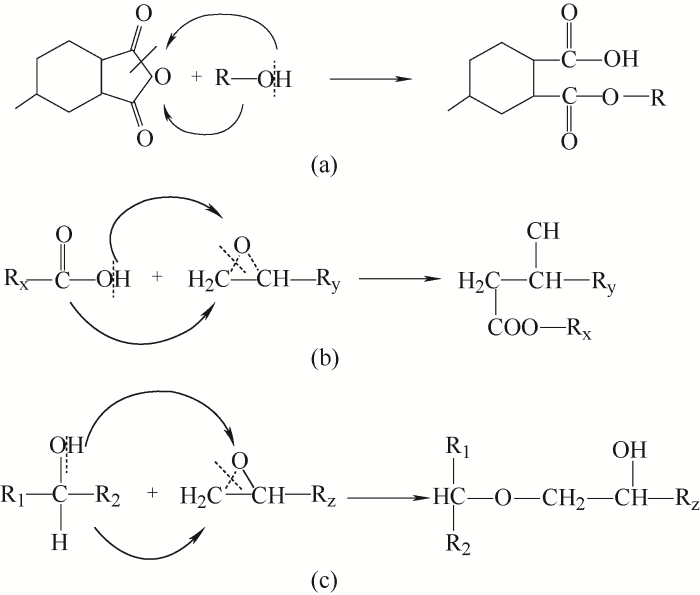
... 环氧树脂与酸酐固化剂的固化机理可概括为酸酐开环、酯化和醚化[38 ⇓ -40 ] ,反应过程如图1 所示.图1a 中,环氧树脂中的羟基与酸酐基发生反应,促使酸酐基开环,形成更易与环氧基开环的羧酸,二者通过酯键连接形成聚酯性结构;图1b 中,酸酐开环后形成的羧基与环氧基反应使其开环,进一步促进交联结构的形成,二者反应后形成新的羟基,又可以使酸酐基开环,这一反应称为酯化反应;图1c 中,体系中的羟基同样也可以使环氧基开环,形成醚键同时产生新的羟基,形成均聚效果促进交联结构的形成,这一反应称为醚化反应.这一反应的反应活性要略低于酯化反应[41 ] .以上三步反应不断进行,最终形成环氧树脂的三维交联网络. ...
Curing degree dependence of dielectric properties of bisphenol-A based epoxy resin cured with methyl hexahydrophthalic anhydride
4
2022
... 环氧树脂与酸酐固化剂的固化机理可概括为酸酐开环、酯化和醚化[38 ⇓ -40 ] ,反应过程如图1 所示.图1a 中,环氧树脂中的羟基与酸酐基发生反应,促使酸酐基开环,形成更易与环氧基开环的羧酸,二者通过酯键连接形成聚酯性结构;图1b 中,酸酐开环后形成的羧基与环氧基反应使其开环,进一步促进交联结构的形成,二者反应后形成新的羟基,又可以使酸酐基开环,这一反应称为酯化反应;图1c 中,体系中的羟基同样也可以使环氧基开环,形成醚键同时产生新的羟基,形成均聚效果促进交联结构的形成,这一反应称为醚化反应.这一反应的反应活性要略低于酯化反应[41 ] .以上三步反应不断进行,最终形成环氧树脂的三维交联网络. ...
... [
39 ]
![]()
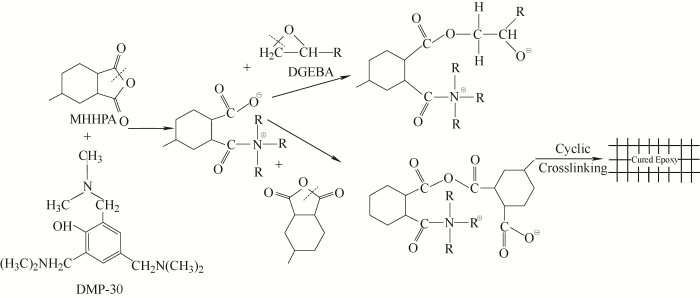
在环氧/酸酐固化体系中存在亲核类促进剂时,如叔胺基团可以使酸酐基开环,形成阴阳离子对,其中羧基阴离子极易与环氧基结合使其开环,引发进一步反应,最终形成聚酯性的交联网络;同时,该阴离子也可以与酸酐基团发生反应,开环的酸酐基团继续与环氧树脂结合,持续推进交联网络的构建.这两个反应又会产生新的阴离子,使反应得以持续进行[42 -43 ] ,具体的催化机理过程如图2 所示. ...
... LI等[39 ] 基于非模型固化动力学,计算了DGEBA/MHHPA/DMP30体系在100 ℃下环氧树脂达到70%、80%和90%固化度所需的固化时间,通过工艺制备的样品与通过仿真获得的交联结构其T g 误差小于4%,验证了特定固化度下确定相应固化工艺的有效性.同时发现在高交联度(>70%)下,产物体系中的酸酐反应完全,醚化反应的活性较弱,主要的交联反应表现为新酯基的形成,通过酯基与醚键作为交联点形成了广泛的三维网状结构.随着固化度的提升,环氧树脂的交流击穿强度提升,这与分子链的刚性增强相关,且玻璃态转化温度条件下击穿强度对温度的变化不甚敏感.可见交联结构调控对于提升环氧树脂绝缘性能具有重要意义. ...
... 第3.2节提到两段固化已成为通用的环氧树脂固化方案.LI等[39 ] 基于DEBGA/MHHPA/DMP30体系,设定了80%和90%的预固化处理(100 ℃下80 min或123 min),在此基础上分别进行140 ℃后固化1 h、2 h、4 h和8 h,以研究后固化对绝缘性能的影响.发现90%固化度基础上后固化的环氧树脂绝缘性能普遍优于80%固化度基础上的后固化产物,且后固化时间的影响存在饱和效应.综合绝缘性能进行评估,最终优选出最佳固化制度为0.5% DMP-30+100 ℃固化123 min+140 ℃后固化4 h[14 ] .综上,固化时间对环氧树脂结构的形成影响复杂,并不是固化时间越长性能越好,分段固化温度与时间的组合可根据试验结果确定最优的生产工艺条件. ...
über den h?rtungsmechanismus der ?thoxylinharze
1
1954
... 环氧树脂与酸酐固化剂的固化机理可概括为酸酐开环、酯化和醚化[38 ⇓ -40 ] ,反应过程如图1 所示.图1a 中,环氧树脂中的羟基与酸酐基发生反应,促使酸酐基开环,形成更易与环氧基开环的羧酸,二者通过酯键连接形成聚酯性结构;图1b 中,酸酐开环后形成的羧基与环氧基反应使其开环,进一步促进交联结构的形成,二者反应后形成新的羟基,又可以使酸酐基开环,这一反应称为酯化反应;图1c 中,体系中的羟基同样也可以使环氧基开环,形成醚键同时产生新的羟基,形成均聚效果促进交联结构的形成,这一反应称为醚化反应.这一反应的反应活性要略低于酯化反应[41 ] .以上三步反应不断进行,最终形成环氧树脂的三维交联网络. ...
The influence of the molecular architecture on the thermal and the dielectric properties of epoxy resin networks
2
... 环氧树脂与酸酐固化剂的固化机理可概括为酸酐开环、酯化和醚化[38 ⇓ -40 ] ,反应过程如图1 所示.图1a 中,环氧树脂中的羟基与酸酐基发生反应,促使酸酐基开环,形成更易与环氧基开环的羧酸,二者通过酯键连接形成聚酯性结构;图1b 中,酸酐开环后形成的羧基与环氧基反应使其开环,进一步促进交联结构的形成,二者反应后形成新的羟基,又可以使酸酐基开环,这一反应称为酯化反应;图1c 中,体系中的羟基同样也可以使环氧基开环,形成醚键同时产生新的羟基,形成均聚效果促进交联结构的形成,这一反应称为醚化反应.这一反应的反应活性要略低于酯化反应[41 ] .以上三步反应不断进行,最终形成环氧树脂的三维交联网络. ...
... 分子动力学模拟通过计算机的高运算性能分析分子运动的统计规律,获得分子的微观结构,揭示分子位置构象、运动状态与宏观性能指标的联系,在环氧树脂的研究领域应用广泛[44 -45 ] .如何通过先进的技术手段模拟出合理准确的环氧树脂交联结构是该领域的重点问题.当前,环氧树脂的交联模型大都基于“距离判断准则”进行设计,即在设定的反应半径内搜索可反应的原子对,交联后进行分子动力学平衡以获得稳定构象,继而不断增大反应半径直至满足相关条件为止[46 -47 ] .现有的环氧树脂交联模型大多基于反应原子之间的直接交联.例如环氧树脂和酸酐固化剂之间的交联反应是在标定的碳原子和氧原子之间直接生成化学键[48 ] .然而,酸酐固化双酚A环氧树脂的过程涉及酯化醚化竞争多反应,因此直接的原子间反应缺乏一定的合理性[41 ] .由于酸酐交联反应的机理没有在模拟中充分体现,很难反映真正的交联变化,从而限制了模型在解释宏观性能方面的有效性.设计更加合理科学的交联规则以揭示交联结构与绝缘性能的联系,对深化环氧树脂固化制度的研究帮助甚大. ...
Recyclable high-performance epoxy-anhydride resins with DMP-30 as the catalyst of transesterification reactions
1
2021
... 在环氧/酸酐固化体系中存在亲核类促进剂时,如叔胺基团可以使酸酐基开环,形成阴阳离子对,其中羧基阴离子极易与环氧基结合使其开环,引发进一步反应,最终形成聚酯性的交联网络;同时,该阴离子也可以与酸酐基团发生反应,开环的酸酐基团继续与环氧树脂结合,持续推进交联网络的构建.这两个反应又会产生新的阴离子,使反应得以持续进行[42 -43 ] ,具体的催化机理过程如图2 所示. ...
Curing kinetics and dielectric properties of anhydride cured epoxy resin with different accelerator contents
4
2023
... 在环氧/酸酐固化体系中存在亲核类促进剂时,如叔胺基团可以使酸酐基开环,形成阴阳离子对,其中羧基阴离子极易与环氧基结合使其开环,引发进一步反应,最终形成聚酯性的交联网络;同时,该阴离子也可以与酸酐基团发生反应,开环的酸酐基团继续与环氧树脂结合,持续推进交联网络的构建.这两个反应又会产生新的阴离子,使反应得以持续进行[42 -43 ] ,具体的催化机理过程如图2 所示. ...
... [
43 ]
![]()
2.3 分子动力学模拟 分子动力学是在一定的初始条件下(如温度、压力等)模拟分子运动的研究方法,它使用牛顿经典力学来模拟分子体系的运动,在由分子体系不同状态构成的系综中抽取样本,从而计算体系的构型积分,并以此为基础计算体系的热力学量和其他宏观性质,对揭示试验现象背后的反应机理与规律具有重要价值. ...
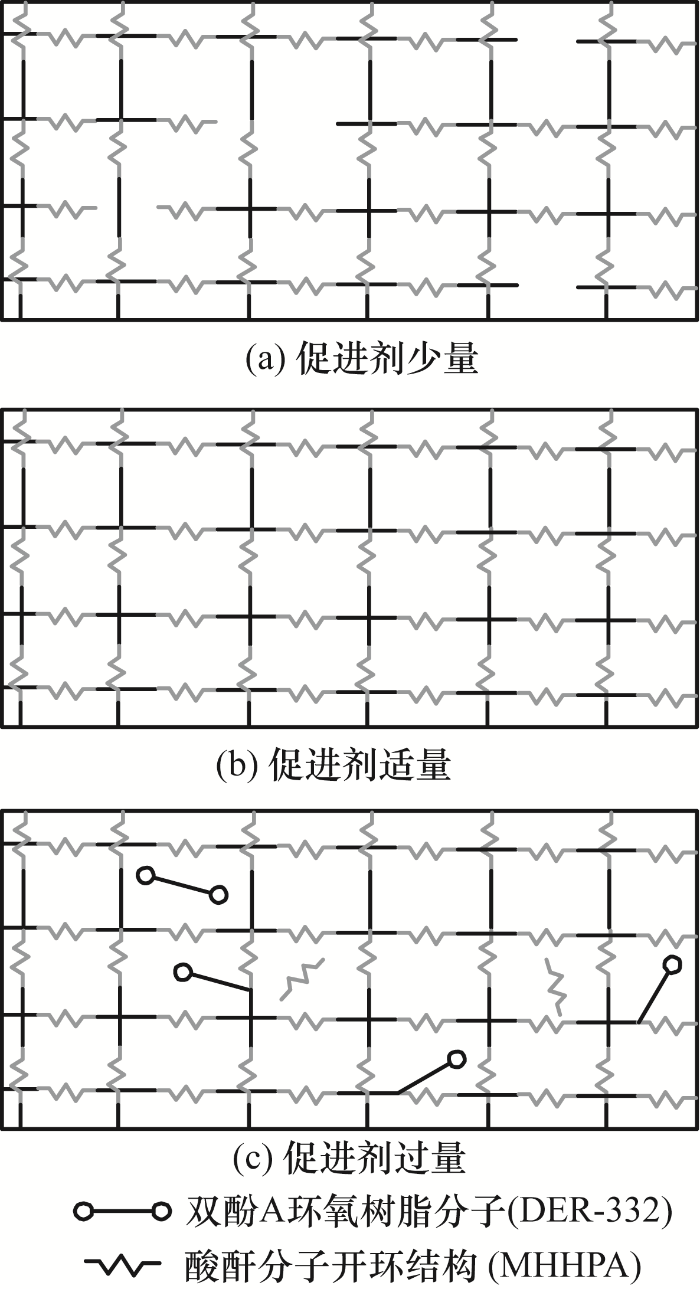
... 促进剂比例对固化产物的影响相比前者尚未得到充分关注.AMIROVA等[70 ] 研究了膦盐催化的环氧/酸酐体系的热性能,确定3wt%~4wt%为膦盐促进剂的最佳比例,有利于形成缺陷最少的三维交联网络.GOU等[71 ] 开发了一种封装三苯基膦(TPP)的环氧/酸酐体系潜伏促进剂,该促进剂基于有机-无机杂化机理提高了环氧热固性树脂的玻璃态转化温度,同时具有增韧效果.杨威等[54 ] 采用DSC对高压绝缘拉杆用环氧树脂体系进行固化动力学分析,验证了促进剂通过降低活化能可使固化温度显著下降,同时发现当促进剂用量为0.5%时,固化产物T g 达到最高值106.3 ℃.然而这些研究多集中关注环氧树脂的热学性能与机械性能,对绝缘性能的研究较少.LI等[43 ] 在保证环氧树脂充分交联的经验固化工艺下,确定添加0.5% DMP-30时环氧树脂-酸酐体系绝缘性能达到最优,主要是对介电性能的影响较为明显,少量与过量的促进剂作用下其交联网络结构不佳,如图6 所示,分析认为环氧树脂固化产物能带间隙的增大是电导率升高的重要原因. ...
... [
43 ]
![]()
4.2.3 固化温度与时间 固化温度与时间的研究难点在于组合极多,缺乏相应的理论依据与选择标准,同时化学原料的供应商一般会提供经验的固化方案,因而此方面的研究并不多.UZAY等[72 ] 研究了后固化热处理对纤维增强复合材料(FRP)拉伸和冲击韧性的影响,分别在常规的固化方案下增加了25 ℃、62.5 ℃和100 ℃后固化1 h的处理,结果表明,后固化对FRP的能量吸收能力和拉伸性能的提升是有益的.GUERRERO等[73 ] 研究了TGDDM/THPA环氧体系的动态力学行为与固化时间和化学计量比的关系,固化制度为120 ℃2 h+170 ℃ 2 h+200 ℃ 2 h.结果显示,后固化提升了环氧树脂的T g 与力学特性,这归因于后固化使未反应的环氧基团发生醚化,使交联结构更加均匀.SAEEDI等[74 ] 研究了双酚A环氧DGEBA/D-230体系在80 ℃下不同固化时间(1~9 h)的直流电导、交流击穿强度和介电性能.结果显示,80 ℃下固化6 h的样品具有最高的T g ,电导率随着固化时间的增长先升高后降低,交流击穿场强的趋势则相反,而极值均出现在固化时间3 h的位置,介电常数与介电损耗在固化时间6 h处达到最大值,之后逐渐降低. ...
Effects of different parameters on thermal and mechanical properties of aminated graphene/epoxy nanocomposites connected by covalent:A molecular dynamics study
1
2020
... 分子动力学模拟通过计算机的高运算性能分析分子运动的统计规律,获得分子的微观结构,揭示分子位置构象、运动状态与宏观性能指标的联系,在环氧树脂的研究领域应用广泛[44 -45 ] .如何通过先进的技术手段模拟出合理准确的环氧树脂交联结构是该领域的重点问题.当前,环氧树脂的交联模型大都基于“距离判断准则”进行设计,即在设定的反应半径内搜索可反应的原子对,交联后进行分子动力学平衡以获得稳定构象,继而不断增大反应半径直至满足相关条件为止[46 -47 ] .现有的环氧树脂交联模型大多基于反应原子之间的直接交联.例如环氧树脂和酸酐固化剂之间的交联反应是在标定的碳原子和氧原子之间直接生成化学键[48 ] .然而,酸酐固化双酚A环氧树脂的过程涉及酯化醚化竞争多反应,因此直接的原子间反应缺乏一定的合理性[41 ] .由于酸酐交联反应的机理没有在模拟中充分体现,很难反映真正的交联变化,从而限制了模型在解释宏观性能方面的有效性.设计更加合理科学的交联规则以揭示交联结构与绝缘性能的联系,对深化环氧树脂固化制度的研究帮助甚大. ...
3
2020
... 分子动力学模拟通过计算机的高运算性能分析分子运动的统计规律,获得分子的微观结构,揭示分子位置构象、运动状态与宏观性能指标的联系,在环氧树脂的研究领域应用广泛[44 -45 ] .如何通过先进的技术手段模拟出合理准确的环氧树脂交联结构是该领域的重点问题.当前,环氧树脂的交联模型大都基于“距离判断准则”进行设计,即在设定的反应半径内搜索可反应的原子对,交联后进行分子动力学平衡以获得稳定构象,继而不断增大反应半径直至满足相关条件为止[46 -47 ] .现有的环氧树脂交联模型大多基于反应原子之间的直接交联.例如环氧树脂和酸酐固化剂之间的交联反应是在标定的碳原子和氧原子之间直接生成化学键[48 ] .然而,酸酐固化双酚A环氧树脂的过程涉及酯化醚化竞争多反应,因此直接的原子间反应缺乏一定的合理性[41 ] .由于酸酐交联反应的机理没有在模拟中充分体现,很难反映真正的交联变化,从而限制了模型在解释宏观性能方面的有效性.设计更加合理科学的交联规则以揭示交联结构与绝缘性能的联系,对深化环氧树脂固化制度的研究帮助甚大. ...
... 固化度通常定义为环氧树脂中已交联的环氧基与所有的环氧基之比,也可以定义为反应已经释放的热量与反应总的放热量之比,它是衡量环氧树脂反应进程的重要指标[45 ,62 ] .环氧树脂交联过程中体系形态的变化大致可划分为液态-凝胶-固态的不同阶段,如图5 所示.在凝胶点之前,环氧树脂体系大致呈液体状态,流动性较强,体系各处的分子均可以发生有效碰撞引发交联反应,反应主要受体系浓度控制,在这一过程中要完成关键部件的浸渍、灌封等,因此要准确获取这个阶段所能够持续的时间;凝胶点之后,环氧树脂体系呈凝胶状态,流动性减弱,之前浓度较高的部分反应完全,浓度较低的部分需要高浓度处剩余的未反应物扩散到低浓度处才能发生反应,交联反应取决于未反应部分的流动能力,反应主要受体系扩散控制,这一过程是完成预定固化度的关键期,也是预防填料沉降、提高耐热、优化强度与韧性的关键期[14 ] . ...
... 环氧树脂的交联结构特性影响着固化产物的绝缘性能,其中自由体积、交联密度等指标常用来反映交联结构的变化.自由体积被认为与介电性能和击穿特性密切相关,ARTBAUER等[63 ] 研究表明自由体积的增大使电子在聚合物中的自由行程增大,会导致绝缘性能尤其是击穿强度的下降.填料的加入会在环氧树脂的交联结构中引入界面,改变体系的交联结构.ALHABILL等[64 ] 研究了环氧树脂/氮化硅体系的直交流击穿强度,发现自由体积并未构成影响击穿强度的主要因素,纳米界面带来的电荷输运状况的改变影响了体系的击穿强度.自由体积的增大通常会导致介电常数的提升和介电损耗的增大,尤其是在环境温度超过玻璃态转化温度以上的条件下.DO等[65 ] 的研究证明,环氧纳米体系的自由体积相比纯环氧体系变化不大,不能很好地解释介电行为的变化.GUO等[66 ] 通过引入联苯介晶的定向结构,增加了环氧树脂网络结构的交联密度,有效地降低了介电常数与介电损耗.付可欣[45 ] 通过构建环氧-酸酐体系交联模型,模拟研究了交联度对环氧-酸酐体系结构参数和性能参数的影响,发现当交联度为89%时,在满足电气性能的情况下,可以在保持较高的T g 时,获得较高的模量. ...
3
2020
... 分子动力学模拟通过计算机的高运算性能分析分子运动的统计规律,获得分子的微观结构,揭示分子位置构象、运动状态与宏观性能指标的联系,在环氧树脂的研究领域应用广泛[44 -45 ] .如何通过先进的技术手段模拟出合理准确的环氧树脂交联结构是该领域的重点问题.当前,环氧树脂的交联模型大都基于“距离判断准则”进行设计,即在设定的反应半径内搜索可反应的原子对,交联后进行分子动力学平衡以获得稳定构象,继而不断增大反应半径直至满足相关条件为止[46 -47 ] .现有的环氧树脂交联模型大多基于反应原子之间的直接交联.例如环氧树脂和酸酐固化剂之间的交联反应是在标定的碳原子和氧原子之间直接生成化学键[48 ] .然而,酸酐固化双酚A环氧树脂的过程涉及酯化醚化竞争多反应,因此直接的原子间反应缺乏一定的合理性[41 ] .由于酸酐交联反应的机理没有在模拟中充分体现,很难反映真正的交联变化,从而限制了模型在解释宏观性能方面的有效性.设计更加合理科学的交联规则以揭示交联结构与绝缘性能的联系,对深化环氧树脂固化制度的研究帮助甚大. ...
... 固化度通常定义为环氧树脂中已交联的环氧基与所有的环氧基之比,也可以定义为反应已经释放的热量与反应总的放热量之比,它是衡量环氧树脂反应进程的重要指标[45 ,62 ] .环氧树脂交联过程中体系形态的变化大致可划分为液态-凝胶-固态的不同阶段,如图5 所示.在凝胶点之前,环氧树脂体系大致呈液体状态,流动性较强,体系各处的分子均可以发生有效碰撞引发交联反应,反应主要受体系浓度控制,在这一过程中要完成关键部件的浸渍、灌封等,因此要准确获取这个阶段所能够持续的时间;凝胶点之后,环氧树脂体系呈凝胶状态,流动性减弱,之前浓度较高的部分反应完全,浓度较低的部分需要高浓度处剩余的未反应物扩散到低浓度处才能发生反应,交联反应取决于未反应部分的流动能力,反应主要受体系扩散控制,这一过程是完成预定固化度的关键期,也是预防填料沉降、提高耐热、优化强度与韧性的关键期[14 ] . ...
... 环氧树脂的交联结构特性影响着固化产物的绝缘性能,其中自由体积、交联密度等指标常用来反映交联结构的变化.自由体积被认为与介电性能和击穿特性密切相关,ARTBAUER等[63 ] 研究表明自由体积的增大使电子在聚合物中的自由行程增大,会导致绝缘性能尤其是击穿强度的下降.填料的加入会在环氧树脂的交联结构中引入界面,改变体系的交联结构.ALHABILL等[64 ] 研究了环氧树脂/氮化硅体系的直交流击穿强度,发现自由体积并未构成影响击穿强度的主要因素,纳米界面带来的电荷输运状况的改变影响了体系的击穿强度.自由体积的增大通常会导致介电常数的提升和介电损耗的增大,尤其是在环境温度超过玻璃态转化温度以上的条件下.DO等[65 ] 的研究证明,环氧纳米体系的自由体积相比纯环氧体系变化不大,不能很好地解释介电行为的变化.GUO等[66 ] 通过引入联苯介晶的定向结构,增加了环氧树脂网络结构的交联密度,有效地降低了介电常数与介电损耗.付可欣[45 ] 通过构建环氧-酸酐体系交联模型,模拟研究了交联度对环氧-酸酐体系结构参数和性能参数的影响,发现当交联度为89%时,在满足电气性能的情况下,可以在保持较高的T g 时,获得较高的模量. ...
Molecular dynamics simulation and experimental studies on the thermomechanical properties of epoxy resin with different anhydride curing agents
1
2019
... 分子动力学模拟通过计算机的高运算性能分析分子运动的统计规律,获得分子的微观结构,揭示分子位置构象、运动状态与宏观性能指标的联系,在环氧树脂的研究领域应用广泛[44 -45 ] .如何通过先进的技术手段模拟出合理准确的环氧树脂交联结构是该领域的重点问题.当前,环氧树脂的交联模型大都基于“距离判断准则”进行设计,即在设定的反应半径内搜索可反应的原子对,交联后进行分子动力学平衡以获得稳定构象,继而不断增大反应半径直至满足相关条件为止[46 -47 ] .现有的环氧树脂交联模型大多基于反应原子之间的直接交联.例如环氧树脂和酸酐固化剂之间的交联反应是在标定的碳原子和氧原子之间直接生成化学键[48 ] .然而,酸酐固化双酚A环氧树脂的过程涉及酯化醚化竞争多反应,因此直接的原子间反应缺乏一定的合理性[41 ] .由于酸酐交联反应的机理没有在模拟中充分体现,很难反映真正的交联变化,从而限制了模型在解释宏观性能方面的有效性.设计更加合理科学的交联规则以揭示交联结构与绝缘性能的联系,对深化环氧树脂固化制度的研究帮助甚大. ...
环氧树脂/酸酐体系热力学特性的分子动力学模拟
1
2020
... 分子动力学模拟通过计算机的高运算性能分析分子运动的统计规律,获得分子的微观结构,揭示分子位置构象、运动状态与宏观性能指标的联系,在环氧树脂的研究领域应用广泛[44 -45 ] .如何通过先进的技术手段模拟出合理准确的环氧树脂交联结构是该领域的重点问题.当前,环氧树脂的交联模型大都基于“距离判断准则”进行设计,即在设定的反应半径内搜索可反应的原子对,交联后进行分子动力学平衡以获得稳定构象,继而不断增大反应半径直至满足相关条件为止[46 -47 ] .现有的环氧树脂交联模型大多基于反应原子之间的直接交联.例如环氧树脂和酸酐固化剂之间的交联反应是在标定的碳原子和氧原子之间直接生成化学键[48 ] .然而,酸酐固化双酚A环氧树脂的过程涉及酯化醚化竞争多反应,因此直接的原子间反应缺乏一定的合理性[41 ] .由于酸酐交联反应的机理没有在模拟中充分体现,很难反映真正的交联变化,从而限制了模型在解释宏观性能方面的有效性.设计更加合理科学的交联规则以揭示交联结构与绝缘性能的联系,对深化环氧树脂固化制度的研究帮助甚大. ...
Molecular dynamics simulation on thermomechanical properties of epoxy resin/anhydride system
1
2020
... 分子动力学模拟通过计算机的高运算性能分析分子运动的统计规律,获得分子的微观结构,揭示分子位置构象、运动状态与宏观性能指标的联系,在环氧树脂的研究领域应用广泛[44 -45 ] .如何通过先进的技术手段模拟出合理准确的环氧树脂交联结构是该领域的重点问题.当前,环氧树脂的交联模型大都基于“距离判断准则”进行设计,即在设定的反应半径内搜索可反应的原子对,交联后进行分子动力学平衡以获得稳定构象,继而不断增大反应半径直至满足相关条件为止[46 -47 ] .现有的环氧树脂交联模型大多基于反应原子之间的直接交联.例如环氧树脂和酸酐固化剂之间的交联反应是在标定的碳原子和氧原子之间直接生成化学键[48 ] .然而,酸酐固化双酚A环氧树脂的过程涉及酯化醚化竞争多反应,因此直接的原子间反应缺乏一定的合理性[41 ] .由于酸酐交联反应的机理没有在模拟中充分体现,很难反映真正的交联变化,从而限制了模型在解释宏观性能方面的有效性.设计更加合理科学的交联规则以揭示交联结构与绝缘性能的联系,对深化环氧树脂固化制度的研究帮助甚大. ...
Structure,microparameters and properties of crosslinked DGEBA/MTHPA:A molecular dynamics simulation
1
2018
... 分子动力学模拟通过计算机的高运算性能分析分子运动的统计规律,获得分子的微观结构,揭示分子位置构象、运动状态与宏观性能指标的联系,在环氧树脂的研究领域应用广泛[44 -45 ] .如何通过先进的技术手段模拟出合理准确的环氧树脂交联结构是该领域的重点问题.当前,环氧树脂的交联模型大都基于“距离判断准则”进行设计,即在设定的反应半径内搜索可反应的原子对,交联后进行分子动力学平衡以获得稳定构象,继而不断增大反应半径直至满足相关条件为止[46 -47 ] .现有的环氧树脂交联模型大多基于反应原子之间的直接交联.例如环氧树脂和酸酐固化剂之间的交联反应是在标定的碳原子和氧原子之间直接生成化学键[48 ] .然而,酸酐固化双酚A环氧树脂的过程涉及酯化醚化竞争多反应,因此直接的原子间反应缺乏一定的合理性[41 ] .由于酸酐交联反应的机理没有在模拟中充分体现,很难反映真正的交联变化,从而限制了模型在解释宏观性能方面的有效性.设计更加合理科学的交联规则以揭示交联结构与绝缘性能的联系,对深化环氧树脂固化制度的研究帮助甚大. ...
绝缘拉杆用环氧树脂固化动力学研究
1
2020
... 活化能是固化动力学分析中的关键参数,它通常指分子由能量稳定的基态转变为容易发生化学反应的活跃状态所需要的能量[49 ] .对于环氧树脂固化这种复杂的非基元反应,活化能体现为包含多个反应进程的表观活化能.表观活化能是统计平均量,反映了1 mol活化分子与1 mol稳定分子的平均能量之差,一般基于试验数据求得,在宏观上唯象地体现体系能量的变化.表观活化能的大小可以衡量化学反应发生的难易程度.在固化动力学计算中,模型与非模型方法均可以获得活化能的数值.模型法基于相应反应机理函数的假设,具有一定的局限性.非模型法基于等转化率原则,不涉及具体的反应机理函数假设,通过对基本热力学方程的数学变换反映活化能的状态. ...
Study on curing kinetics of epoxy resin for insulated tension pole
1
2020
... 活化能是固化动力学分析中的关键参数,它通常指分子由能量稳定的基态转变为容易发生化学反应的活跃状态所需要的能量[49 ] .对于环氧树脂固化这种复杂的非基元反应,活化能体现为包含多个反应进程的表观活化能.表观活化能是统计平均量,反映了1 mol活化分子与1 mol稳定分子的平均能量之差,一般基于试验数据求得,在宏观上唯象地体现体系能量的变化.表观活化能的大小可以衡量化学反应发生的难易程度.在固化动力学计算中,模型与非模型方法均可以获得活化能的数值.模型法基于相应反应机理函数的假设,具有一定的局限性.非模型法基于等转化率原则,不涉及具体的反应机理函数假设,通过对基本热力学方程的数学变换反映活化能的状态. ...
Kissinger method in kinetics of materials:Things to beware and be aware of
2
2020
... 非模型拟合法基于等转化率假设,即固化度相同时,体系的反应速率仅与温度有关.它规避了模型拟合法需要预先假设反应机理函数的前提条件,对复杂反应的拟合效果较好.非模型拟合法的本质为将积分或差分的热流信号转化为固化度,常用的非模型拟合法有Kissinger法、Friedman法、Flynn-Wall-Ozawa (FWO)法等[50 ⇓ -52 ] . ...
... (1) Kissinger法.Kissinger法基于峰值温度不受升温速率影响的假设,仅使用体系的峰值温度来计算反应的活化能[50 ] .根据峰值温度处热流导数为0的假设,对动力学基本方程求导并代入相应的关系,得到Kissinger方程 ...
Isoconversional kinetic analysis of thermally stimulated processes in polymers
2
2006
... 非模型拟合法基于等转化率假设,即固化度相同时,体系的反应速率仅与温度有关.它规避了模型拟合法需要预先假设反应机理函数的前提条件,对复杂反应的拟合效果较好.非模型拟合法的本质为将积分或差分的热流信号转化为固化度,常用的非模型拟合法有Kissinger法、Friedman法、Flynn-Wall-Ozawa (FWO)法等[50 ⇓ -52 ] . ...
... (2) Friedman法.Friedman法基于等转化率微分原则进行活化能的计算[51 ] .对动力学方程两边取对数,可得 ...
Assessment of Avrami,Ozawa and Avrami-Ozawa equations for determination of EVA crosslinking kinetics from DSC measurements
2
2008
... 非模型拟合法基于等转化率假设,即固化度相同时,体系的反应速率仅与温度有关.它规避了模型拟合法需要预先假设反应机理函数的前提条件,对复杂反应的拟合效果较好.非模型拟合法的本质为将积分或差分的热流信号转化为固化度,常用的非模型拟合法有Kissinger法、Friedman法、Flynn-Wall-Ozawa (FWO)法等[50 ⇓ -52 ] . ...
... (3) Flynn-Wall-Ozawa(FWO)法.FWO法同样基于等转化率的假设,不需要预先假设反应机理函数,即可获得反应体系的活化能[52 ] .需要引入固化度函数g (a )与温度积分,固化度函数定义为 ...
The curing kinetics analysis of four epoxy resins using a diamine terminated polyether as curing agent
1
2021
... 三种模型结果均表明,环氧树脂/酸酐体系在中后期反应机理由浓度控制转为扩散控制,反应速率降低,活化能有所提高[53 ] .随着促进剂含量的提升,环氧树脂体系的活化能降低,反应更加容易进行.其中Kissinger法与FWO法计算的DGEBA/ MHHPA/DMP30体系反应活化能较为接近,验证了活化能计算的准确性,同时证明该环氧树脂体系遵循等转化率准则.非模型拟合法可以根据非等温的测试结果预测体系的等温固化行为,对指导固化工艺,尤其是特定温度下环氧树脂达到特定固化度所需的固化时间具有重要意义. ...
环氧树脂固化动力学及促进剂用量对体系的影响
3
2020
... 模型拟合法假设固化过程符合某一动力学模型,通过拟合模型的动力学参数,建立固化速率、固化度与时间、温度之间的关系,实现对固化全过程的规律反映.拟合模型又可分为机理模型与唯象模型,唯象模型回避了固化过程中化学反应的类型与细节,直接根据热流曲线的放热形态反映热力学规律;机理模型从根本的固化原理上推导固化反应模型.虽然机理模型能够更好地预测和解释固化过程,但由于固化反应的复杂性,机理模型的推导非常困难.当前绝大多数研究还是采用唯象模型,常用的环氧树脂反应的唯象模型有Sestak-Berggren (SB(m , n ))模型、Kamal模型、n 级反应模型等[54 ⇓ -56 ] . ...
... (3) n 级反应模型.Kamal反应模型着重体现反应过程的自催化性,而n 级反应模型将浓度视为影响反应速率的主要因素,未反应部分通过反应级数n 与反应速率建立联系,其动力学方程表达如下[54 ] ...
... 促进剂比例对固化产物的影响相比前者尚未得到充分关注.AMIROVA等[70 ] 研究了膦盐催化的环氧/酸酐体系的热性能,确定3wt%~4wt%为膦盐促进剂的最佳比例,有利于形成缺陷最少的三维交联网络.GOU等[71 ] 开发了一种封装三苯基膦(TPP)的环氧/酸酐体系潜伏促进剂,该促进剂基于有机-无机杂化机理提高了环氧热固性树脂的玻璃态转化温度,同时具有增韧效果.杨威等[54 ] 采用DSC对高压绝缘拉杆用环氧树脂体系进行固化动力学分析,验证了促进剂通过降低活化能可使固化温度显著下降,同时发现当促进剂用量为0.5%时,固化产物T g 达到最高值106.3 ℃.然而这些研究多集中关注环氧树脂的热学性能与机械性能,对绝缘性能的研究较少.LI等[43 ] 在保证环氧树脂充分交联的经验固化工艺下,确定添加0.5% DMP-30时环氧树脂-酸酐体系绝缘性能达到最优,主要是对介电性能的影响较为明显,少量与过量的促进剂作用下其交联网络结构不佳,如图6 所示,分析认为环氧树脂固化产物能带间隙的增大是电导率升高的重要原因. ...
Kinetics of epoxy resin curing and the effects of varying the amount of accelerator
3
2020
... 模型拟合法假设固化过程符合某一动力学模型,通过拟合模型的动力学参数,建立固化速率、固化度与时间、温度之间的关系,实现对固化全过程的规律反映.拟合模型又可分为机理模型与唯象模型,唯象模型回避了固化过程中化学反应的类型与细节,直接根据热流曲线的放热形态反映热力学规律;机理模型从根本的固化原理上推导固化反应模型.虽然机理模型能够更好地预测和解释固化过程,但由于固化反应的复杂性,机理模型的推导非常困难.当前绝大多数研究还是采用唯象模型,常用的环氧树脂反应的唯象模型有Sestak-Berggren (SB(m , n ))模型、Kamal模型、n 级反应模型等[54 ⇓ -56 ] . ...
... (3) n 级反应模型.Kamal反应模型着重体现反应过程的自催化性,而n 级反应模型将浓度视为影响反应速率的主要因素,未反应部分通过反应级数n 与反应速率建立联系,其动力学方程表达如下[54 ] ...
... 促进剂比例对固化产物的影响相比前者尚未得到充分关注.AMIROVA等[70 ] 研究了膦盐催化的环氧/酸酐体系的热性能,确定3wt%~4wt%为膦盐促进剂的最佳比例,有利于形成缺陷最少的三维交联网络.GOU等[71 ] 开发了一种封装三苯基膦(TPP)的环氧/酸酐体系潜伏促进剂,该促进剂基于有机-无机杂化机理提高了环氧热固性树脂的玻璃态转化温度,同时具有增韧效果.杨威等[54 ] 采用DSC对高压绝缘拉杆用环氧树脂体系进行固化动力学分析,验证了促进剂通过降低活化能可使固化温度显著下降,同时发现当促进剂用量为0.5%时,固化产物T g 达到最高值106.3 ℃.然而这些研究多集中关注环氧树脂的热学性能与机械性能,对绝缘性能的研究较少.LI等[43 ] 在保证环氧树脂充分交联的经验固化工艺下,确定添加0.5% DMP-30时环氧树脂-酸酐体系绝缘性能达到最优,主要是对介电性能的影响较为明显,少量与过量的促进剂作用下其交联网络结构不佳,如图6 所示,分析认为环氧树脂固化产物能带间隙的增大是电导率升高的重要原因. ...
Curing kinetics of DGEBA epoxy resin modified by poly (phthalazinone ether ketone) (PPEK)
1
2012
... 模型拟合法假设固化过程符合某一动力学模型,通过拟合模型的动力学参数,建立固化速率、固化度与时间、温度之间的关系,实现对固化全过程的规律反映.拟合模型又可分为机理模型与唯象模型,唯象模型回避了固化过程中化学反应的类型与细节,直接根据热流曲线的放热形态反映热力学规律;机理模型从根本的固化原理上推导固化反应模型.虽然机理模型能够更好地预测和解释固化过程,但由于固化反应的复杂性,机理模型的推导非常困难.当前绝大多数研究还是采用唯象模型,常用的环氧树脂反应的唯象模型有Sestak-Berggren (SB(m , n ))模型、Kamal模型、n 级反应模型等[54 ⇓ -56 ] . ...
The kinetic analysis of non-isothermal data
1
1992
... 模型拟合法假设固化过程符合某一动力学模型,通过拟合模型的动力学参数,建立固化速率、固化度与时间、温度之间的关系,实现对固化全过程的规律反映.拟合模型又可分为机理模型与唯象模型,唯象模型回避了固化过程中化学反应的类型与细节,直接根据热流曲线的放热形态反映热力学规律;机理模型从根本的固化原理上推导固化反应模型.虽然机理模型能够更好地预测和解释固化过程,但由于固化反应的复杂性,机理模型的推导非常困难.当前绝大多数研究还是采用唯象模型,常用的环氧树脂反应的唯象模型有Sestak-Berggren (SB(m , n ))模型、Kamal模型、n 级反应模型等[54 ⇓ -56 ] . ...
Fourty years of the esták-Berggren equation
1
2011
... (1) SB(m , n )模型.SB(m , n )模型,即自催化模型描述[57 -58 ] ,其固化动力学方程表达如下 ...
Study of the kinetics of the mechanism of solid-state reactions at increasing temperatures
1
1971
... (1) SB(m , n )模型.SB(m , n )模型,即自催化模型描述[57 -58 ] ,其固化动力学方程表达如下 ...
盆式绝缘子用环氧/氧化铝复合体系固化动力学
1
2019
... 式中,m 和n 分别代表催化效应与浓度效应对应的反应级数.毕全瑞等[59 ] 研究了SB(m , n )模型对环氧树脂/酸酐/氧化铝体系的适用性,发现拟合效果较好,动力学参数没有随固化剂含量增加而表现出明显的线性关系. ...
Curing kinetics of epoxy/alumina composite system for basin insulator
1
2019
... 式中,m 和n 分别代表催化效应与浓度效应对应的反应级数.毕全瑞等[59 ] 研究了SB(m , n )模型对环氧树脂/酸酐/氧化铝体系的适用性,发现拟合效果较好,动力学参数没有随固化剂含量增加而表现出明显的线性关系. ...
Curing kinetics of o-cresol formaldehyde epoxy resin and succinic anhydride system catalyzed by tertiary amine
1
2006
... 式中,k 1 和k 2 为速率常数.MA等[60 ] 研究了Kamal模型拟合环氧/酸酐体系的效果,结果证明了反应体系的自催化性,反应后期受到扩散控制,Kamal模型不能描述该阶段的反应,引入扩散因子后的修正方程理论值与试验数据吻合得较好. ...
1
2014
... 通过DSC测试得到的热流曲线能够反映热流速率随时间的变化关系(dH /dt -t ),进一步分析可以获得环氧树脂/酸酐体系的固化特征温度,包括峰始温度、峰值温度和峰终温度.一般认为,峰始温度对应体系开始发生反应的温度,峰值温度对应反应最为剧烈的温度.在实际固化工艺流程中,为了防止初始反应太快,反应放热太剧烈引起局部温度集中和明显的热应力,固化方案先采用较低温度固化一段时间,而后提高温度使反应加快以完成固化[61 ] .两段固化成为通用的环氧树脂固化方案,前固化温度一般在初始反应温度附近选择,后固化温度一般选择峰值温度.在实际的固化过程中,环氧树脂在特定的温度下进行固化,即升温速度为0 K/min.因此,对不同升温速率下反应的特征温度进行线性拟合,可以外推获得升温速率为0 K/min时的特征温度,即温度外推法.图4 为根据DGEBA/MHHPA/ DMP30体系不同升温速率下DSC热流曲线特征温度的外推拟合结果,可以确定该体系前固化温度为100 ℃,后固化温度为140 ℃[14 ] . ...
1
2014
... 通过DSC测试得到的热流曲线能够反映热流速率随时间的变化关系(dH /dt -t ),进一步分析可以获得环氧树脂/酸酐体系的固化特征温度,包括峰始温度、峰值温度和峰终温度.一般认为,峰始温度对应体系开始发生反应的温度,峰值温度对应反应最为剧烈的温度.在实际固化工艺流程中,为了防止初始反应太快,反应放热太剧烈引起局部温度集中和明显的热应力,固化方案先采用较低温度固化一段时间,而后提高温度使反应加快以完成固化[61 ] .两段固化成为通用的环氧树脂固化方案,前固化温度一般在初始反应温度附近选择,后固化温度一般选择峰值温度.在实际的固化过程中,环氧树脂在特定的温度下进行固化,即升温速度为0 K/min.因此,对不同升温速率下反应的特征温度进行线性拟合,可以外推获得升温速率为0 K/min时的特征温度,即温度外推法.图4 为根据DGEBA/MHHPA/ DMP30体系不同升温速率下DSC热流曲线特征温度的外推拟合结果,可以确定该体系前固化温度为100 ℃,后固化温度为140 ℃[14 ] . ...
Cure kinetics characterization and monitoring of an epoxy resin using DSC,Raman Spectroscopy,and DEA
1
2013
... 固化度通常定义为环氧树脂中已交联的环氧基与所有的环氧基之比,也可以定义为反应已经释放的热量与反应总的放热量之比,它是衡量环氧树脂反应进程的重要指标[45 ,62 ] .环氧树脂交联过程中体系形态的变化大致可划分为液态-凝胶-固态的不同阶段,如图5 所示.在凝胶点之前,环氧树脂体系大致呈液体状态,流动性较强,体系各处的分子均可以发生有效碰撞引发交联反应,反应主要受体系浓度控制,在这一过程中要完成关键部件的浸渍、灌封等,因此要准确获取这个阶段所能够持续的时间;凝胶点之后,环氧树脂体系呈凝胶状态,流动性减弱,之前浓度较高的部分反应完全,浓度较低的部分需要高浓度处剩余的未反应物扩散到低浓度处才能发生反应,交联反应取决于未反应部分的流动能力,反应主要受体系扩散控制,这一过程是完成预定固化度的关键期,也是预防填料沉降、提高耐热、优化强度与韧性的关键期[14 ] . ...
Electric strength of polymers
1
1999
... 环氧树脂的交联结构特性影响着固化产物的绝缘性能,其中自由体积、交联密度等指标常用来反映交联结构的变化.自由体积被认为与介电性能和击穿特性密切相关,ARTBAUER等[63 ] 研究表明自由体积的增大使电子在聚合物中的自由行程增大,会导致绝缘性能尤其是击穿强度的下降.填料的加入会在环氧树脂的交联结构中引入界面,改变体系的交联结构.ALHABILL等[64 ] 研究了环氧树脂/氮化硅体系的直交流击穿强度,发现自由体积并未构成影响击穿强度的主要因素,纳米界面带来的电荷输运状况的改变影响了体系的击穿强度.自由体积的增大通常会导致介电常数的提升和介电损耗的增大,尤其是在环境温度超过玻璃态转化温度以上的条件下.DO等[65 ] 的研究证明,环氧纳米体系的自由体积相比纯环氧体系变化不大,不能很好地解释介电行为的变化.GUO等[66 ] 通过引入联苯介晶的定向结构,增加了环氧树脂网络结构的交联密度,有效地降低了介电常数与介电损耗.付可欣[45 ] 通过构建环氧-酸酐体系交联模型,模拟研究了交联度对环氧-酸酐体系结构参数和性能参数的影响,发现当交联度为89%时,在满足电气性能的情况下,可以在保持较高的T g 时,获得较高的模量. ...
Effect of stoichiometry on AC and DC breakdown of silicon nitride/epoxy nanocomposites
1
2021
... 环氧树脂的交联结构特性影响着固化产物的绝缘性能,其中自由体积、交联密度等指标常用来反映交联结构的变化.自由体积被认为与介电性能和击穿特性密切相关,ARTBAUER等[63 ] 研究表明自由体积的增大使电子在聚合物中的自由行程增大,会导致绝缘性能尤其是击穿强度的下降.填料的加入会在环氧树脂的交联结构中引入界面,改变体系的交联结构.ALHABILL等[64 ] 研究了环氧树脂/氮化硅体系的直交流击穿强度,发现自由体积并未构成影响击穿强度的主要因素,纳米界面带来的电荷输运状况的改变影响了体系的击穿强度.自由体积的增大通常会导致介电常数的提升和介电损耗的增大,尤其是在环境温度超过玻璃态转化温度以上的条件下.DO等[65 ] 的研究证明,环氧纳米体系的自由体积相比纯环氧体系变化不大,不能很好地解释介电行为的变化.GUO等[66 ] 通过引入联苯介晶的定向结构,增加了环氧树脂网络结构的交联密度,有效地降低了介电常数与介电损耗.付可欣[45 ] 通过构建环氧-酸酐体系交联模型,模拟研究了交联度对环氧-酸酐体系结构参数和性能参数的影响,发现当交联度为89%时,在满足电气性能的情况下,可以在保持较高的T g 时,获得较高的模量. ...
Breakdown,free-volume and dielectric behavior of the nanodielectric coatings based on epoxy/metal oxides
1
2016
... 环氧树脂的交联结构特性影响着固化产物的绝缘性能,其中自由体积、交联密度等指标常用来反映交联结构的变化.自由体积被认为与介电性能和击穿特性密切相关,ARTBAUER等[63 ] 研究表明自由体积的增大使电子在聚合物中的自由行程增大,会导致绝缘性能尤其是击穿强度的下降.填料的加入会在环氧树脂的交联结构中引入界面,改变体系的交联结构.ALHABILL等[64 ] 研究了环氧树脂/氮化硅体系的直交流击穿强度,发现自由体积并未构成影响击穿强度的主要因素,纳米界面带来的电荷输运状况的改变影响了体系的击穿强度.自由体积的增大通常会导致介电常数的提升和介电损耗的增大,尤其是在环境温度超过玻璃态转化温度以上的条件下.DO等[65 ] 的研究证明,环氧纳米体系的自由体积相比纯环氧体系变化不大,不能很好地解释介电行为的变化.GUO等[66 ] 通过引入联苯介晶的定向结构,增加了环氧树脂网络结构的交联密度,有效地降低了介电常数与介电损耗.付可欣[45 ] 通过构建环氧-酸酐体系交联模型,模拟研究了交联度对环氧-酸酐体系结构参数和性能参数的影响,发现当交联度为89%时,在满足电气性能的情况下,可以在保持较高的T g 时,获得较高的模量. ...
Relationship between crosslinking structure and low dielectric constant of hydrophobic epoxies based on substituted biphenyl mesogenic units
1
2015
... 环氧树脂的交联结构特性影响着固化产物的绝缘性能,其中自由体积、交联密度等指标常用来反映交联结构的变化.自由体积被认为与介电性能和击穿特性密切相关,ARTBAUER等[63 ] 研究表明自由体积的增大使电子在聚合物中的自由行程增大,会导致绝缘性能尤其是击穿强度的下降.填料的加入会在环氧树脂的交联结构中引入界面,改变体系的交联结构.ALHABILL等[64 ] 研究了环氧树脂/氮化硅体系的直交流击穿强度,发现自由体积并未构成影响击穿强度的主要因素,纳米界面带来的电荷输运状况的改变影响了体系的击穿强度.自由体积的增大通常会导致介电常数的提升和介电损耗的增大,尤其是在环境温度超过玻璃态转化温度以上的条件下.DO等[65 ] 的研究证明,环氧纳米体系的自由体积相比纯环氧体系变化不大,不能很好地解释介电行为的变化.GUO等[66 ] 通过引入联苯介晶的定向结构,增加了环氧树脂网络结构的交联密度,有效地降低了介电常数与介电损耗.付可欣[45 ] 通过构建环氧-酸酐体系交联模型,模拟研究了交联度对环氧-酸酐体系结构参数和性能参数的影响,发现当交联度为89%时,在满足电气性能的情况下,可以在保持较高的T g 时,获得较高的模量. ...
Effect of resin/hardener stoichiometry on electrical behavior of epoxy networks
1
2018
... 环氧树脂与固化剂的最优配比研究已经较为充分,虽然直流电导率、介电性能与交/直流击穿的影响机理不尽相同,但依照理论的等摩尔反应比配制的固化产物大部分获得了最佳的性能.直流电导率取决于体系的化学成分,受网络结构的影响较小,在固化剂过量后,固化样品电导率出现了明显的增大,这可能与残余的基团含量有关;直流击穿强度在等摩尔配比处得到最大值,也可以用网络结构的差异来解释[67 ] .NGUYEN等[68 ] 研究了双酚A环氧树脂与酸酐固化剂HY906配比对纯环氧与添加纳米SiO2 填料体系热稳定性与直流击穿强度的影响.无论是否添加填料,环氧体系均在等摩尔配比处表现出最大的T g ,击穿强度的结果则略有不同,纯环氧体系在等摩尔配比处击穿场强最大,达到近173 kV/mm,而添加SiO2 填料后,击穿场强的最大值出现在环氧基体稍稍过量的位置,这说明填料的加入需要对最佳反应比进行补偿计算.VRYONIS等[69 ] 在存在环氧稀释剂八缩水甘油酯(OG)的条件下,依照等比例反应原则重新计算双酚A环氧树脂DGEBA与酸酐固化剂MTHPA的最佳配比,并研究了热稳定性与介电性能.补偿后的最佳配比表现出最佳的T g ,虽然固化剂过量的样品介电常数最低,但补偿后的最佳配比样品表现出更低的α 与β 弛豫峰强度.此外,何元菡的研究[35 ] 表明固化剂MNA、Me-THPA、Me-HHPA分子结构中存在的—CH3 和羧酸碳原子相距较近,具有一定的空间位阻,利用这几种固化剂制备出的环氧材料结构紧凑,有利于内部深陷阱的形成和绝缘性能提升.郭鹏翔等[36 ] 发现甲基六氢邻苯二甲酸酐和六氢苯酐摩尔比为8∶2的混合酸酐固化产物玻璃化转变温度达到最高,在介质损耗基本不变的条件下,电气强度得到了提升,这与体系刚性的增强密切相关.总结来说,依照反应原理基于环氧基与酸酐基等摩尔比反应计算出的理论质量比即为环氧树脂与固化剂的最优配比,环氧或固化剂过量均会影响致密交联网络的形成,对固化产物性能产生不利的效果. ...
The effect of resin stoichiometry and nanoparticle addition on epoxy/silica nanodielectrics
1
2015
... 环氧树脂与固化剂的最优配比研究已经较为充分,虽然直流电导率、介电性能与交/直流击穿的影响机理不尽相同,但依照理论的等摩尔反应比配制的固化产物大部分获得了最佳的性能.直流电导率取决于体系的化学成分,受网络结构的影响较小,在固化剂过量后,固化样品电导率出现了明显的增大,这可能与残余的基团含量有关;直流击穿强度在等摩尔配比处得到最大值,也可以用网络结构的差异来解释[67 ] .NGUYEN等[68 ] 研究了双酚A环氧树脂与酸酐固化剂HY906配比对纯环氧与添加纳米SiO2 填料体系热稳定性与直流击穿强度的影响.无论是否添加填料,环氧体系均在等摩尔配比处表现出最大的T g ,击穿强度的结果则略有不同,纯环氧体系在等摩尔配比处击穿场强最大,达到近173 kV/mm,而添加SiO2 填料后,击穿场强的最大值出现在环氧基体稍稍过量的位置,这说明填料的加入需要对最佳反应比进行补偿计算.VRYONIS等[69 ] 在存在环氧稀释剂八缩水甘油酯(OG)的条件下,依照等比例反应原则重新计算双酚A环氧树脂DGEBA与酸酐固化剂MTHPA的最佳配比,并研究了热稳定性与介电性能.补偿后的最佳配比表现出最佳的T g ,虽然固化剂过量的样品介电常数最低,但补偿后的最佳配比样品表现出更低的α 与β 弛豫峰强度.此外,何元菡的研究[35 ] 表明固化剂MNA、Me-THPA、Me-HHPA分子结构中存在的—CH3 和羧酸碳原子相距较近,具有一定的空间位阻,利用这几种固化剂制备出的环氧材料结构紧凑,有利于内部深陷阱的形成和绝缘性能提升.郭鹏翔等[36 ] 发现甲基六氢邻苯二甲酸酐和六氢苯酐摩尔比为8∶2的混合酸酐固化产物玻璃化转变温度达到最高,在介质损耗基本不变的条件下,电气强度得到了提升,这与体系刚性的增强密切相关.总结来说,依照反应原理基于环氧基与酸酐基等摩尔比反应计算出的理论质量比即为环氧树脂与固化剂的最优配比,环氧或固化剂过量均会影响致密交联网络的形成,对固化产物性能产生不利的效果. ...
Stoichiometry and molecular dynamics of anhydride-cured epoxy resin incorporating octa-glycidyl POSS co-monomer
1
2020
... 环氧树脂与固化剂的最优配比研究已经较为充分,虽然直流电导率、介电性能与交/直流击穿的影响机理不尽相同,但依照理论的等摩尔反应比配制的固化产物大部分获得了最佳的性能.直流电导率取决于体系的化学成分,受网络结构的影响较小,在固化剂过量后,固化样品电导率出现了明显的增大,这可能与残余的基团含量有关;直流击穿强度在等摩尔配比处得到最大值,也可以用网络结构的差异来解释[67 ] .NGUYEN等[68 ] 研究了双酚A环氧树脂与酸酐固化剂HY906配比对纯环氧与添加纳米SiO2 填料体系热稳定性与直流击穿强度的影响.无论是否添加填料,环氧体系均在等摩尔配比处表现出最大的T g ,击穿强度的结果则略有不同,纯环氧体系在等摩尔配比处击穿场强最大,达到近173 kV/mm,而添加SiO2 填料后,击穿场强的最大值出现在环氧基体稍稍过量的位置,这说明填料的加入需要对最佳反应比进行补偿计算.VRYONIS等[69 ] 在存在环氧稀释剂八缩水甘油酯(OG)的条件下,依照等比例反应原则重新计算双酚A环氧树脂DGEBA与酸酐固化剂MTHPA的最佳配比,并研究了热稳定性与介电性能.补偿后的最佳配比表现出最佳的T g ,虽然固化剂过量的样品介电常数最低,但补偿后的最佳配比样品表现出更低的α 与β 弛豫峰强度.此外,何元菡的研究[35 ] 表明固化剂MNA、Me-THPA、Me-HHPA分子结构中存在的—CH3 和羧酸碳原子相距较近,具有一定的空间位阻,利用这几种固化剂制备出的环氧材料结构紧凑,有利于内部深陷阱的形成和绝缘性能提升.郭鹏翔等[36 ] 发现甲基六氢邻苯二甲酸酐和六氢苯酐摩尔比为8∶2的混合酸酐固化产物玻璃化转变温度达到最高,在介质损耗基本不变的条件下,电气强度得到了提升,这与体系刚性的增强密切相关.总结来说,依照反应原理基于环氧基与酸酐基等摩尔比反应计算出的理论质量比即为环氧树脂与固化剂的最优配比,环氧或固化剂过量均会影响致密交联网络的形成,对固化产物性能产生不利的效果. ...
Thermal properties of epoxy-anhydride formulations cured using phosphonium accelerators
1
2018
... 促进剂比例对固化产物的影响相比前者尚未得到充分关注.AMIROVA等[70 ] 研究了膦盐催化的环氧/酸酐体系的热性能,确定3wt%~4wt%为膦盐促进剂的最佳比例,有利于形成缺陷最少的三维交联网络.GOU等[71 ] 开发了一种封装三苯基膦(TPP)的环氧/酸酐体系潜伏促进剂,该促进剂基于有机-无机杂化机理提高了环氧热固性树脂的玻璃态转化温度,同时具有增韧效果.杨威等[54 ] 采用DSC对高压绝缘拉杆用环氧树脂体系进行固化动力学分析,验证了促进剂通过降低活化能可使固化温度显著下降,同时发现当促进剂用量为0.5%时,固化产物T g 达到最高值106.3 ℃.然而这些研究多集中关注环氧树脂的热学性能与机械性能,对绝缘性能的研究较少.LI等[43 ] 在保证环氧树脂充分交联的经验固化工艺下,确定添加0.5% DMP-30时环氧树脂-酸酐体系绝缘性能达到最优,主要是对介电性能的影响较为明显,少量与过量的促进剂作用下其交联网络结构不佳,如图6 所示,分析认为环氧树脂固化产物能带间隙的增大是电导率升高的重要原因. ...
Triphenylphosphine-containing microcapsules fabricated from pickering emulsions as a thermal latent curing accelerator for an epoxy/anhydride system
1
2021
... 促进剂比例对固化产物的影响相比前者尚未得到充分关注.AMIROVA等[70 ] 研究了膦盐催化的环氧/酸酐体系的热性能,确定3wt%~4wt%为膦盐促进剂的最佳比例,有利于形成缺陷最少的三维交联网络.GOU等[71 ] 开发了一种封装三苯基膦(TPP)的环氧/酸酐体系潜伏促进剂,该促进剂基于有机-无机杂化机理提高了环氧热固性树脂的玻璃态转化温度,同时具有增韧效果.杨威等[54 ] 采用DSC对高压绝缘拉杆用环氧树脂体系进行固化动力学分析,验证了促进剂通过降低活化能可使固化温度显著下降,同时发现当促进剂用量为0.5%时,固化产物T g 达到最高值106.3 ℃.然而这些研究多集中关注环氧树脂的热学性能与机械性能,对绝缘性能的研究较少.LI等[43 ] 在保证环氧树脂充分交联的经验固化工艺下,确定添加0.5% DMP-30时环氧树脂-酸酐体系绝缘性能达到最优,主要是对介电性能的影响较为明显,少量与过量的促进剂作用下其交联网络结构不佳,如图6 所示,分析认为环氧树脂固化产物能带间隙的增大是电导率升高的重要原因. ...
Effect of post-curing heat treatment on mechanical properties of fiber reinforced polymer (FRP) composites
1
2017
... 固化温度与时间的研究难点在于组合极多,缺乏相应的理论依据与选择标准,同时化学原料的供应商一般会提供经验的固化方案,因而此方面的研究并不多.UZAY等[72 ] 研究了后固化热处理对纤维增强复合材料(FRP)拉伸和冲击韧性的影响,分别在常规的固化方案下增加了25 ℃、62.5 ℃和100 ℃后固化1 h的处理,结果表明,后固化对FRP的能量吸收能力和拉伸性能的提升是有益的.GUERRERO等[73 ] 研究了TGDDM/THPA环氧体系的动态力学行为与固化时间和化学计量比的关系,固化制度为120 ℃2 h+170 ℃ 2 h+200 ℃ 2 h.结果显示,后固化提升了环氧树脂的T g 与力学特性,这归因于后固化使未反应的环氧基团发生醚化,使交联结构更加均匀.SAEEDI等[74 ] 研究了双酚A环氧DGEBA/D-230体系在80 ℃下不同固化时间(1~9 h)的直流电导、交流击穿强度和介电性能.结果显示,80 ℃下固化6 h的样品具有最高的T g ,电导率随着固化时间的增长先升高后降低,交流击穿场强的趋势则相反,而极值均出现在固化时间3 h的位置,介电常数与介电损耗在固化时间6 h处达到最大值,之后逐渐降低. ...
Influence of cure schedule and stoichiometry on the dynamic mechanical behaviour of tetrafunctional epoxy resins cured with anhydrides
1
1996
... 固化温度与时间的研究难点在于组合极多,缺乏相应的理论依据与选择标准,同时化学原料的供应商一般会提供经验的固化方案,因而此方面的研究并不多.UZAY等[72 ] 研究了后固化热处理对纤维增强复合材料(FRP)拉伸和冲击韧性的影响,分别在常规的固化方案下增加了25 ℃、62.5 ℃和100 ℃后固化1 h的处理,结果表明,后固化对FRP的能量吸收能力和拉伸性能的提升是有益的.GUERRERO等[73 ] 研究了TGDDM/THPA环氧体系的动态力学行为与固化时间和化学计量比的关系,固化制度为120 ℃2 h+170 ℃ 2 h+200 ℃ 2 h.结果显示,后固化提升了环氧树脂的T g 与力学特性,这归因于后固化使未反应的环氧基团发生醚化,使交联结构更加均匀.SAEEDI等[74 ] 研究了双酚A环氧DGEBA/D-230体系在80 ℃下不同固化时间(1~9 h)的直流电导、交流击穿强度和介电性能.结果显示,80 ℃下固化6 h的样品具有最高的T g ,电导率随着固化时间的增长先升高后降低,交流击穿场强的趋势则相反,而极值均出现在固化时间3 h的位置,介电常数与介电损耗在固化时间6 h处达到最大值,之后逐渐降低. ...
The effect of curing conditions on the electrical properties of an epoxy resin
1
2016
... 固化温度与时间的研究难点在于组合极多,缺乏相应的理论依据与选择标准,同时化学原料的供应商一般会提供经验的固化方案,因而此方面的研究并不多.UZAY等[72 ] 研究了后固化热处理对纤维增强复合材料(FRP)拉伸和冲击韧性的影响,分别在常规的固化方案下增加了25 ℃、62.5 ℃和100 ℃后固化1 h的处理,结果表明,后固化对FRP的能量吸收能力和拉伸性能的提升是有益的.GUERRERO等[73 ] 研究了TGDDM/THPA环氧体系的动态力学行为与固化时间和化学计量比的关系,固化制度为120 ℃2 h+170 ℃ 2 h+200 ℃ 2 h.结果显示,后固化提升了环氧树脂的T g 与力学特性,这归因于后固化使未反应的环氧基团发生醚化,使交联结构更加均匀.SAEEDI等[74 ] 研究了双酚A环氧DGEBA/D-230体系在80 ℃下不同固化时间(1~9 h)的直流电导、交流击穿强度和介电性能.结果显示,80 ℃下固化6 h的样品具有最高的T g ,电导率随着固化时间的增长先升高后降低,交流击穿场强的趋势则相反,而极值均出现在固化时间3 h的位置,介电常数与介电损耗在固化时间6 h处达到最大值,之后逐渐降低. ...