

1 引言
剧烈的温升会产生一系列的危害,例如内部永磁体退磁、绕组绝缘层损坏、机械结构变形等诸多问题[7]。因此,探索更加准确的电机温度建模方法以及更加高效的电机系统热管理手段已经成为国内外相关学者的研究热点。目前国内外关于电机温度场建模和热管理方面的文献数量众多,方法种类繁杂,缺乏系统的分析和归纳。本文归纳和整理了近年来国内外文献中关于电机温度场建模和热管理的方法,以期能够较为系统地呈现电机温度建模与热管理的发展现状和发展趋势。
2 电机损耗建模
图1
2.1 电磁损耗
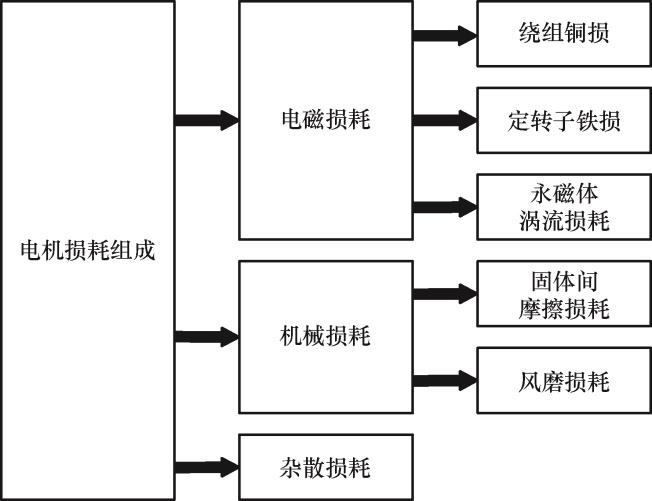
电磁损耗是电机中由于电流和磁场而导致的损耗,是电机的主要损耗,主要包括绕组铜损、定转子铁损、永磁体涡流损耗等三部分,具体介绍如下。
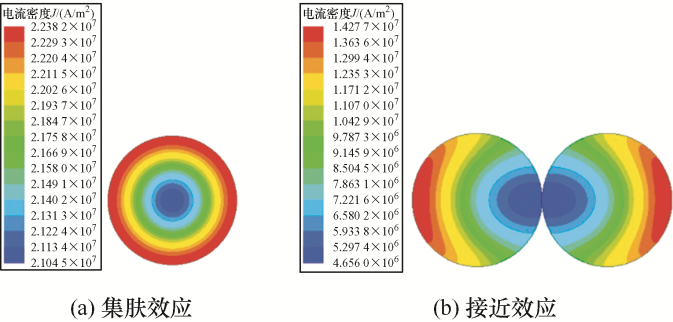
常规铜损通过式(1)计算,附加铜损可通过有限元法计算
式中,
由集肤效应引起的附加铜损受导体半径与集肤深度比值
式中,
图2
由于永磁电机内部磁场分布情况十分复杂,且磁路饱和现象严重,因此精确计算定转子铁损较为困难,需要使用数值计算方法或依赖经验公式,如表1所示。
表1 铁耗计算经验公式
表2 永磁体涡流损耗计算经验公式
2.2 机械损耗
(1) 固体间摩擦损耗。固体间摩擦损耗通常是由不同部件之间的摩擦引起的,例如转子和轴承间,轴和端环间。影响该部分损耗的物理因素包括转子转速、润滑剂性能、负载转矩和制造工艺等[20]。
2.3 杂散损耗
3 电机热模型建模
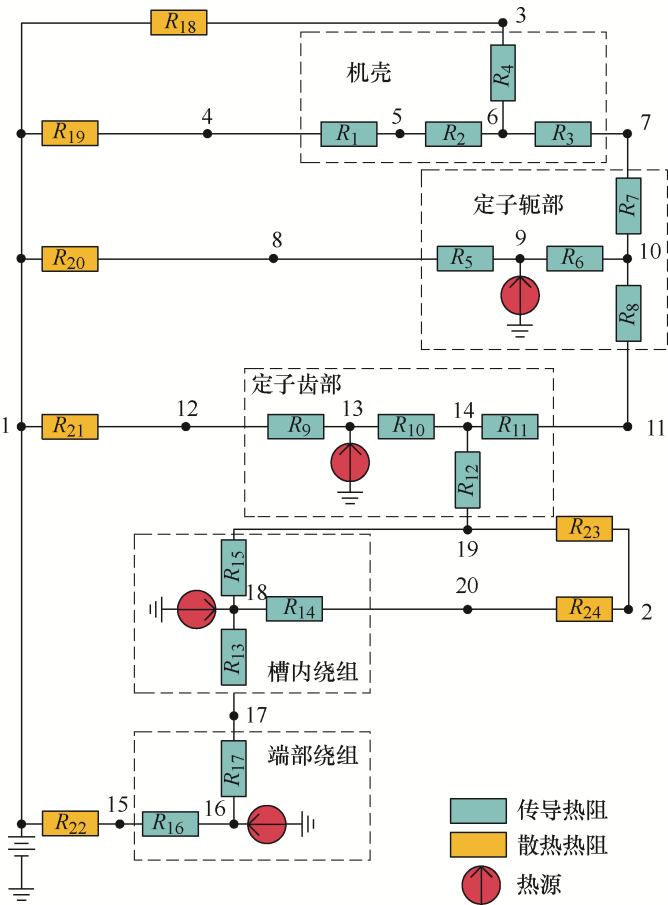
电机内部产生的热量大部分通过热传导及热对流的方式进行换热。在热传导过程中,建立精确度高的热力学模型,对于电机内部固体元件,特别是定子绕组的温度估算是至关重要的;对于热对流而言,由于冷却流体主要存在于气隙及绕组端部,因此确定这两处的对流传热系数对于计算电机发热是至关重要的。
3.1 公式简化法
3.2 等效热路法
图3
3.3 数值计算法
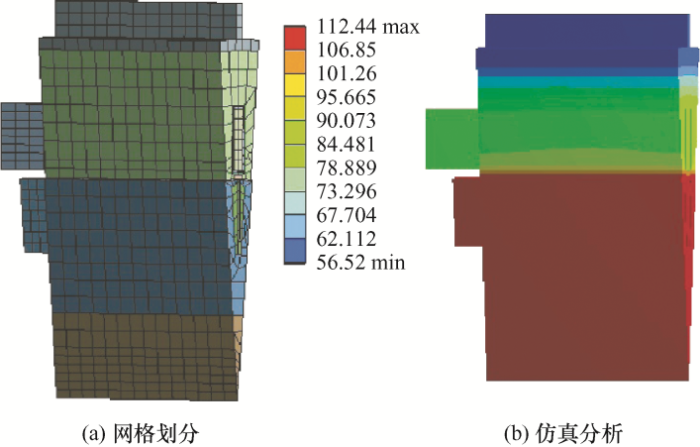
数值计算法是基于导热微分方程实现的,如式(3)所示,通过确定边界条件及式(4)~(6)可以求解电机构件内部的温度场分布。
式中,
目前应用最为广泛的数值计算方法为有限元法和集总参数热网络法。
3.3.1 有限元计算法
图4
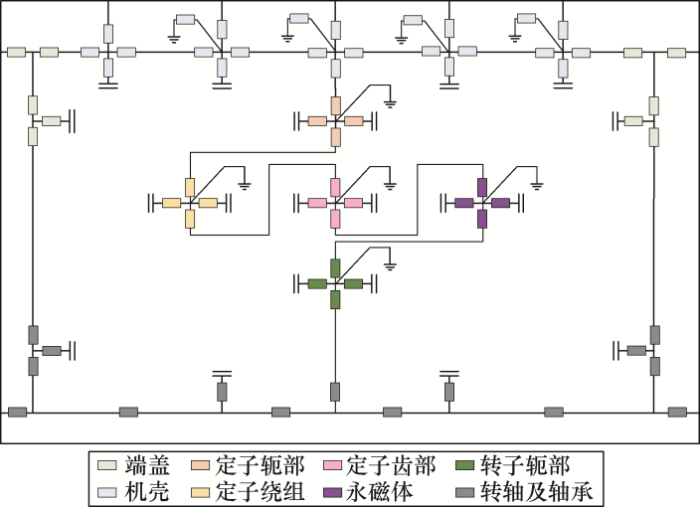
3.3.2 集总参数热网络法
图5
3.3.3 粒子法
何联格等[55]使用移动粒子半隐式法(Moving particle semi-implicit, MPS)对淋油冷却永磁同步电机进行温度场分析,使用核函数计算粒子数密度,并通过设定梯度矢量模型、拉普拉斯模型、散度模型三种模型,外加相应边界条件,建立淋油冷却系统热模型。
3.4 电机热模型建立过程中主要参数计算
3.4.1 绕组等效导热系数
BOGLIETTI等[60]通过试验验证的方法,利用数值回归法将绕组等效导热系数计算公式总结如式(7)所示
式中,
式中,
HUANG等[62]在此基础上考虑绕组填充系数及绕组空隙率对于等效导热系数的影响,对计算式进行了改进,如式(9)所示
式中,
IDOUGHI等[63]使用双重均匀化方法计算绕组等效导热系数,计算方法如式(10)所示
式中,
LIU等[64]在双重均匀化方法的基础上提出两步相关法,实现对等效导热系数的计算,该方法通过计算导体截面占比槽面积的方式实现目的,过程中需要计算绕组填充因数、槽满率、均匀化导体和绝缘物质的等效导热系数进而计算绕组等效导热系数,具体计算如式(11)~(16)所示
式中,
3.4.2 气隙对流换热系数计算
通常情况下研究人员会将电机气隙看成厚度极薄的中空柱体,其中的气流被搅动、剪切,形成径向速度梯度,这导致气隙内流体产生层流、紊流混合分布的复杂状态。
式中,
当气隙中存在轴流时,需要使用Taylor-Couette- Poiseuille流来描述气隙气流,此时需要定义的换热系数为修正Taylor数
式中,
式中,
HOWEY等[72]提出轴向、径向雷诺数分别覆盖到
式中,
除了应用经典的热力学原理计算Nu、Re等换热系数计算电机气隙换热的方式,还有研究人员将整个气隙看成电机内部固体组件,通过计算等效导热系数的方式计算换热,例如REHMAN等[73]将气隙等效导热系数表示为
4 热管理技术
电机热管理技术的优劣直接影响电机功率密度的提升以及效率的高低,根据处理方法大体上可以将热管理技术分为两类,一类是从主动限制发热源角度限制电机发热量在允许范围内,实现电机热管理,即主动热管理;另一类是从散热角度实现电机热管理,即被动热管理,二者都能实现对电机的热管理。
4.1 电机主动热管理
限制电机过热主要从限制电机发热入手,传统方法是在设计过程中估计电机的额定电流和转矩,并根据经验确定电机的过载运行时间和程度。但是这种方法往往使得设计趋于保守,无法最大程度发挥电机的功率密度。而且在很多应用场合,电机输出转矩波动很大,电机很多情况下处于轻载运行。此时若将电机短时最大输出功率定为电机的额定功率,则会导致余量过大,影响系统的集成度和成本。因此,很多情况下需要对电机进行过载运行,以提升电机系统的瞬时功率密度。
目前国内外对于电机过载控制和过温保护的研究很少,虽然可以通过实时测量电机温度,并在电机温度超过极限值时切断电源实现对电机的保护,但这种方法会导致电机系统忽然失控,给系统带来很大的安全隐患。
BROECK等[77]提出一种通过操纵交流驱动逆变器实现电机在极限工作状态下,在保证电机使用寿命的前提下,最大限度提升工作电流及输出转矩的主动热管理方法。该方法的实现依赖两个核心要素,其一是需要控制系统实时监测冷却剂及结温,实现根据冷却剂的温度自适应调整工作电流大小;其二是需要利用热阻抗频率响应函数,基于该函数根据频率升高而衰弱的特点实现在高频状态下增大工作电流而不增大结温峰值。图6为该主动热管理系统框图,包含驱动控制模块(Drive control)、电源模块(Power module)、温度监控模块(Temperature monitoring)、冷却介质温度估算模块(Coolant temperature estimation)、动态峰值电流控制模块(Dynamic peak current control)。
图6
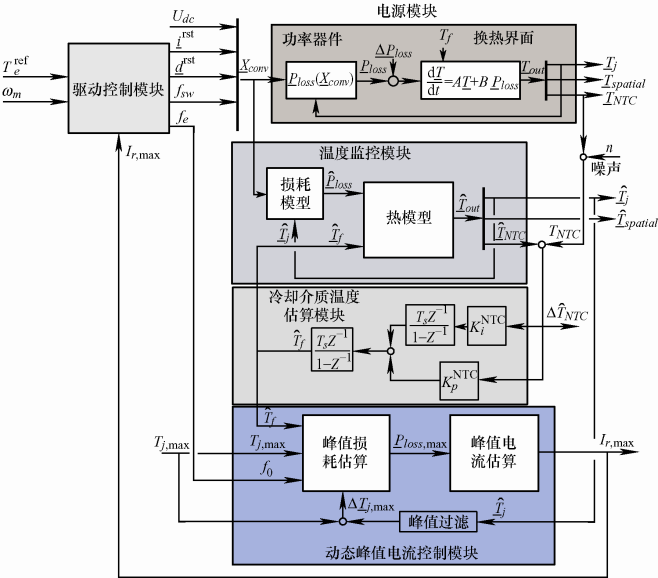
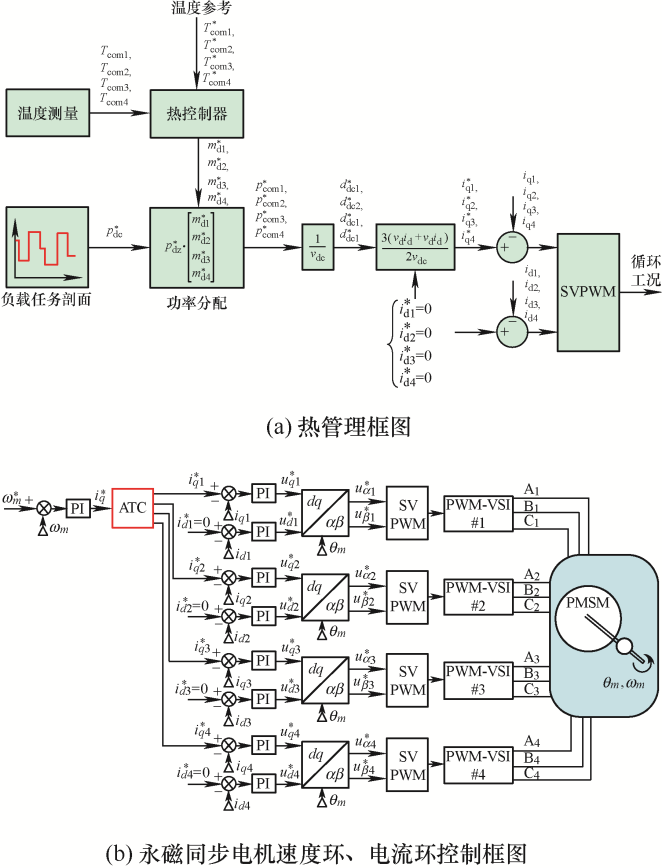
图7
4.2 冷却方法
由于永磁同步电机工作时内部热量与外界交换的主要形式是热对流和热传导,因此目前针对永磁同步电机的冷却方法总体上可分为对流换热冷却和增强传热冷却两大类。二者都是利用热力学原理加快电机与环境间的换热效率,从而允许电机提高工作电流和输出转矩,实现提高效率和功率密度的目标。
4.2.1 对流换热冷却
对流换热根据流体的物态分为风冷和液冷,风冷的冷却流体是空气,根据冷却方法及作用部位将其分为自然对流换热、强制对流换热两种,其中自然对流换热通常发生在电机外表面和自然空气之间,强制对流换热通常发生在电机内部诸如气隙之类的部位,气流冲击换热在电机内外部均可使用。
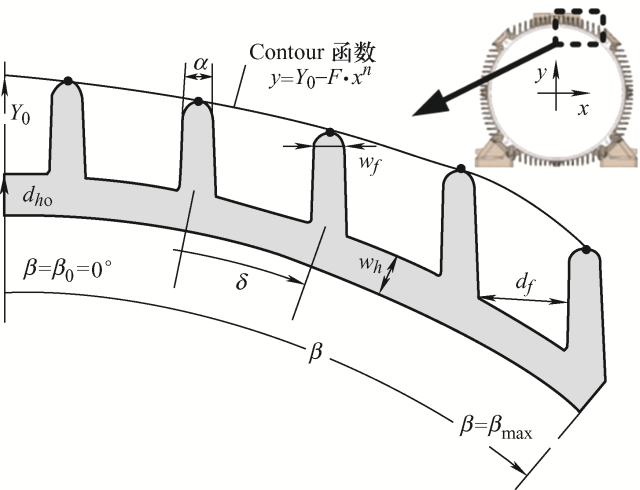
对于自然对流换热,常见的增强方法是在电动机外壳添加散热鳍,这样可以增大电机外壳和空气的接触面积,试验证明翅片几何形状越大,翅片间距越小,翅片阵列中的气流速度越高,冷却性能越好[80],如何确定散热鳍数量及几何尺寸是该领域的一个重要研究方向。ULBRICH等[81]通过建模分析某特定型号电机散热鳍数量从6增加到9时,电机换热能力得到提升,但是当数量进一步提升到10之后,换热能力没有出现明显提升。KIMOTHO 等[82]通过分析发现散热鳍的取向对于电机自然对流换热没有明显影响。PENG等[83]发现随着散热鳍节距比、高度、厚度的增加,绕组温度会降低,其中鳍片节距比对温度下降影响最大。图8为电动机机壳散热鳍局部放大图,展现其结构特性。
图8
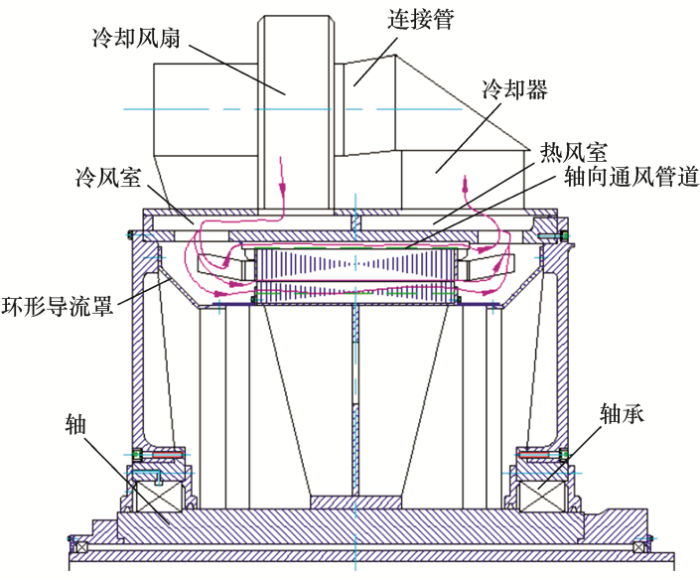
强制对流换热是指在电机内部较为狭小的空间内,空气自然流动基本停滞,难以实现点电机换热需求[84]。因此通常情况下需要在电机端部添加风扇,强迫电机内部空气流动。因此如何确定风扇结构以及如何对电机风扇进行优化处理成为该领域的一个重要研究方向[85-86]。TONG等[87]采用外置风扇对1.65 MW永磁同步电机定子铁心、定子绕组和永磁体进行轴向强制对流换热。RUUSKANEN等[88]应用二维有限元法分析永磁同步电机径向强制对流换热的冷却性能。LI等[89]提出一种混合转子通风系统,该系统相比于传统强制对流系统能够使测试电机铁心温度下降17%。WEN等[90]在传统强制对流换热系统的基础上在流体通路添加导流板,消除涡流能量损失,使得测试电机内部平均温度降低3.3 ℃。图9为以空气作为冷却介质的强制对流换热的原理图,由冷却风扇(Cooling fan)提供冷却空气流动动力,冷却介质经由轴向通风管道(Axial ventilation duct)吸收电机构件在工作中散发的热量。
图9
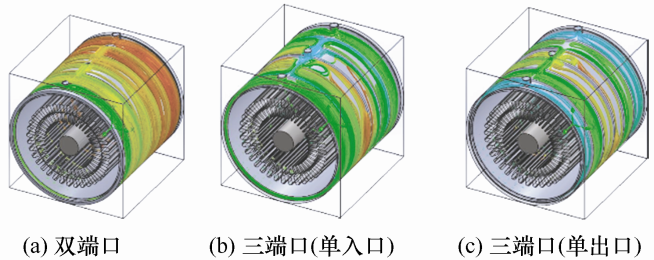
大量试验证明受限于空气自身物理性质,空冷仅适用于功率密度不高的商用永磁电机,对于功率密度大的永磁同步电机,更多使用液冷进行对流换热[27]。永磁同步电机常用的液冷方式有液体夹套冷却、喷雾冷却等。
图10
4.2.2 增强传热冷却
目前大多数电机定转子铁心仍由硅钢片堆叠制成,为了规避铁损,往往造成定转子轴向热阻高,导热性能差,因此除加强电机对流换热之外,还需要加强电机的热传导性能。增强电机热传导性能通常从填充材料、导热器、热管及相变材料三个维度进行优化。
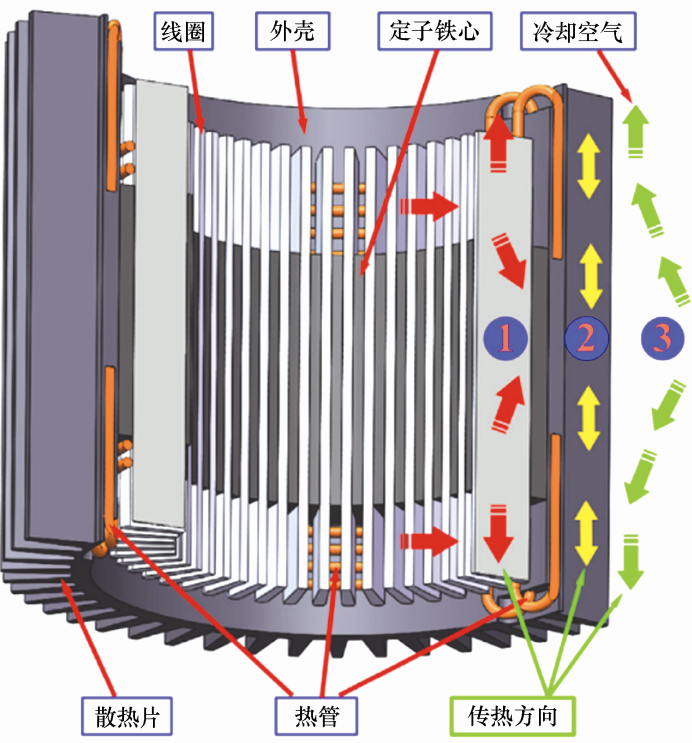
导热板常用于绕组槽内换热,GALEA等[96]在绕组槽空隙间添加导热板,增强绕组与定子间的热传导,使得绕组温度降低40%。WROBEL等[97]改进传统导热板制造方法,改用增材方法,使测试电机绕组到定子的热导率提升55%。VANSOMPEL 等[98]通过延伸导热板包裹端部绕组,增大端部绕组和电机外壳接触面积,使端部绕组承受工作电流上限提高40%。图11展示了导热板的结构特性及安装位置。热管通常情况下需要搭配水、乙醇等相变材料进行使用,通过热管内的相变材料在电机内部高低温区域间反复相变进行换热实现热管理。FANG等[99]通过对比外壳直嵌和三维圆角两种不同模式热管对于电机热传导的影响,对比分析显示两种方式均可以提升电机在极限状态下运转的时间,前者提升28.6%,后者提升21.4%。CHAI等[100]比较了绕组槽内不同位置布置热管对电机温升的影响,研究发现将热管置于槽中央部位使得测试电机绕组温度降低5 ℃。通过比较自然冷却和热管冷却,还验证了热管冷却的电机寿命比自然冷却延长66.7%。图12展示了热管(Heat pipe)在电机内部的分布位置及其工作原理。
图11
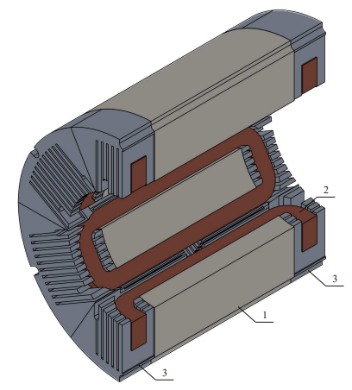
图12
5 总结与展望
尽管国内外学者已经在永磁同步电机热管理领域提出了多种方法和开发了多种技术,但由于永磁同步电机系统高功率密度、高集成度和高动态性能的发展趋势,热管理技术仍然面临多重挑战。本节将总结这些挑战,并展望未来的发展方向。
首先,针对电机热模型的建立,需要更加完善相关参数的计算精度。目前,绕组等效导热系数和端部绕组发热量等参数的计算仍依赖经验系数,这可能导致电机温度场的估算出现误差。未来的研究可以集中在开发更准确的热模型,通过试验数据和仿真来验证模型的准确性,以提高电机热管理的可预测性和效率。
其次,电机的冷却涉及多个学科领域,包括电力、机械、液压和材料工程等。工程师需要综合考虑各个方面对冷却装置性能的影响,这增加了技术温度分布的复杂性。未来的研究可以促进多学科交叉合作,以开发更智能化的冷却系统,提高冷却效率并减少功耗。这可以涉及新材料的应用,提高热传导效率,以及更高效的冷却介质的研究。
第三,随着永磁同步电机系统集成度的日益提升,开发人员需要更多考虑整体系统对电机热管理的影响。这包括系统级的控制策略,以确保电机在不同工况下的稳定运行,同时最大程度地减少热量的积累。未来的发展方向应该聚焦于整体系统优化,以更好地满足电机系统性能和热管理的需求。
最后,为提高能源利用率,应尽量综合利用电机所产生的热量,而不是仅仅将其耗散掉。热再利用技术可以包括热能回收系统,将废热用于其他用途,如加热或制冷,有助于减少能源浪费,提高系统的整体效率。
综上所述,尽管永磁同步电机热管理领域仍然面临挑战,但通过改进热模型的准确性、跨学科合作、整体系统优化和热能回收等方面的努力,我们可以期待未来更高效、可持续和智能化的永磁同步电机热管理技术的发展。这将有助于推动电机系统在各种应用中的性能和可靠性提升。
参考文献
Thorough state-of-the-art analysis of electric and hybrid vehicle powertrains:Topologies and integrated energy management strategies
[J].DOI:10.1016/j.rser.2019.109596 URL [本文引用: 1]
The cultural barriers to a low-carbon future:A review of six mobility and energy transitions across 28 countries
[J].DOI:10.1016/j.rser.2019.109569 URL [本文引用: 1]
Empirical evaluation of exponentially weighted moving averages for simple linear thermal modeling of permanent magnet synchronous machines
[C]//
Thermal management of electrified propulsion system for low-carbon vehicles
[J].
DOI:10.1007/s42154-020-00124-y
[本文引用: 1]

An overview of current thermal challenges in transport electrification is introduced in order to underpin the research developments and trends of recent thermal management techniques. Currently, explorations of intelligent thermal management and control strategies prevail among car manufacturers in the context of climate change and global warming impacts. Therefore, major cutting-edge systematic approaches in electrified powertrain are summarized in the first place. In particular, the important role of heating, ventilation and air-condition system (HVAC) is emphasised. The trends in developing efficient HVAC system for future electrified powertrain are analysed. Then electric machine efficiency is under spotlight which could be improved by introducing new thermal management techniques and strengthening the efforts of driveline integrations. The demanded integration efforts are expected to provide better value per volume, or more power output/torque per unit with smaller form factor. Driven by demands, major thermal issues of high-power density machines are raised including the comprehensive understanding of thermal path, and multiphysics challenges are addressed whilst embedding power electronic semiconductors, non-isotropic electromagnetic materials and thermal insulation materials. Last but not least, the present review has listed several typical cooling techniques such as liquid cooling jacket, impingement/spray cooling and immersion cooling that could be applied to facilitate the development of integrated electric machine, and a mechanic-electric-thermal holistic approach is suggested at early design phase. Conclusively, a brief summary of the emerging new cooling techniques is presented and the keys to a successful integration are concluded.
Enhancement of electric motor thermal management through axial cooling methods:A materials approach
[C]//
Active thermal control for modular power converters in multi-phase permanent magnet synchronous motor drive system
[J].DOI:10.1109/Access.6287639 URL [本文引用: 3]
Water cooling,PSG,PCM,Cryogenic cooling strategies and thermal analysis (experimental and analytical) of a permanent magnet synchronous motor:A review
[J].DOI:10.1007/s12046-021-01650-z [本文引用: 1]
Methods of resistance estimation in permanent magnet synchronous motors for real-time thermal management
[J].DOI:10.1109/TEC.2010.2051811 URL [本文引用: 1]
A practical thermal model for the estimation of permanent magnet and stator winding temperatures
[J].DOI:10.1109/TPEL.2013.2253128 URL [本文引用: 1]
A general model of the laminated steel losses in electric motors with PWM voltage supply
[C]//
Iron-loss modeling for rotating machines:Comparison between Bertotti’s three-term expression and 3-D Eddy-current analysis
[J].DOI:10.1109/TMAG.2010.2044384 URL [本文引用: 1]
Calculation of iron loss in rotating machines by direct consideration of eddy currents in electrical steel sheets
[J].DOI:10.1002/eej.v176.3 URL [本文引用: 1]
Electrical machine iron loss predictions:A unique engineering approach utilizing transient finite element methods - Part 1:Theory and calculation method
[C]//
Influence of sleeve thickness and various structures on eddy current losses of rotor parts and temperature field in surface mounted permanent-magnet synchronous motor
[J].DOI:10.1049/elp2.v12.8 URL [本文引用: 1]
磁钢充磁方式对高速永磁电机性能的影响研究
[J].
Effect of magnetic magnetizing method on the performance of high speed permanent magnet motor
[J].
Analysis and design of a 300-W 500 000-r/min slotless self-bearing permanent-magnet motor
[J].DOI:10.1109/TIE.2013.2284159 URL [本文引用: 1]
Multiphysics design and optimization of high-speed permanent-magnet electrical machines for air blower applications
[J].DOI:10.1109/TIE.2016.2518121 URL [本文引用: 1]
Numerical and experimental modelling of gas flow and heat transfer in the air gap of an electric machine
[J].DOI:10.1007/s11630-004-0041-4 URL [本文引用: 1]
A new stray-load loss formula for small and medium-sized induction motors
[J].DOI:10.1109/TEC.2016.2539959 URL [本文引用: 2]
Energy-efficient cooperative spectrum sensing:A survey
[J].
A flux barrier cooling for traction motors in hybrid drives
[C]//
Analysis of power loss of permanent magnet synchronous motors in more-electric-aircraft considering the impact of temperature
[C]//
Thermal analysis of a PMaSRM using partial FEA and lumped parameter modeling
[J].DOI:10.1109/TEC.2012.2188295 URL [本文引用: 1]
A critical review on thermal management technologies for motors in electric cars
[J].DOI:10.1016/j.applthermaleng.2021.117758 URL [本文引用: 2]
Reliability assessment of the switched reluctance motor drive under single switch chopping strategy
[J].DOI:10.1109/TPEL.2015.2429557 URL [本文引用: 2]
Equivalent magnetic circuit method of estimating iron losses in induction motor spindles
[J].
DOI:10.1038/s41598-022-13055-x
PMID:35681068
[本文引用: 2]
The iron losses in the motor of motorized spindles have a significant effect on their heat generation, thermal deformation, and machining accuracy. The equivalent magnetic circuit (EMC) method for estimating iron losses in the spindle motor is proposed, where the magnetic flux density distribution of any cross section inside the spindle motor is assumed as a uniform one. A mechanical loss separation method of no load running combined with a sudden loss of power supply is also proposed. The EMC method is verified by prototype experiment and a different analysis method comparison. The EMC does not need to solve complex electromagnetic fields, and to do 2D or 3D eddy current analysis and the corresponding post-processing. There is only need to perform a simple magnetic circuit calculation. Therefore, it can realize a fast analysis and prediction. The proposed mechanical loss separation method requires only one prototype during a whole testing process. There is no need for any other same prototype and a coupling device. It is simpler, and can eliminate the braking torque and electromagnetic losses of the spindle motor.© 2022. The Author(s).
CFD analyses of a radial fan for electric motor cooling
[J].DOI:10.1016/j.tsep.2018.10.003 URL [本文引用: 1]
Improved cooling performance of large motors using fans
[J].DOI:10.1109/TEC.2006.874245 URL [本文引用: 2]
A combined electromagnetic and thermal analysis of induction motors
[J].DOI:10.1109/TMAG.2005.845044 URL [本文引用: 1]
Direct oil cooling of traction motors in hybrid drives
[C]//
Review on thermal behavior and cooling aspects of axial flux permanent magnet motors:A mechanical approach
[J].DOI:10.1109/ACCESS.2023.3235782 URL [本文引用: 2]
Coupled 3-D thermal and electromagnetic modelling of a liquid-cooled transverse flux traction motor
[C]//2018 XIII International Conference on Electrical Machines (ICEM).
Thermal analysis of induction motor with forced cooling channels
[J].DOI:10.1109/20.877700 URL [本文引用: 1]
Thermal modeling of “direct lamination cooling (DLC)” induction motor for hybrid electric vehicle applications
[C]//
TEFC induction motors thermal models:A parameter sensitivity analysis
[C]//
Thermal analysis of transverse flux linear switched reluctance motor based on lumped parameter thermal network method
[C]//
Thermal management of a formula E electric motor:Analysis and optimization
[J].DOI:10.1016/j.applthermaleng.2019.113733 URL [本文引用: 1]
Thermal modeling of flux-switching permanent-magnet machines considering anisotropic conductivity and thermal contact resistance
[J].DOI:10.1109/TIE.2016.2522942 URL [本文引用: 1]
Active thermal management for interior permanent magnet synchronous machine (IPMSM) drives based on model predictive control
[J].DOI:10.1109/TIA.2018.2843350 URL [本文引用: 2]
Global identification of a low-order lumped-parameter thermal network for permanent magnet synchronous motors
[J].DOI:10.1109/TEC.2015.2473673 URL [本文引用: 1]
Lumped parameter thermal model for axial flux surface mounted permanent magnet BLDC machine
[J].DOI:10.1016/j.matpr.2017.11.054 URL [本文引用: 1]
Transient thermal analysis using both lumped-circuit approach and finite element method of a permanent magnet traction motor
[C]//
Thermal modeling of an induction machine through the association of two numerical approaches
[J].DOI:10.1109/TEC.2005.859964 URL [本文引用: 1]
Transient thermal modeling and analysis of railway traction motors
[J].DOI:10.1109/TIE.41 URL [本文引用: 1]
Electric vehicle driver clustering using statistical model and machine learning
[C]//2018 IEEE Power & Energy Society General Meeting (PESGM). Portland,
Controlling the charging of electric vehicles with neural networks
[C]//
A general method to predict the performance of closed pulsating heat pipe by artificial neural network
[J].DOI:10.1016/j.applthermaleng.2019.113761 URL [本文引用: 1]
A numerical approach to the testing of the fission hypothesis
[J].DOI:10.1086/112164 URL [本文引用: 1]
Smoothed particle hydrodynamics simulations of flow separation at bends
[J].DOI:10.1016/j.compfluid.2013.11.019 URL [本文引用: 1]
油水复合冷却下永磁同步电机温升特性
[J].
Temperature rise characteristics of a permanent magnet synchronous motor under oil-water compound cooling
[J].
Solving the more difficult aspects of electric motor thermal analysis
[C]//
Thermal analysis of radial-flux electrical machines with a high power density
[J].DOI:10.1109/TIE.2008.927403 URL [本文引用: 1]
A review of structural and thermal analysis of traction motors
[J].DOI:10.1109/TTE.2015.2476478 URL [本文引用: 1]
A systematic experimental approach in deriving stator-winding heat transfer
[C]//2017 IEEE International Electric Machines and Drives Conference (IEMDC). Miami,FL,
Determination of critical parameters in electrical machine thermal models
[J].DOI:10.1109/TIA.2008.926233 URL [本文引用: 1]
Thermal modeling and analysis of active and end windings of enclosed permanent-magnet synchronous in-wheel motor based on multi-block method
[J].DOI:10.1109/TEC.60 URL [本文引用: 1]
Winding temperature field model considering void ratio and temperature rise of a permanent-magnet synchronous motor with high current density
[J].DOI:10.1109/TIE.2016.2625242 URL [本文引用: 1]
Thermal model with winding homogenization and fit discretization for stator slot
[J].DOI:10.1109/TMAG.2011.2159013 URL [本文引用: 1]
Comparative study of thermal properties of electrical windings impregnated with alternative varnish materials
[J].DOI:10.1049/tje2.v2019.17 URL [本文引用: 1]
Grey relational based Taguchi analysis on heat transfer performances of direct oil spray cooling system for electric vehicle driving motor
[J].DOI:10.1016/j.ijheatmasstransfer.2022.123596 URL [本文引用: 1]
Thermal analysis of totally enclosed fan cooled synchronous reluctance motor-state of art
[C]//
Taylor-Couette flow and transient heat transfer inside the annulus air-gap of rotating electrical machines
[J].DOI:10.1016/j.apenergy.2017.07.011 URL [本文引用: 1]
Air-gap convection in a switched reluctance machine
[C]//
Measurements of diabatic flow in an annulus with an inner rotating cylinder
[J].
DOI:10.1115/1.3684335
URL
[本文引用: 1]
The present paper is part of the second phase of an investigation of the phenomena and variables which control the rate of heat transfer in the air gap of a rotating electrical machine. Experimental data for diabatic flow in an annulus are summarized and compared with the results of previous studies. The data are examined in terms of the types of flow processes occurring in an annulus, and it is found that the results for diabatic flow clearly confirm those obtained for adiabatic flow in showing the existence of three, and possibly four, modes of flow in this annulus. These modes are: (1) Laminar flow; (2) laminar-plus-Taylor-vortexes flow; (3) turbulent flow; (4) turbulent-plus-vortexes flow. The heat-transfer data were subdivided into the following two limiting cases and one general case: Case A. Axial flow with zero rotation. Case B. Rotation of inner cylinder with zero axial flow. Case C. General case of combined axial flow and rotation. The heat-transfer data from this study and of previous investigations were correlated in terms of Reynolds number and Taylor number over a wide range of these variables in terms of fairly simple equations. Radial temperature profiles in the annular gap were measured for the diabatic flow and aided in the understanding of the different flow phenomena in the annulus with an inner rotating cylinder.
Convection heat transfer and flow calculations suitable for electric machines thermal models
[J].DOI:10.1109/TIE.2008.922604 URL [本文引用: 1]
A review of heat transfer between concentric rotating cylinders with or without axial flow
[J].DOI:10.1016/j.ijthermalsci.2011.02.013 URL [本文引用: 1]
Air-gap convection in rotating electrical machines
[J].DOI:10.1109/TIE.2010.2100337 URL [本文引用: 1]
Three-D numerical thermal analysis of electric motor with cooling jacket
[J].
DOI:10.3390/en11010092
URL
[本文引用: 3]
The need of a sustainable clean future has paved the way for environmental friendly electric vehicle technology. In electric vehicles, overloading is limited by the maximum temperature rise in the electric motor. Although an improved cooling jacket design is of vital importance in lowering the maximum temperature of the motor, there has not been as much study in the thermal analysis of motors compared to electromagnetic design studies. In this study, a three-dimensional steady state numerical method is used to investigate the performance of a cooling jacket using water as the primary coolant of a three-phase induction motor with special emphasis on the maximum temperature and the required pumping power. The effective thermal conductivity approach is employed to model the stator winding, stator yoke, rotor winding and rotor yoke. Heat transfer by induced air is treated as forced convection at the motor ends and effective conductivity is obtained for air in the stator-rotor gap. Motor power losses, i.e., copper and iron losses, are treated as heat generation sources. The effect of bearings and end windings is not considered in the current model. Pressure and temperature distributions under various coolant flow rates, number of flow passes and different cooling jacket configurations are obtained. The study is successful in identifying the hot spots and understanding the critical parameters that affect the temperature profile. The cooling jacket configuration affects the region of maximum temperature inside the motor. Increasing the number of flow passes and coolant flow rate decreases maximum motor temperature but results in an increase in the pumping power. Of the cooling jacket configurations and operating conditions investigated, a cooling jacket with six passes at a flow rate of 10 LPM with two-port configuration was found to be optimal for a 90-kW induction motor for safe operation at the maximum output.
Maximum torque per ampere (MTPA) control for interior permanent magnet synchronous machine drives based on virtual signal injection
[J].DOI:10.1109/TPEL.2014.2365814 URL [本文引用: 1]
Extension of virtual-signal-injection- based MTPA control for interior permanent-magnet synchronous machine drives into the field-weakening region
[J].DOI:10.1109/TIE.2015.2438772 URL [本文引用: 1]
A low-order thermal model for monitoring critical temperatures in permanent magnet synchronous motors
[C]//
Increasing torque capability of ac drives via active thermal management of inverters
[J].DOI:10.1109/TIA.2021.3103812 URL [本文引用: 1]
Reliability of power electronic systems:An industry perspective
[J].DOI:10.1109/MIE.2018.2825481 URL [本文引用: 1]
Prediction and validation of wear-out reliability metrics for power semiconductor devices with mission profiles in motor drive application
[J].DOI:10.1109/TPEL.63 URL [本文引用: 1]
Thermal management for motor
[C]//
Cooling fin optimization on a tefc electrical machine housing using a 2-D conjugate heat transfer model
[J].DOI:10.1109/TIE.2017.2748051 URL [本文引用: 2]
Thermal management of electric vehicle BLDC motor
[C]//
Investigation of parameters affecting heat transfer and fluid flow of a TEFC electric motor by using Taguchi method
[J].DOI:10.1088/1757-899X/491/1/012021 URL [本文引用: 1]
Thermal nexus model for the thermal characteristic analysis of an open-type air-cooled induction motor
[J].DOI:10.1016/j.applthermaleng.2016.10.197 URL [本文引用: 1]
Comparison of different cooling fan designs for electric motors
[C]//2017 IEEE International Electric Machines and Drives Conference (IEMDC). Miami,FL,
Piezoelectric fan cooling:A novel high reliability electric machine thermal management solution
[J].DOI:10.1109/TIE.2012.2224081 URL [本文引用: 1]
Totally enclosed self-circulation axial ventilation system design and thermal analysis of a 1.65-MW direct-drive PMSM
[J].DOI:10.1109/TIE.2018.2823698 URL [本文引用: 2]
Effect of lamination stack ends and radial cooling channels on no-load voltage and inductances of permanent-magnet synchronous machines
[J].DOI:10.1109/TMAG.20 URL [本文引用: 1]
Thermal analysis of the solid rotor permanent magnet synchronous motors with air-cooled hybrid ventilation systems
[J].DOI:10.1109/TIE.2021.3057002 URL [本文引用: 1]
Numerical analysis of the external wind path for medium-size high-voltage asynchronous motors
[J].DOI:10.1016/j.applthermaleng.2015.07.065 URL [本文引用: 1]
Direct oil cooling of end-windings in torus-type axial-flux permanent-magnet machines
[J].DOI:10.1109/TIA.2021.3059811 URL [本文引用: 1]
Improved cooling in the end region of a strip-wound totally enclosed fan-cooled induction electric machine
[J].DOI:10.1109/TIE.2008.2003101 URL [本文引用: 1]
Integration principles and thermal analysis of an oil-cooled and -lubricated permanent magnet motor planetary gearbox drive system
[J].DOI:10.1109/Access.6287639 URL [本文引用: 1]
Applicability study of the potting material based thermal management strategy for permanent magnet synchronous motors
[J].DOI:10.1016/j.applthermaleng.2018.12.141 URL [本文引用: 1]
Application of potting material for a 100 kW radial flux PMSM
[C]//2014 International Conference on Electrical Machines (ICEM). Berlin,
A thermal improvement technique for the phase windings of electrical machines
[J].DOI:10.1109/TIA.2011.2175470 URL [本文引用: 1]
A feasibility study of additively manufactured heat guides for enhanced heat transfer in electrical machines
[J].DOI:10.1109/TIA.28 URL [本文引用: 1]
Extended end-winding cooling insert for high power density electric machines with concentrated windings
[J].DOI:10.1109/TEC.60 URL [本文引用: 2]
Thermal management integrated with three-dimensional heat pipes for air-cooled permanent magnet synchronous motor
[J].DOI:10.1016/j.applthermaleng.2019.02.120 URL [本文引用: 2]
Design and analysis of high torque density permanent magnet synchronous motor based on heat pipe
[C]//


