

1 引言
随着全球石油、煤炭等不可再生能源的大量消耗和环境污染,利用太阳能、风能等清洁能源发电的微电网技术应运而生。分布式电源(Distributed generation,DG)、储能装置、能量转换设备等组成了微电网,为多种类型的负荷提供了可靠供电。微电网可以连接在大电网运行,即并网,也可以脱离于电网单独运行,即孤岛运行模式,文献[1]以直流微电网为研究对象,提出一种基于独立与并网两种运行模式的无缝切换控制策略。
微电网孤岛运行时,针对频率、电压、功率等相关调节问题,会实施相应的控制策略。文献[2]针对含有多个虚拟同步发电机并联运行时的微电网系统频率动态响应差、能源利用率低等问题,提出一种基于参数自适应功率协调与频率优化控制策略。文献[3]为保证电力系统的安全稳定、经济运行,提出一种基于二次规划算法的精确功率分配方法。此外,由于孤岛运行的微电网失去与大电网的联系,基于传统的下垂控制难以保障系统的电能质量[4]。为了弥补由于下垂控制缺陷造成的系统频率、电压偏差问题,文献[5]提出了一种改进下垂控制的分层控制并建立了相应的调频模型,实现了频率的稳定。文献[6]提出一种电压频率控制策略,该方法通过改变负荷的需求功率来调节频率,从而达到稳定频率的目的。文献[7]根据二次调频理论来调整下垂曲线,维持系统的电压、频率在额定值。文献[8]提出一种基于电压的频率控制,降低了外部扰动对微电网频率的影响。
由于分布式电源运行特性的差异,尽量减少发电成本,即经济调度问题成为微电网领域关注的重点之一。传统的经济调度优化策略大多为集中式[9-10],对于中心控制有着较高要求,由此带来较多负面影响。分布式控制[11-12]可以改善集中式全局通信的缺陷,只需要局部通信,即可实现相应的优化控制。因此,作为典型分布式控制的一致性算法被大量应用于微电网的分布式经济调度策略中,文献[13]提出了基于分布式事件触发控制的微电网经济调度问题,通过获得最优的增量成本和最优的功率输出来解决经济调度问题。文献[14]采用分布式的一致性算法来获取局部信息,进一步地结合鞍点法解决经济调度问题。文献[15]在微电网三次层的经济调节器中嵌入基于增量成本一致性算法,用来搜索最佳解决方案。文献[16]采用牵引一致性算法计算每个分布式电源每个时段的最优功率,实现了微电网的分布式经济调度。
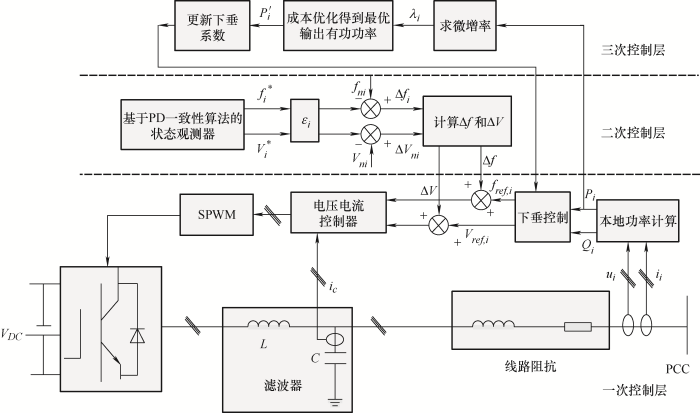
本文提出一种基于PD一致性算法的孤岛微电网分层优化控制策略,如图1所示。在二次层中,利用PD控制的一致性算法构造状态观测器,解决一次层频率、电压偏差问题。三次控制层,采用PD控制的一致性算法使分布式电源的微增率趋于一致状态,并求出每个分布式电源的最优发电功率值,最后通过调节下垂参数,使每个分布式电源的实际发电功率维持在最优值附近,同时该策略加快了系统响应。
图1
2 分布式一致性算法
2.1 微电网的图论描述
对于含有n个DG的微电网系统,可用无向图G={V,E}描述DGs间的通信拓扑结构。节点集V={v1,v2,…,vn}中每一个节点表示一个DGi;E为边集,其元素eij=(vi,vj)表示第i个DG和第j个DG,为图G的一条边。如果DGi和DGj可以相互通信,则两者彼此间可互称为邻居节点,对于节点i,它的邻居集可表示为Ni={j∈V | eij∈E}。邻接矩阵A=(aij)n×n用来判断两个节点是否为相邻节点,若是,元素aij=1,否则为0。度矩阵D=diag{d1,d2,…,dn},其中元素di表示含有节点vi的边数。拉普拉斯矩阵一般用来描述图G的通信结构,可由公式L=D-A得到。
2.2 基本一致性算法
由n个DG组成的微电网系统可看成由n个智能体构成的多智能体系统,第i个智能体的状态量由xi表示,该状态量可以是电压、频率和功率等。ui为控制变量,表示智能体i的状态输入,可表示为
控制输入表示为
联立式(1)和式(2),得到的基本一致性算法可写成
式中,x为状态向量,
2.3 基于PD一致性算法
考虑到PD控制器常用来改善系统的动态性能,具有加快系统响应的优点,因此,在基本一致性算法的基础上,加入PD控制的一致性算法,式(2)改为
相应地,系统的动态方程为
式中,η为PD反馈强度参数,若选取合适的η,在一定程度上可加快系统的动态响应,缩短系统状态达到一致的时间。
3 基于PD一致性算法的分层优化
3.1 一次控制层
微电网的一次控制层采用下垂控制,控制方程为
式中,
3.2 二次控制层
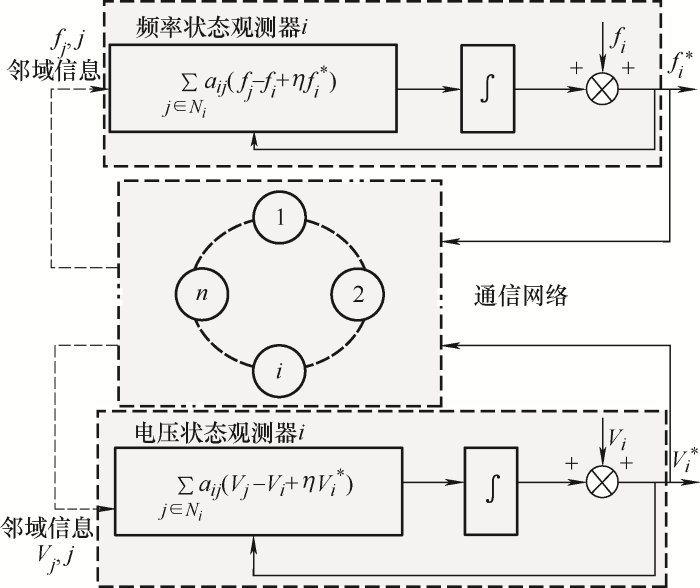
下垂控制虽然保持了系统电压、频率的稳定,但此类控制是一种典型的有差控制,因其固有特性,频率和电压会偏离于标称值。为了恢复偏差,在微电网的二次层中,应用基于PD一致性算法的状态观测器,实现动态补偿参考电压和参考频率的偏差值。首先通过PD一致性算法获取对应状态量的平均值,然后与其相应的额定值进行比较得到补偿量,其补偿量的计算过程为
式中,
由于每个智能体DG计算得到的频率补偿可能不同,这对于并联于微电网中的DG而言,补偿量不一致将导致无法协调运行。因此,整体补偿量按照所有DG补偿量的平均值求得
上述所述状态观测器如图2所示。
图2
3.3 三次控制层
微电网的三级控制层主要实现经济运行最优为目的,通过调节微电网中每一个DG的发电功率,使得整体的发电成本最少,这就涉及到DG最优发电功率问题。DG的发电成本函数是一个二次函数,表示为
式中,
三级控制层要实现的目标可表示为
同时需要满足
式中,
3.3.1 不考虑发电功率限制的成本优化
在解决发电功率最优化问题时,通常借用微增率λi(表示第i个DG的微增率),通过对二次成本函数求导得到
当所有的DG微增率相同时,总体成本最少。将
通过式(15)得到最终收敛值
可以得到最优微增率
3.3.2 考虑发电功率限制的成本优化
考虑到根据上述所得到的DG的最优功率可能会超过其自身的发电功率范围,因此,DG的发电功率需要限制于式(12),不在限制范围内的DG输出功率只能为限制范围的最大值或最小值。假设
设
此时,
由式(12)和式(17)得到
设定不在功率限制范围的发电功率部分由属于集合
由式(20)和式(21)可推导出不考虑功率限制条件下的最优微增率
考虑发电机发电功率限制条件下的最优发电功率值为
此时当
根据上述两种情况得到DG发电功率的最优值,基于其值调节相应的下垂参数,使各DG的实际输出功率为最优输出功率,总体成本达到最小。
4 仿真验证及分析
图3
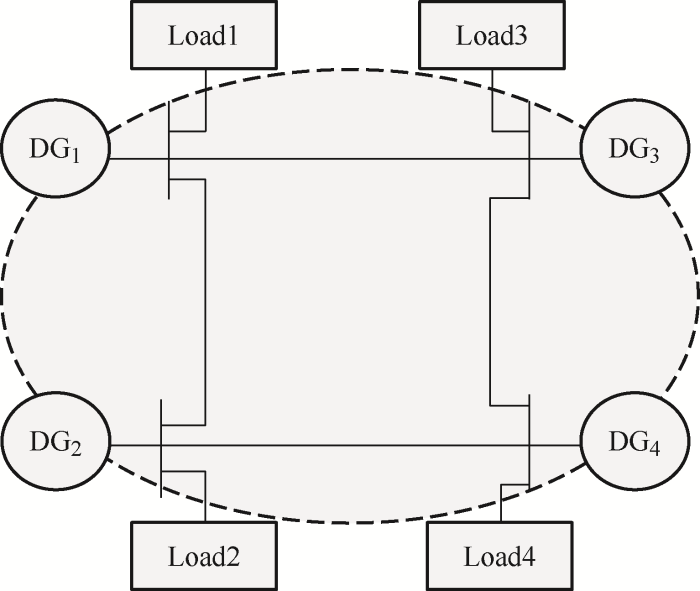
表1 各DG的成本系数
| DG | ai | bi | ci | Pi,min | Pi,max |
|---|---|---|---|---|---|
| DG1 | 0.032 | 0.828 | 21.68 | 0 | 30 |
| DG2 | 0.053 | 1.442 | 52.54 | 0 | 25 |
| DG3 | 0.062 | 1.086 | 38.15 | 0 | 25 |
| DG4 | 0.093 | 1.854 | 37.74 | 0 | 20 |
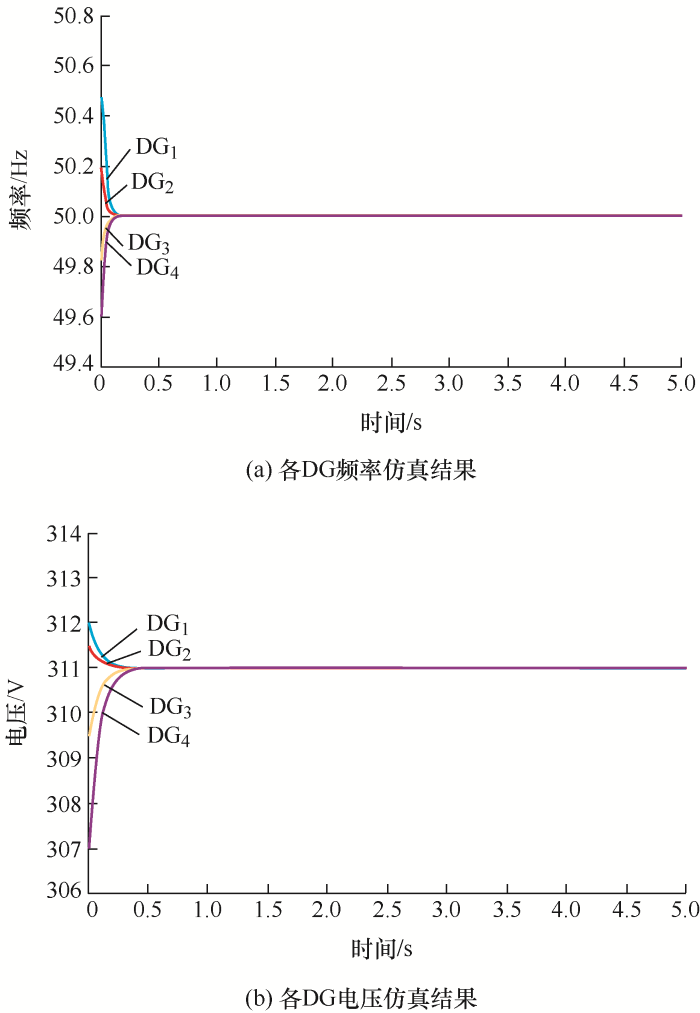
4.1 基于PD一致性算法状态观测器的有效性
图4
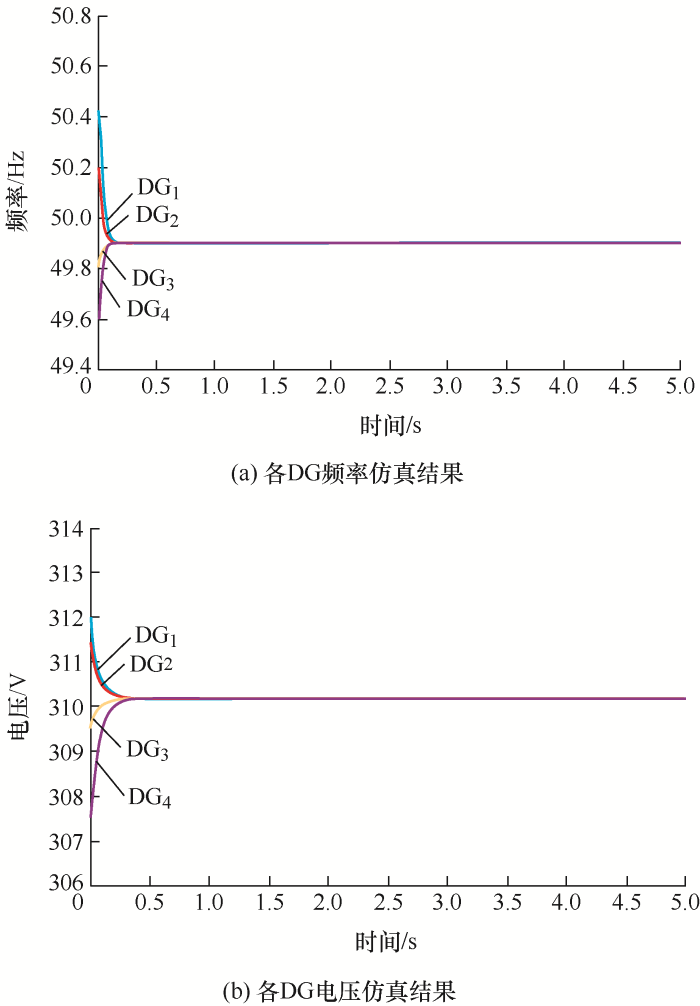
图5
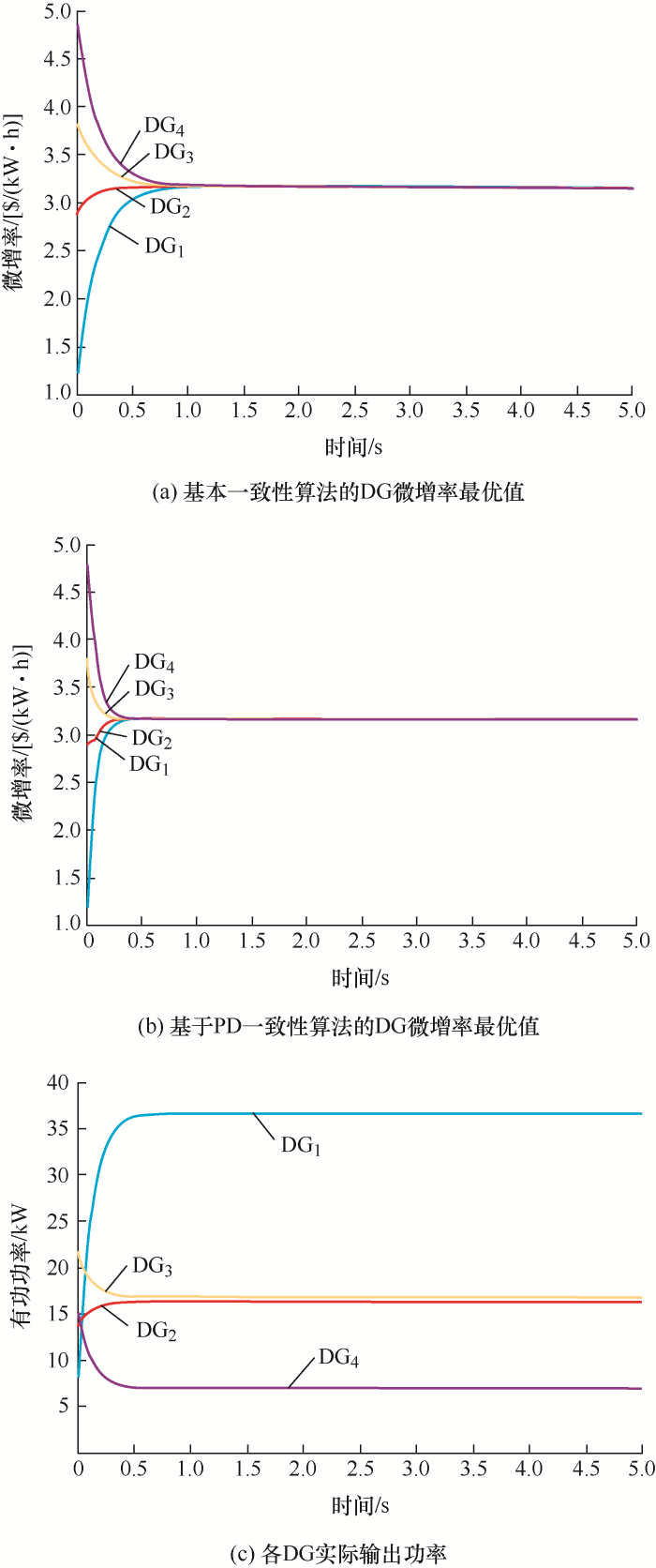
4.2 基于PD一致性算法的成本优化
图6
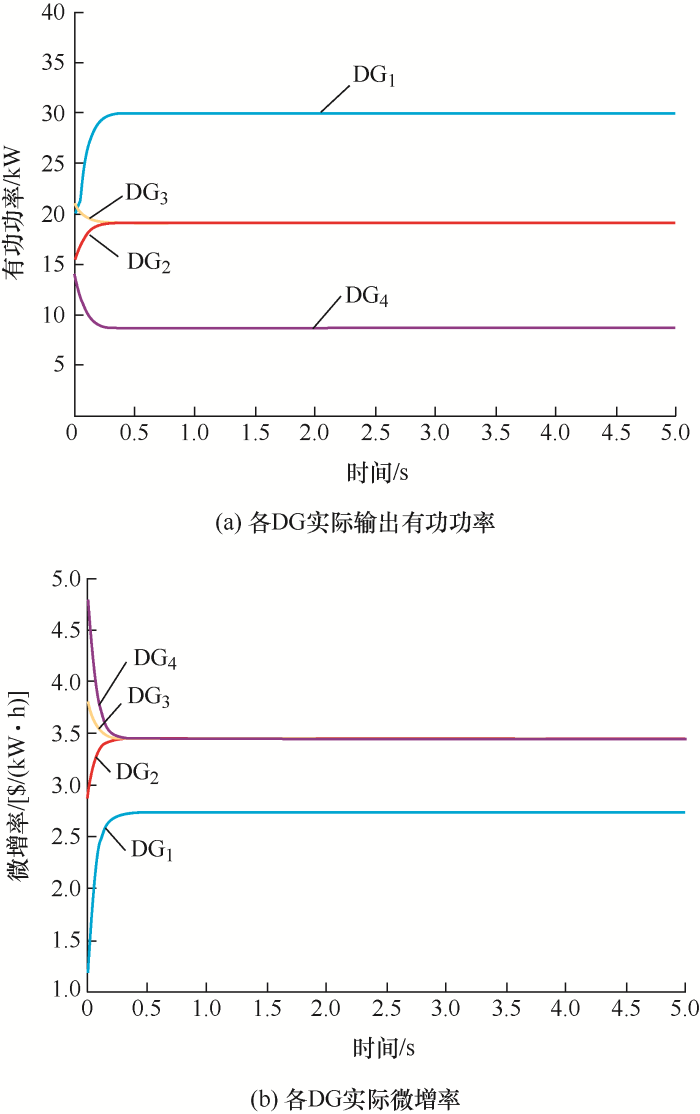
由于每个发电机在实际运行时,存在最大和最小发电功率的限制问题。注意到,DG1的最优发电功率为36.67 kW,超出了其自身发电的最大值30 kW,DG4只能以最大发电功率作为最优发电功率,并根据式(24)重新计算其最优微增率为2.748
图7
4.3 基于负荷波动及分布式电源切除接入时的微电网稳定性验证
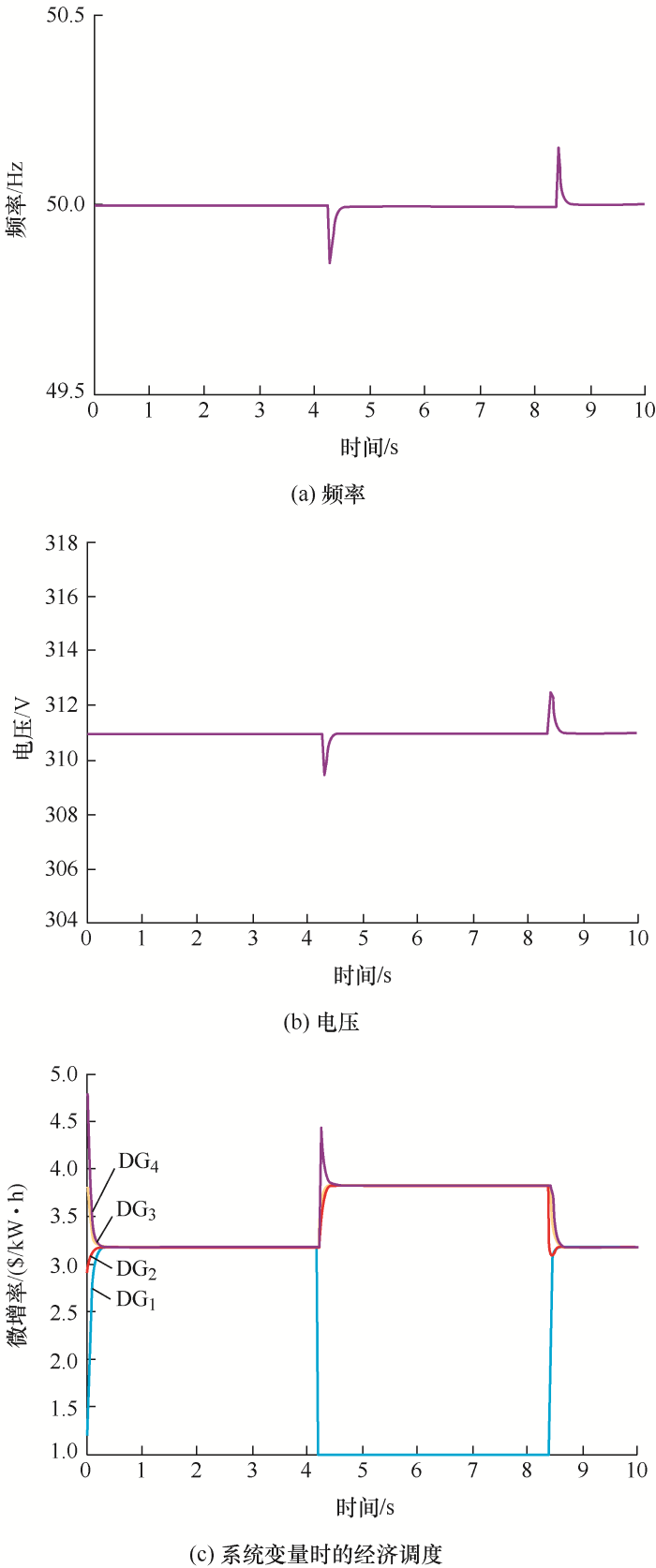
考虑到负荷的波动以及分布式电源发电的“波动性”和“间歇性”均会对微电网的稳定运行产生影响,为了验证本算法在上述情况下,系统仍能维持稳定运行状态。设定t=2~7 s,模拟负荷波动,t=2 s时,突然增加负荷,t=7 s时将增加的负荷切除,如图8a所示,负荷的突然增加或减少会导致系统总的有功功率增加和减少,图8b和图8c表明负荷的波动会导致微电网系统频率和电压发生波动。仿真结果显示采用本文提出的二次控制算法能快速抑制负荷波动产生的影响,维持系统频率、电压的稳定。为了模拟分布式电源发电的“波动性”和“间歇性”,设定在t=4.2 s时,DG1退出系统运行,在t=8.4 s时DG1重新投入运行并参与经济调度,如图9a和图9b所示,分布式电源的切除及接入同样会影响系统频率和电压稳定,由于分布式控制的作用,系统的频率、电压偏差能快速得到恢复。图9c显示在DG1退出后,系统可达到新的一致性稳定运行状态,当DG1重新参与经济调度,微电网系统又能恢复原有的稳定运行状态。
图8
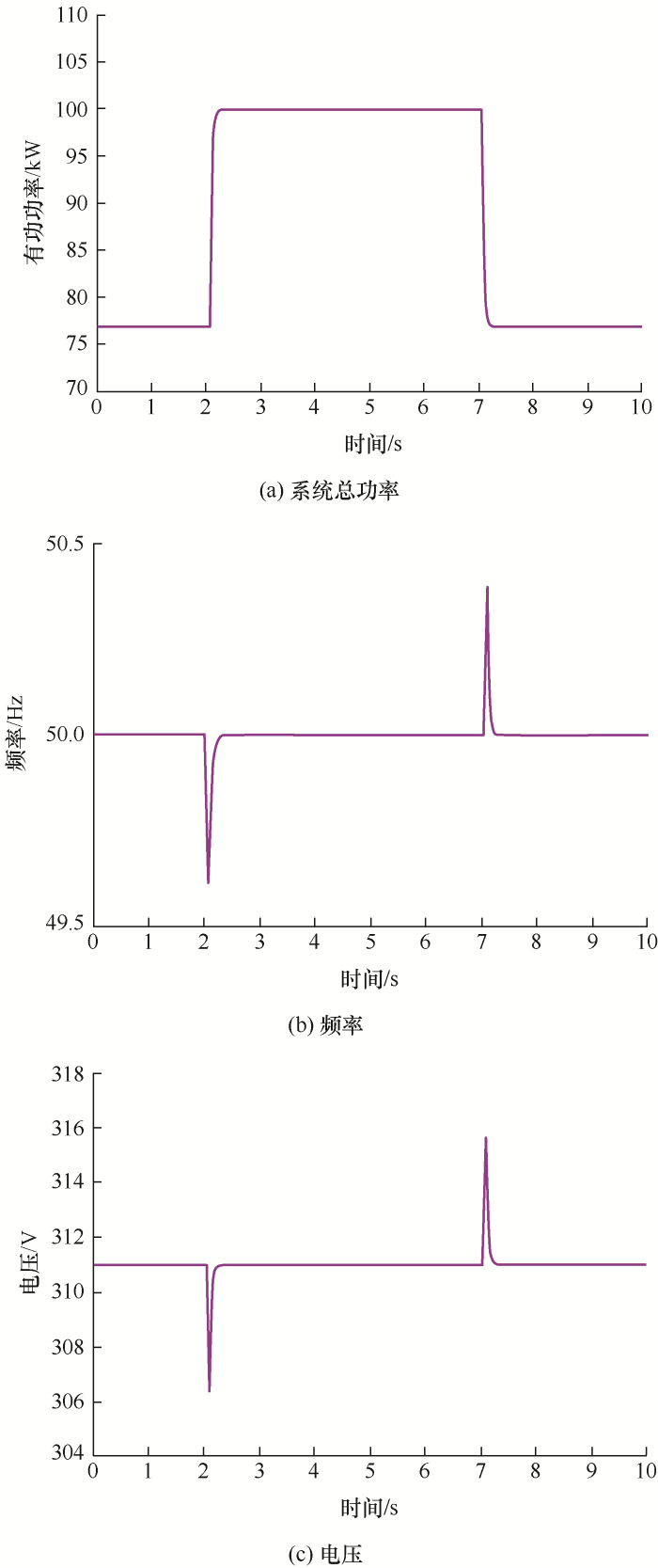
图9
5 结论
针对独立型微电网,本文提出了一种基于PD一致性算法的微电网分层优化控制策略,结论如下所述。
(1) 采用PD控制的一致性算法在一定程度上能够加快系统响应。
(2) 将PD一致性算法运用于微电网的二级、三级控制层中,实现了系统频率、电压偏差的恢复,同时在考虑分布式电源的发电限制问题下,实现了系统的经济运行。
(3) 在负荷波动以及分布式电源特殊发电特性下,本文所提算法仍能保持微电网的可靠运行。
参考文献
直流微电网独立与并网模式无缝切换控制策略
[J].
DOI:10.13234/j.issn.2095-2805.2020.6.77
[本文引用: 1]

独立与并网工作模式无缝切换是直流微电网的重要研究问题。为了解决这一问题,提出了一种基于大电网电压检测和储能双向DC/DC变换器多控制环调度的切换策略,该策略根据同步参考坐标系-锁相环SRF-PLL(synchronous reference frame-phase locked loop)检测的交流电压对DC/DC控制环路进行调度,在不同的运行状态下启动不同的控制环路,调整储能双向DC/DC变换器的功率流向与控制对象,实现微电网运行模式的无缝切换。在建立SRF-PLL和双向DC/DC变换器的s域小信号模型并设计不同控制环路补偿器的基础上,搭建了直流微电网的仿真平台,实现了所提出的无缝切换控制策略。在搭建的仿真平台上,对储能双向变换器不同能量流向条件下的模式切换进行了研究。仿真结果表明,所提控制策略具有良好的稳态和暂态性能,可以满足直流微电网独立与并网模式无缝切换的控制要求。
Control strategy of seamless switching between stand-alone and grid-connected modes of DC microgrid
[J].
DOI:10.13234/j.issn.2095-2805.2020.6.77
[本文引用: 1]
The seamless switching between the stand-alone and grid-connected modes of DC microgrid is an important research issue. To solve this problem, a switching strategy based on large grid voltage sensing and the dispatching of multiple control loops of an energy-storage bidirectional DC/DC converter was proposed in this paper. According to the AC voltage sensed by the synchronous reference frame-phase locked loop (SRF-PLL), this strategy dispatches the DC/DC control loop, starts different control loops in different operation states, and adjusts the direction of power flow in the converter and the control object, thus realizing seamless switching between different operation modes of microgrid. On the basis of building an s-domain small-signal model of the SRF-PLL and the bidirectional DC/DC converter and designing different control loop compensators, a simulation platform for DC microgrid is established, thereby realizing the proposed seamless switching control strategy. On this platform, the switching between different modes of the converter under different energy flow directions is studied, and simulation results show that the proposed control strategy has good performance in both the steady and transient states, which can satisfy the control requirements of seamless switching between stand-alone and grid-connected modes of DC microgrid.
含多光储VSG单元孤岛微网参数自适应功率协调与频率优化控制
[J].
DOI:10.13234/j.issn.2095-2805.2020.6.20
[本文引用: 1]
虚拟同步发电机VSG(virtual synchronous generator)技术因能增加惯性、改善系统稳定性而在分布式发电和微网等领域愈发受到关注。但VSG逆变器并联运行时,通常忽略直流侧分布式电源特性,且参数大多固定不变,不能保证最大限度利用可再生能源,且系统频率动态响应较差。针对这一问题,提出了适用于含多光储VSG单元孤岛微网的参数自适应功率协调与频率优化控制策略。综合考虑系统负荷需求、光伏单元出力情况以及系统频率变化,自适应调节转动惯量、阻尼系数和虚拟电感等参数,确保系统各单元间功率有效分配,避免了光伏利用不充分、逆变器过载及系统交直流侧功率变动引起的频率骤变等不良影响,系统频率动态调节特性也可改善。最后,基于RT-LAB搭建了含3组光储VSG单元的孤岛微网实时仿真平台,对多工况下仿真结果进行分析与对比,验证了所述控制方法的正确性及有效性。
Parameter adaptive power coordination and frequency optimization of islanded microgrid with PV/battery VSG units
[J].
DOI:10.13234/j.issn.2095-2805.2020.6.20
[本文引用: 1]
Owing to the increased inertia and enhanced system stability, the virtual synchronous generator (VSG) technology has attracted growing attention in the fields including distributed generation (DG) and microgrid systems. How-ever, when the VSG-controlled inverter is under parallel operation, the characteristics of DC-side DGs are usually ignored, and the VSG parameters are mostly designed as fixed values, resulting in the lower utilization of renewable energies and poor dynamic response of system frequency. To solve this problem, a parameter adaptive power coordination and frequency optimization strategy for islanded microgrid with PV/battery VSG units is proposed. By comprehensively considering the system load requirements, output from PV units, and system frequency variation, the parameters such as moment of inertia, damping coefficient, and virtual inductance can be adaptively adjusted to ensure an effective power allocation between units in the system, thus avoiding undesirable phenomena such as insufficient PV utilization, inverter overload, and sharp frequency fluctuations caused by AC- or DC-side power variations. In addition, the system's dynamic frequency response characteristics can be improved. Finally, a real-time microgrid simulation platform with three PV/battery VSG units is built based on RT-LAB. The simulation results under multiple scenarios are analyzed and compared, which proves the correctness and effectiveness of the proposed control method.
直流船舶综合电力系统中混合储能的精确功率分配策略研究
[J].
DOI:10.13234/j.issn.2095-2805.2020.6.12
[本文引用: 1]
直流船舶综合电力系统是未来船舶的重要发展趋势,可实现全船能源的集中控制和管理。确保船载直流微电网中各分布式电源间的精确功率分配以及母线电压稳定是维持系统安全、经济运行的先决条件。因此,提出一种基于二次规划算法的精确功率分配方法,该方法充分考虑混合储能系统中不同储能介质的额定容量、荷电状态、爬坡速率以及充放电效率的差异,旨在保证系统稳定性的前提下,实现调压成本最小化。具体而言,其通过直流母线电压波动值确定目标功率,采用二次规划算法将目标功率值在混合储能间进行合理分配,从而以最小成本维持母线电压在允许范围内。最后,通过两个实时仿真研究案例验证了所提控制方法的有效性。
Research on accurate power distribution strategy for hybrid energy storage in DC shipboard integrated power system
[J].
DOI:10.13234/j.issn.2095-2805.2020.6.12
[本文引用: 1]
The DC shipboard integrated power system is an important development trend for ships in the future, which can realize the centralized control and management of energy for a whole ship. Ensuring the accurate power distribution among distributed power sources in the shipboard DC microgrid and maintaining the stability of DC bus voltage are prerequisites for the safe and economic operation of the system. Therefore, an accurate power distribution method based on a quadratic programming algorithm is proposed, which aims at minimizing the cost of voltage regulation under the premise of ensuring the system stability, considering the rated capacity, state of charge, and ramp rate of different energy storage media in the hybrid energy storage system (HESS), as well as the difference in the charging and discharging efficiencies. Specifically, the target power is determined based on the DC bus voltage fluctuations, which is further distributed in the HESS reasonably using the quadratic programming algorithm, so as to maintain the DC bus voltage within the desired range at a minimum cost. Finally, two real-time simulation cases are used to verify the effectiveness of the proposed control method.
A novel droop control method based on virtual frequency in DC microgrid
[J].
基于一致性改进下垂控制的微电网频率研究
[J].
Research on micro-grid frequency under consistency-based improved droop control
[J].
计及负荷电压静态特性的光储微电网频率控制策略
[J].
Frequency control strategy of photovoltaic storage microgrid considering static load voltage characteristics
[J].
基于电能质量等级的孤岛微电网分层控制策略
[J].
Research on hierarchical control strategy of island micro grid based on power quality grades
[J].
基于源荷协调控制的微电网一次调频模型
[J].
Microgrid primary frequency control model considering source-load coordination control
[J].
Market-based versus price-based microgrid optimal scheduling
[J].DOI:10.1109/TSG.2016.2558517 URL [本文引用: 1]
基于两级需求响应的并网微电网双层优化调度
[J].
Bi-layer optimal dispatch of grid connected microgrid based on two-stage demand response
[J].
MAS-based distributed coordinated control and optimization in microgrid and microgrid clusters:A comprehensive overview
[J].DOI:10.1109/TPEL.2017.2761438 URL [本文引用: 1]
基于有限步一致性算法的交直流混联微电网分布式动态经济调度
[J].
Dynamic economic dispatch of AC/DC microgrid based on the finite-step consensus algorithm
[J].
Consensus-based economic dispatch algorithm in a microgrid via distributed event-triggered control
[J].DOI:10.1080/00207721.2020.1808110 URL [本文引用: 1]
Distributed economic dis-patch control via saddle point dynamics and consensus algorithms
[J].DOI:10.1109/TCST.2017.2776222 URL [本文引用: 1]
Distributed economic dispatch scheme for droop-based autonomous DC microgrid
[J].
DOI:10.3390/en13020404
URL
[本文引用: 1]
In this paper, a distributed economic dispatch scheme considering power limit is proposed to minimize the total active power generation cost in a droop-based autonomous direct current (DC) microgrid. The economical dispatch of the microgrid is realized through a fully distributed hierarchical control. In the tertiary level, an incremental cost consensus-based algorithm embedded into the economical regulator is utilized to search for the optimal solution. In the secondary level, the voltage regulator estimating the average voltage of the DC microgrid is used to generate the voltage correction item and eliminate the power and voltage oscillation caused by the deviation between different items. Then, the droop controller in the primary level receives the reference values from the upper level to ensure the output power converging to the optimum while recovering the average voltage of the system. Further, the dynamic model is established and the optimal communication network topology minimizing the impact of time delay on the voltage estimation is given in this paper. Finally, a low-voltage DC microgrid simulation platform containing different types of distributed generators is built, and the effectiveness of the proposed scheme and the performance of the optimal topology are verified.


