

1 引言
随着“双碳”战略的提出,锂离子电池和钠离子电池的应用逐渐向电力储能、调峰等领域拓展,为了满足对能量密度和功率密度不断增长的需求,我们仍需要探索开发具有更高容量、更好循环和倍率性能的电极材料。
目前,锂离子电池和钠离子电池的负极材料主要包括金属氧化物[5,9⇓⇓⇓ -13]、金属硫化物[4,14⇓ -16]和金属负极材料(锡、锑、锗或合金)等[17⇓⇓⇓-21]。其中,金属类负极材料可以通过合金反应提供较高的理论容量,可以实现较高的活性材料利用率(M+xA++ xe-↔AxM, M=Sn, Sb, Ge等, A=Li, Na),同时在反应过程中不会生成氧化锂、氧化钠等低电导率的中间产物,从而保证了电极材料的电导率[22-23]。然而,在充放电过程中,一方面,较大的体积膨胀则会使得电极材料粉化失活,电极材料的固体电解质界面膜反复破裂,导致可逆容量减少和循环寿命衰减。另一方面,由于合金类负极材料具有较高的表面活性,很容易导致在合成或循环过程中再堆集,从而加重了体积变化所带来的负面效应[24⇓-26]。因此,合理改性调控电极材料的成分尺寸和微观结构对于提高储锂/钠性能非常重要。
为此,很多研究人员将目光转向锡锑(SnSb)双金属合金材料,其中Sn和Sb的氧化还原电位不同,可以极大地减缓在充放电过程中材料内部的应力。在锂/钠离子电池中,由于Li3Sb/Na3Sb形成的电位较高,锂/钠离子将先会和Sb进行结合(SnSb+3Li→Li3Sb+Sn,SnSb+3Na→Na3Sb+Sn),此时,Sn将提供稳定的结构,缓解嵌入时的体积膨胀;随后,锂/钠离子将会在更低的电位与Sn结合(Sn+4.4Li→Li4.4Sn,4Sn+15Na→Na15Sn4),这种分步反应会极大程度减少电极材料粉化,同时通过这种合金机制反应,SnSb合金负极材料可以在锂/钠离子中提供很高的理论容量[27-28]。然而,在实际材料合成和应用中仍存在着诸多问题,如锡盐和锑盐在水溶液中极易水解,导致锡、锑纳米颗粒分散不均;锡锑合金具有较高表面能,在合成过程中很容易结块;在循环过程中,仍存在较大的体积变化等。
针对上述问题,目前SnSb合金负极材料的主要改性和缺陷调控方法有结构设计[29-30]、与碳材料复合[29,31⇓⇓⇓⇓ -36]、三元合金材料[37⇓⇓-40]等方面:① 结构设计,对锡锑合金进行结构设计(纳米结构、多孔结构、阵列结构等),合理的结构能够增加材料的比表面积,巧妙的结构设计(如多孔结构等)能够缩短Li+/Na+的扩散距离,从而保证活性材料的充分利用;② 与碳材料复合,将锡锑合金封装在碳纳米纤维、氧化还原石墨烯、三维的碳微球中,利用碳材料的限域效应,在制备过程中限制锡锑合金颗粒团聚,并在反复的Li+/Na+嵌入脱出中缓解锡锑合金的体积变化,同时提供优异的电子传输通道,提高电池的循环寿命和倍率性能;③ 三元合金材料,通过引入Ni、Fe、Co等元素提高活性材料的结构稳定性。
2 结构设计
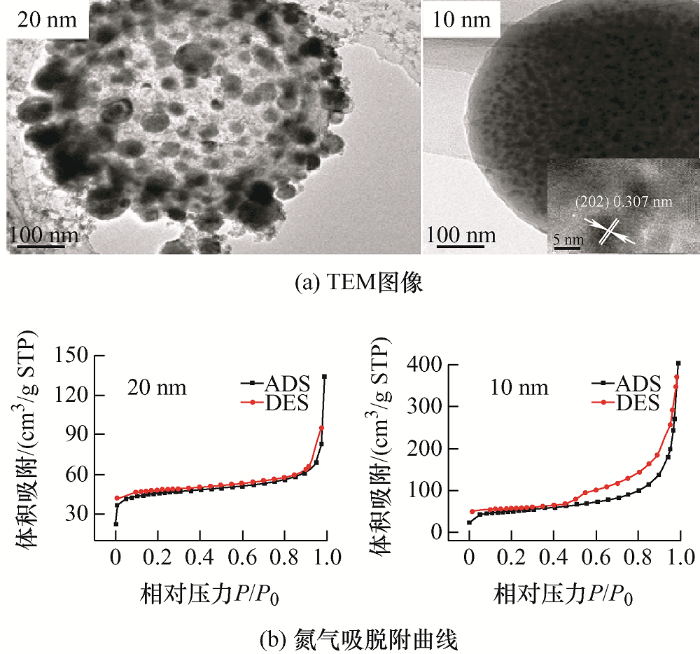
在锂/钠离子电池中设计纳米化的负极材料能够有效增加合金颗粒的比表面积、缩短Li+/Na+的扩散距离、使活性材料能够充分参与反应,同时也能够在一定程度上缓解再循环过程中体积变化带来的负面影响,提高电极的循环稳定性。YUE等[34]以不同粒径的纳米锑掺杂二氧化锡(小于10 nm,20~40 nm,小于100 nm)粉末为前驱体,通过高温煅烧制备得到分散均匀的SnSb合金颗粒/石墨烯复合材料(图1a),发现锡锑合金颗粒的尺寸分布在3~6 nm时,具有最高的比表面积(图1b),图中高度分散的纳米SnSb合金具有良好的应力适应性和良好的完整性,还提供了快速的Na+扩散和电子传输通道。此外,在电化学阻抗谱中,尺寸小于10 nm的SnSb合金颗粒复合材料表现出最低的电荷转移电阻 (图1c)。用作钠离子电池负极材料时,在600 mA/g电流密度下循环300次仍保持320 mA·h/g的可逆容量。LI等[35]通过一种简单的化学还原法,利用NaBH4将SnCl4·5H2O和SbCl3还原成SnSb纳米颗粒并嵌入纳米多孔碳骨架中(SnSb@NPC),其中,SnSb纳米颗粒的尺寸仅为2 nm(图2a),这种超小的SnSb纳米颗粒均匀分布在三维多孔碳材料中,增大了电极材料的比表面积,从而保证了活性材料的充分利用,同时也缩短了钠离子的扩散路径,最终在0.2 A/g电流密度下,经100次循环后仍有693.6 mA·h/g的可逆容量(图2b)。李海霞等[41]通过调节前驱液的锡离子和锑离子浓度,利用喷雾热解技术制备了不同粒径(10 nm,20 nm)的SnSb合金颗粒。BET测试发现,SnSb合金颗粒尺寸为10 nm时,活性材料表现出更高的比表面积(图3),超小的SnSb纳米颗粒(10 nm)可以显著减小活性物质在脱嵌锂/钠过程中产生的形变应力,提高其反应利用率,并能有效缓冲SnSb纳米颗粒在循环过程中的体积变化,从而有效抑制粉化与团聚。当用作钠离子电池负极材料时,经200次循环容量达到623 mA·h/g,容量保持率达95%。
图1
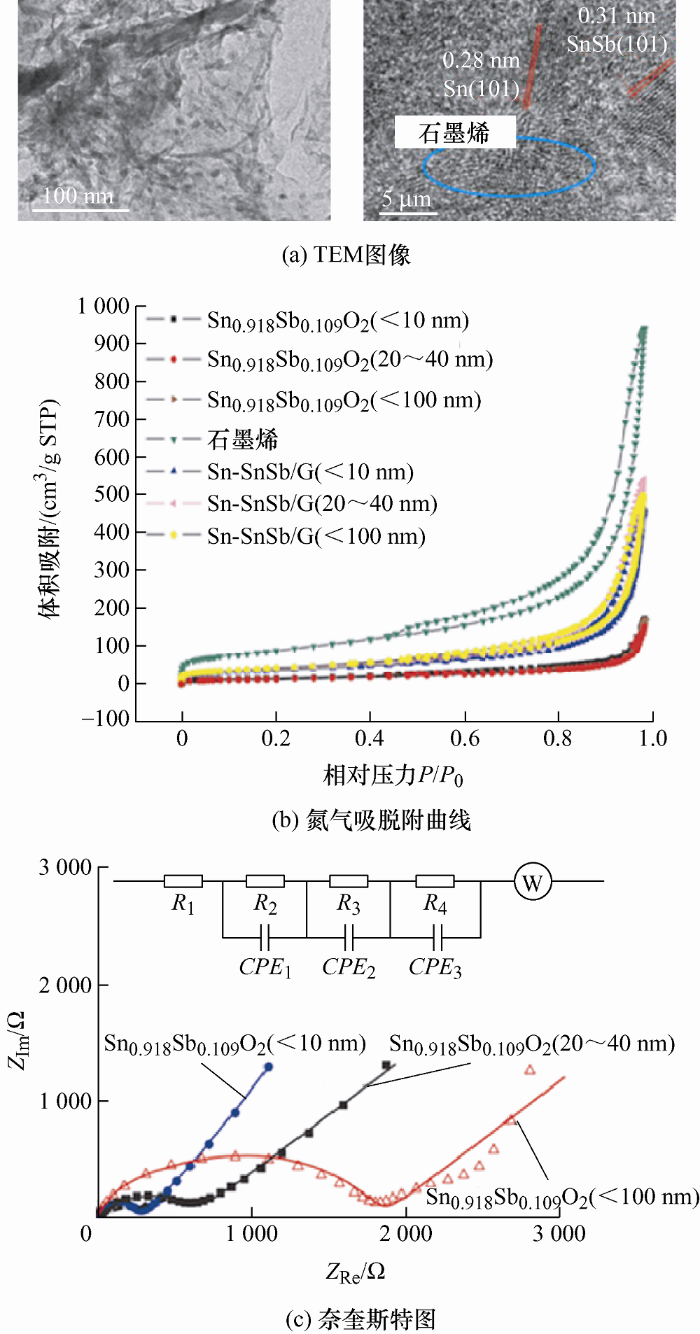
图2
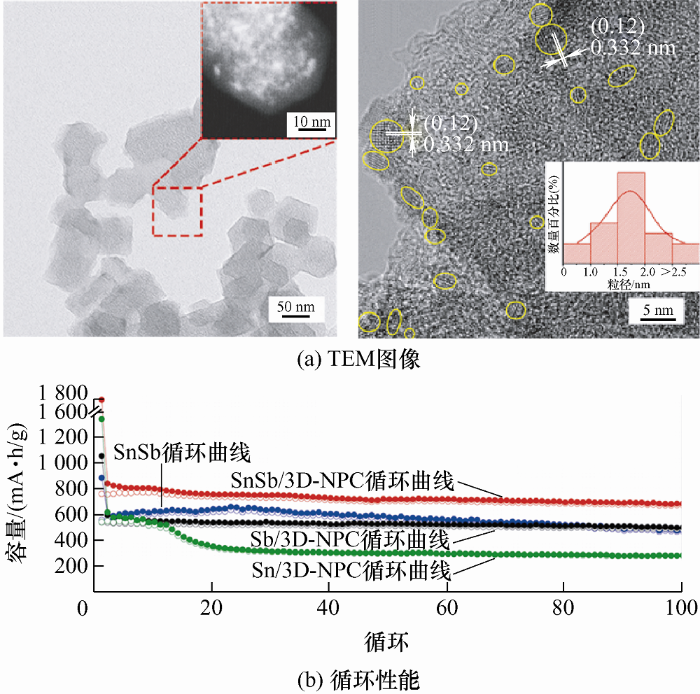
图3
纳米化SnSb合金颗粒的高表面积导致的高表面活性,使得SnSb合金在循环过程中逐渐团聚和生长,造成电极的循环性能变差。此外,由于SnSb合金负极材料在循环过程中体积变化较大,需要不断消耗电解液形成新的SEI膜,造成不可逆容量的损失。为了进一步提高负极材料的结构和循环稳定性,在纳米化的基础上,有研究人员直接对SnSb合金进行了多孔化结构设计[42-43]。MA等[27]以Mg90Sn5Sb5为前驱体,利用酒石酸溶液(2 wt%)进行化学脱合金制备得到了纳米多孔SnSb合金(图4a)结构,该结构具有纳米级相互连接的多孔(图4b),将其作为钠离子电池负极材料,具有优异的循环稳定性和倍率性能(图4c)。在0.2 A/g到10 A/g的电流密度下,钠离子电池的可逆容量仍然高达458.2 mA·h/g。CHOI等[43]通过熔融纺丝和化学蚀刻的方法(图5a),制备得到多孔无碳的SnSb合金纳米颗粒。BET测试发现,多孔SnSb合金纳米颗粒的比表面积高达12 m2/g(图5b),将其作为钠离子电池负极材料时,表现出高可逆容量和高容量保持率特性。YI等[42]以纳米锡粉为模板和还原剂(图6a),通过置换反应制备SnSb合金也具有多孔的结构(图6b),在该结构中,中空的球形结构可以缩短离子的传输距离,并提供额外的自由空间来缓冲嵌脱锂/钠离子时的体积膨胀。作为锂离子电池的负极材料,在100 mA·h/g电流密度下,经100次循环容量达到751 mA·h/g。
图4

图5
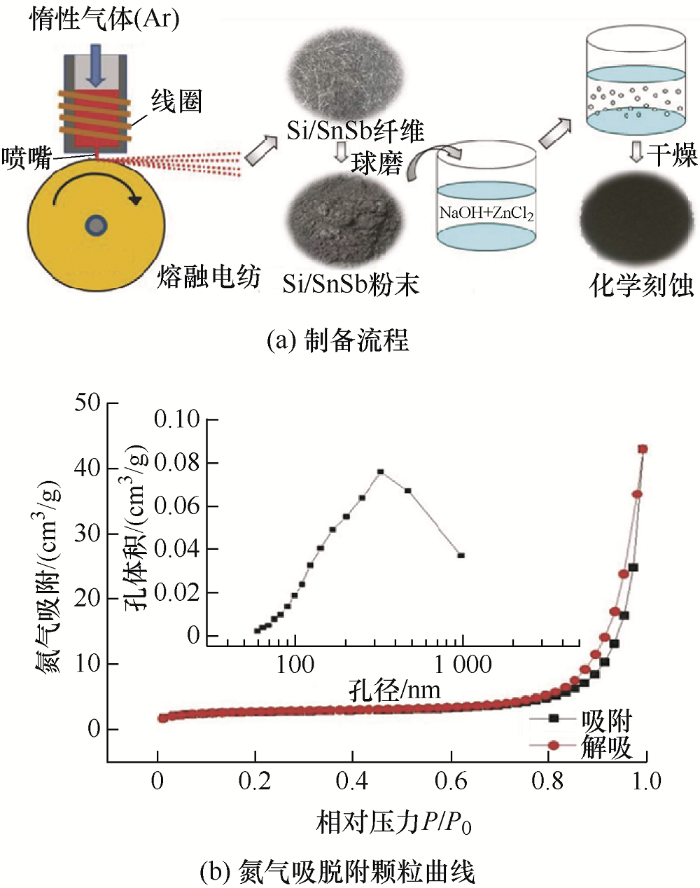
图6
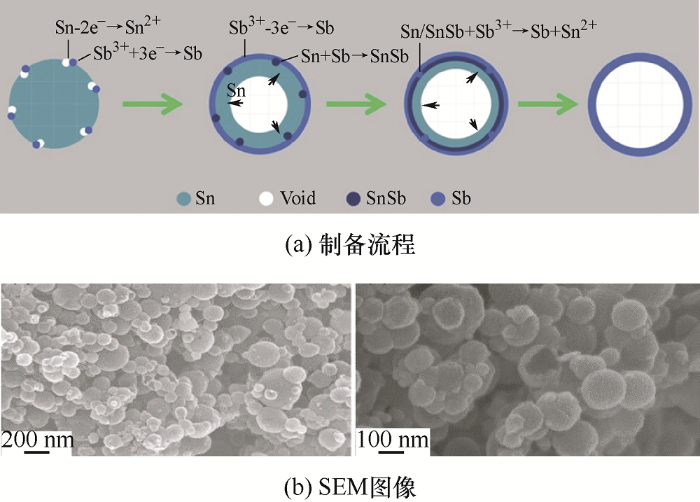
图7
3 碳材料复合
3.1 碳纤维
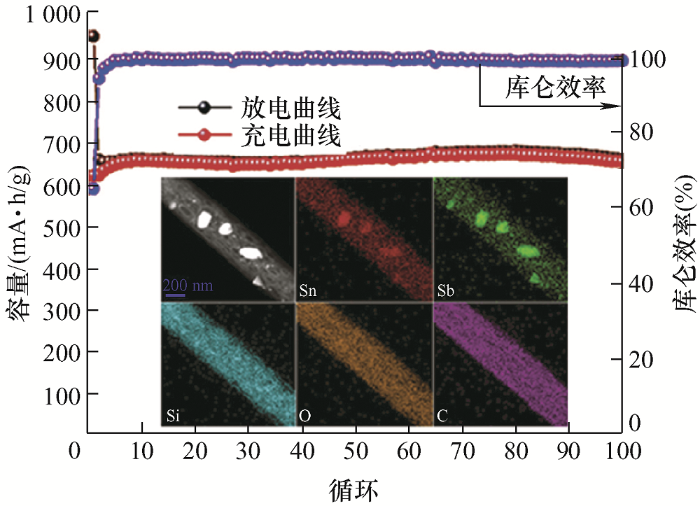
GU等[28]通过静电纺丝和顺序煅烧制备了富氮多孔碳纳米线包覆SnSb纳米颗粒的复合结构(SnSb@N-PCNW),纳米SnSb颗粒被牢固地包裹在一维碳纳米线内部(图8a)。作为钠离子电池负极材料,表现出了极高的储钠容量和优越的循环的性能,在2 A/g电流密度下,经过10 000次循环容量依然高达180 mA·h/g(图8b)。富氮多孔碳纳米线不但在纳米尺度上均匀分散SnSb颗粒,而且抑制了纳米颗粒的再团聚,使得SnSb纳米颗粒在超长循环周期内保持活性。JIA等[52]以聚丙烯腈(PAN)和聚甲基丙烯酸甲酯(PMMA)为碳源和成孔剂,制备了SnSb/rGO@CNF,通过在碳纳米纤维中引入还原氧化石墨烯(rGO),利用rGO适当的层间距和柔韧性,为电极材料提供稳定的结构,保证其循环稳定性。将其作为钠离子电池负极,也表现出储钠容量高、循环和倍率性能优异的特点。此外,WANG等[50]在静电纺丝前驱体溶液中通过引入正硅酸四乙酯促进SnSb合金颗粒完全嵌入纳米纤维中,同时形成了多孔通道,这种结构有效地减弱Li-Sn和Li-Sb在合金/去合金过程中由体积膨胀所带来的负面效应,该电极在200 mA/g的电流密度下完成100次循环后仍有660 mA·h/g的比容量(图9),其容量保持率几乎为100%。
图8
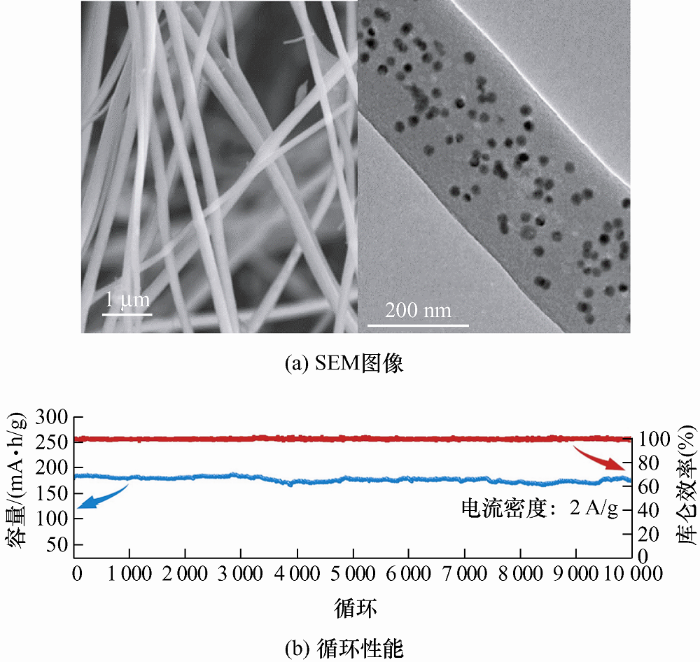
图9
3.2 二维碳层
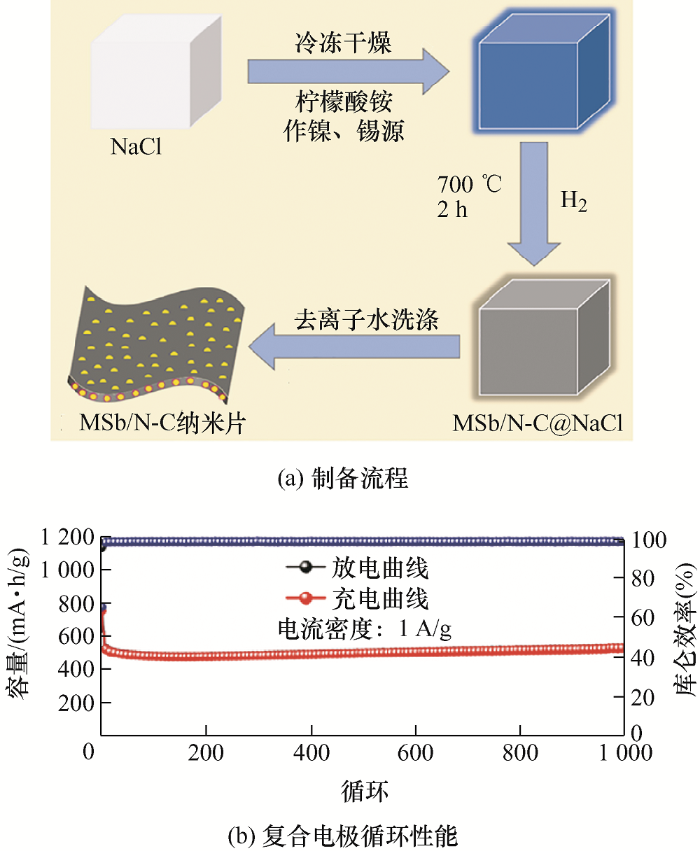
PAN等[40]以NaCl作模板,用柠檬酸铵作碳源和氮源,通过冷冻干燥方法制备了N掺杂碳纳米片封装SnSb纳米颗粒的复合结构(图10a),片状的氮掺杂碳纳米片结构能够提高电导率,缩短离子和电子的传输距离,并避免SnSb纳米颗粒的团聚生长,用作锂离子电池负极材料时表现出优异的循环和倍率性能。在1 A/g的电流密度下,循环1 000次仍能达到537.5 mA·h/g的高容量 (图10b)。JENA等[38]通过一种廉价且工业可推广的微波辅助水热法制备了N掺杂Sn-SnSb/rGO的三明治结构,SnSb纳米颗粒固定并分散在石墨烯片之间,缓解电极的体积变化及合金颗粒的团聚生长。此外,掺杂N原子的石墨烯片引入了机械缺陷,降低扩散势垒,一定程度上提高了锂的可逆存储。将其作为锂离子电池负极材料时,也表现出优异的循环和倍率性能。
图10
3.3 三维碳骨架
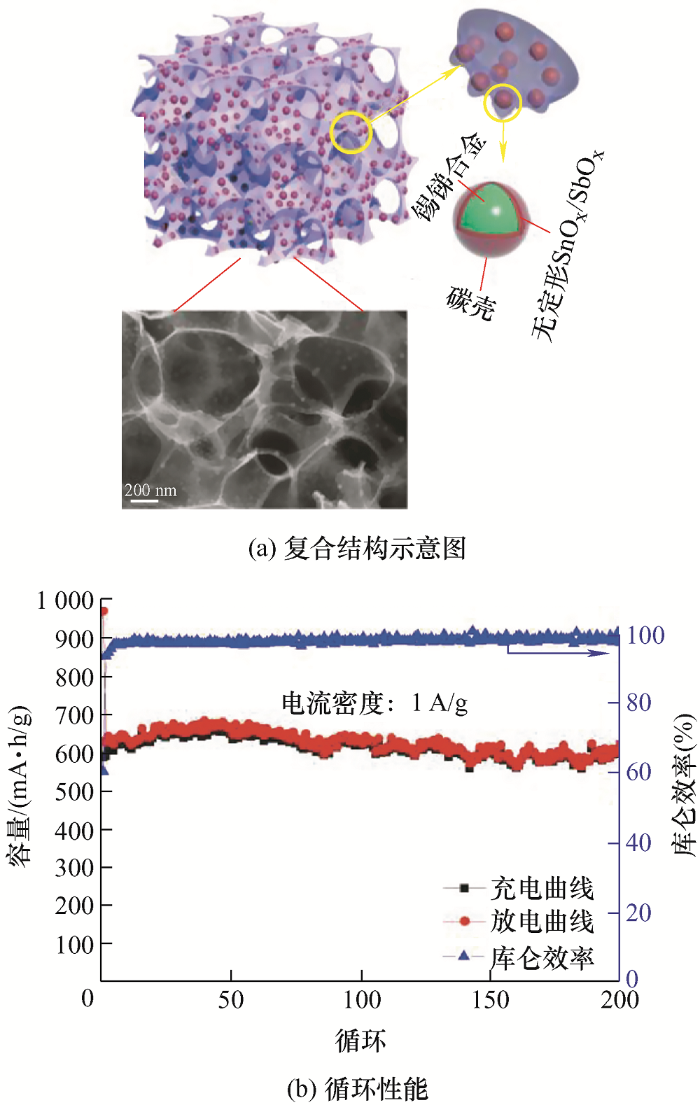
QIN等[24,58]以NaCl为模板,利用喷雾干燥方法原位制备三维N掺杂多孔石墨烯骨架面内约束SnSb纳米颗粒(3D-SnSb@N-PG)的复合结构(图11a, 图11b)。一方面,复合结构中SnSb合金颗粒的超小粒径和均匀分布能够提高活性材料在电化学反应中的利用率,使得电极材料具有较高的倍率性能;另一方面,该结构中的少层石墨烯对SnSb纳米颗粒的包覆,极大地提高了活性材料的电子电导率和结构稳定性。作为钠离子电池的负极材料,在10 A/g的大电流密度下,经过4 000次循环容量依然高达190 mA·h/g,容量保持率接近100%(图11c)。WANG等[59]报道了三维类石墨烯多孔碳网络包覆SnSb@SnOx/SbOx@C纳米颗粒的复合结构(图12a),该结构中连续的类石墨烯多孔碳网络能提供大量的离子通道,合金颗粒最外层的石墨层阻止SnSb纳米颗粒的团聚和生长,并提高了电子导电率,中间的非晶SnOx/SbOx层有效增强了SnSb合金和碳基体之间的界面相互作用。作为锂离子电池负极材料,表现出了优异的循环性能,在1 A/g的电流密度下,经过200次循环其可逆放电容量依然达到600 mA·h/g(图12b)。
图11
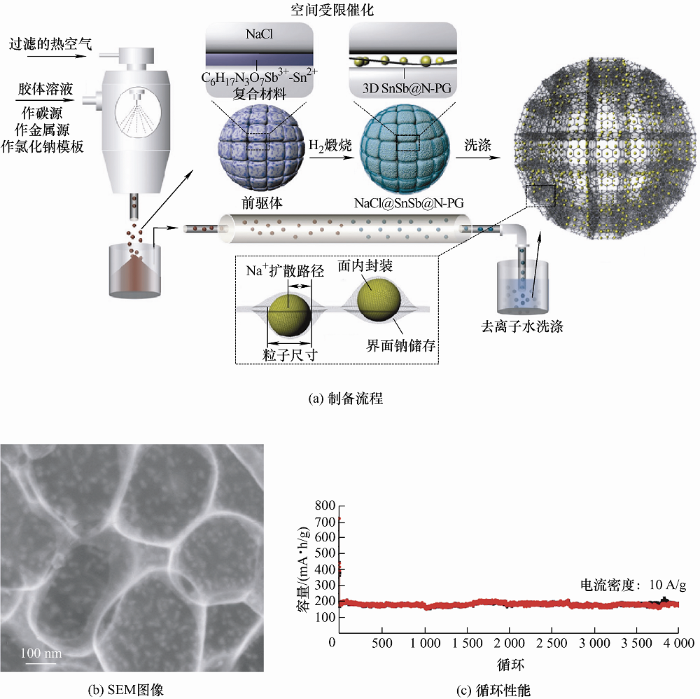
图12
4 三元合金材料
SnSb合金作为负极材料在嵌脱金属离子过程中,体积容易发生变化导致电极开裂和粉化,因此,SnSb合金作为离子电池负极材料仍然存在很大的问题。目前,对SnSb合金改性的常见方法之一是引入非活性金属元素。SnSb合金与引入的第三种元素形成金属间化合物,这种合金负极材料能够对体积膨胀起到一定的抑制作用,提高电极的循环性能。其中,常用的非活性金属有Ni、Cu、Fe等元素,它们与锂/钠不发生反应,这样锂/钠嵌入SnSb合金时,由于非活性金属的可延性,能使体积变化大大减小,从而提供了稳定的结构。
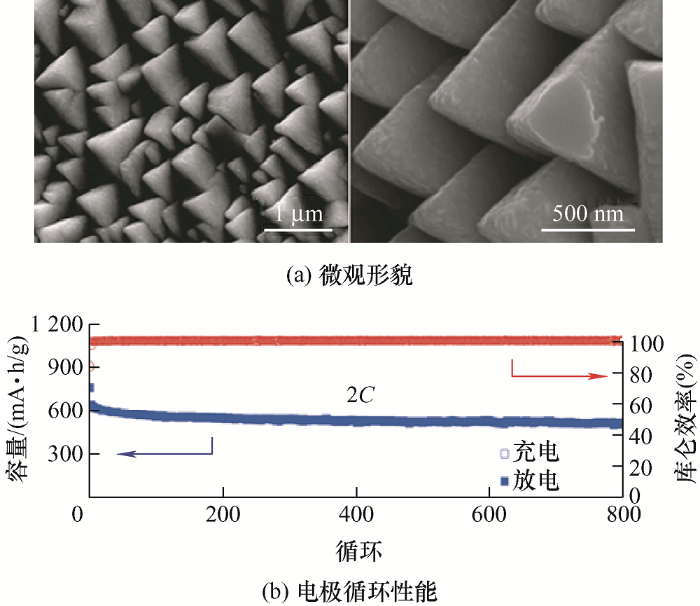
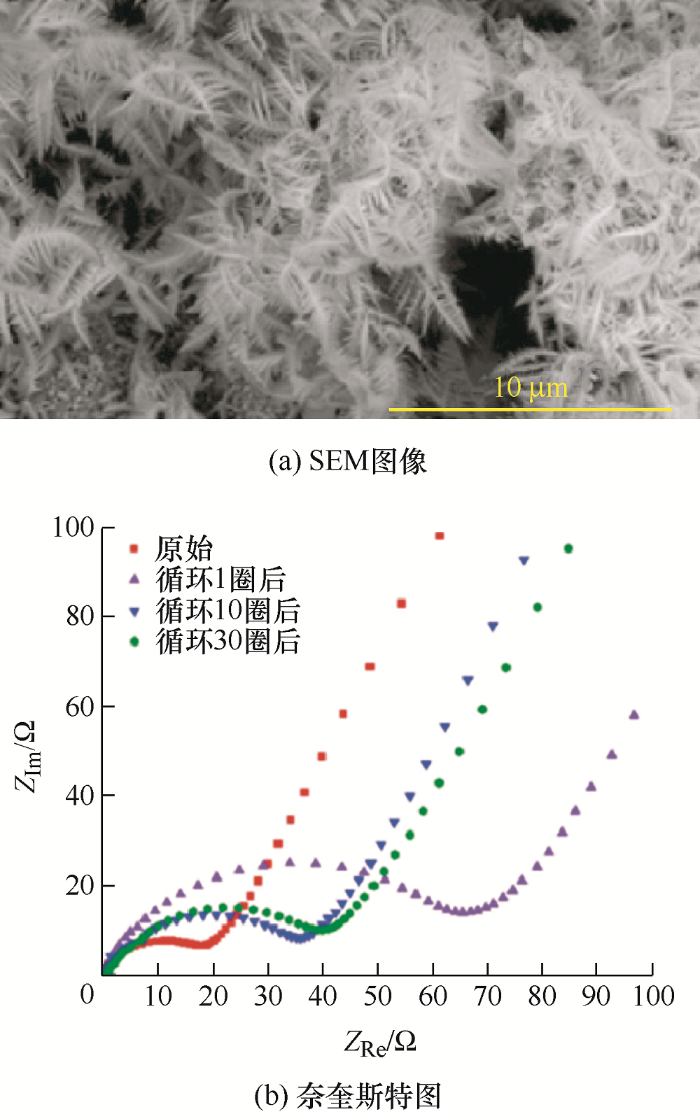
EDISON等[37]利用快速凝固技术制备Fe-SnSb合金,由于引入电化学性质不活跃的Fe元素,电极的循环稳定性显著提高。作为钠离子电池负极材料时,在1 A/g的电流密度下,经过400次循环,可逆容量仍然达到200 mA·h/g。ZHONG等[60]利用梯度电沉积法制备了SnCoSb合金,通过加入Co元素来部分缓解SnSb合金的体积变化。当Sn、Co、Sb的质量比为71.3∶12.8∶15.9时,表现出最佳的电化学性能。在0.2 A/g的电流密度下,循环200次后储锂容量仍然高达671.8 mA·h/g。SENGUPTA等[61]利用电沉积方法制备SnSbNi三元合金负极,该负极具有树枝状结构(图13a),有利于缩短离子扩散距离。此外,分步锂化能够减轻循环过程中的体积应力,缓冲界面处的剪切应力,防止电极分层脱落,从而提高了库仑效率。从电化学阻抗谱中可以发现(图13b),电荷转移电阻先变大后减小,表明SnSbNi三元合金负极材料能在很短的循环次数里形成稳定的结构,有效缓解循环过程中的体积变化。将其作为锂离子电池负极时,具有优异的倍率性能和稳定的循环保持率。
图13
5 总结与展望
能量密度、循环性能和制造成本等指标是衡量锂/钠离子电池应用前景的标准。负极材料的微观结构和表面化学性质是决定离子电池电化学性能的关键要素。锡锑合金负极材料具有高理论容量、高电导率和低反应电位等优点,但是目前面临的主要问题是充放电循环过程中体积变化过大使得电极材料粉化失活从而导致容量的快速衰减。本文从尺寸控制、结构设计、与碳材料复合、三元合金材料等方面对锡锑合金负极材料进行改性和缺陷调控。
尽管以上方法都取得了很大进展,但用于锂/钠离子电池的SnSb合金负极材料的开发、超小SnSb纳米颗粒及其结构合成目前仍处于实验室水平。未来的研究应当立足于以下方面:① 从理论和试验两个方面揭示SnSb合金负极的电化学反应机制,通过有限元计算、原位透射电子显微镜、拉曼、X射线衍射等测试揭示SnSb合金负极失活机理,探究尺寸控制、结构设计等多方面的协同作用,以期获得优异的电池性能;② 设计基于SnSb合金负极材料的全电池研究,匹配合适电解液、正极材料参数;③ 开发、优化工艺,从而降低材料制备的成本;④ 优化和探索SnSb合金与碳材料进行复合的制备工艺,掌握SnSb合金形貌和尺寸等参数对于负极材料电化学性能的影响规律和机制。
参考文献
Building better batteries
[J].DOI:10.1038/451652a URL [本文引用: 1]
Nano-sized transition-metal oxides as negative-electrode materials for lithium-ion batteries
[J].DOI:10.1038/35035045 URL [本文引用: 1]
An outlook on lithium ion battery technology
[J].
DOI:10.1021/acscentsci.7b00288
PMID:29104922
[本文引用: 1]

Lithium ion batteries as a power source are dominating in portable electronics, penetrating the electric vehicle market, and on the verge of entering the utility market for grid-energy storage. Depending on the application, trade-offs among the various performance parameters-energy, power, cycle life, cost, safety, and environmental impact-are often needed, which are linked to severe materials chemistry challenges. The current lithium ion battery technology is based on insertion-reaction electrodes and organic liquid electrolytes. With an aim to increase the energy density or optimize the other performance parameters, new electrode materials based on both insertion reaction and dominantly conversion reaction along with solid electrolytes and lithium metal anode are being intensively pursued. This article presents an outlook on lithium ion technology by providing first the current status and then the progress and challenges with the ongoing approaches. In light of the formidable challenges with some of the approaches, the article finally points out practically viable near-term strategies.
Constructing three-dimensional ordered porous MoS2/C hierarchies for excellent high-rate long-life pseudocapacitive sodium storage
[J].DOI:10.1016/j.cej.2020.125385 URL [本文引用: 2]
Metal-organic framework derived vanadium-doped TiO2@carbon nanotablets for high-performance sodium storage
[J].DOI:10.1016/j.jcis.2021.06.143 URL [本文引用: 2]
From lithium-ion to sodium-ion batteries:Advantages,challenges,and surprises
[J].DOI:10.1002/anie.201703772 URL [本文引用: 1]
Sodium-ion batteries
[J].DOI:10.1002/adfm.201200691 URL [本文引用: 1]
Sodium-ion batteries:Present and future
[J].DOI:10.1039/C6CS00776G URL [本文引用: 1]
Hollow TiNb2O7 nanospheres with a carbon coating as high-efficiency anode materials for lithium-ion batteries
[J].
Polyvinylpyrrolidone regulated synthesis of mesoporous titanium niobium oxide as high-performance anode for lithium-ion batteries
[J].DOI:10.1016/j.jcis.2021.10.073 URL [本文引用: 1]
Coaxially integrating TiO2/MoO3 into carbon nanofibers via electrospinning towards enhanced lithium ion storage performance
[J].DOI:10.1002/slct.202000288 URL [本文引用: 1]
Porous N-doped carbon nanoflakes supported hybridized SnO2/Co3O4 nanocomposites as high-performance anode for lithium-ion batteries
[J].DOI:10.1016/j.jcis.2019.10.096 URL [本文引用: 1]
Space-confined synthesis of ultrasmall SnO2 nanodots within ordered mesoporous carbon CMK-3 for high-performance lithium ion batteries
[J].DOI:10.1021/acs.energyfuels.0c01396 URL [本文引用: 1]
Porous graphene-like MoS2/carbon hierarchies for high-performance pseudocapacitive sodium storage
[J].
Flower-like Mn/Co glycerolate-derived alpha-MnS/Co9S8/Carbon heterostructures for high-performance lithium-ion batteries
[J].DOI:10.1021/acsaem.0c02014 URL [本文引用: 1]
Facile synthesis of hybrid MoS2/graphene nanosheets as high-performance anode for sodium-ion batteries
[J].DOI:10.1007/s11581-019-03235-7 URL [本文引用: 1]
Synergizing phase and cavity in CoMoOxSy yolk-shell anodes to co-enhance capacity and rate capability in sodium storage
[J].
Oxidizing solid Co into hollow Co3O4 within electrospun (carbon) nanofibers towards enhanced lithium storage performance
[J].DOI:10.1039/C9TA00045C URL [本文引用: 1]
Rational design of hierarchical nanotubes through encapsulating CoSe2 nanoparticles into MoSe2/C composite shells with enhanced lithium and sodium storage performance
[J].
Electrochemical performance of porous carbon/tin composite anodes for sodium-ion and lithium-ion batteries
[J].DOI:10.1002/aenm.201200346 URL [本文引用: 1]
Encapsulating silica/antimony into porous electrospun carbon nanofibers with robust structure stability for high-efficiency lithium storage
[J].
DOI:10.1021/acsnano.7b09092
PMID:29641178
[本文引用: 1]
To address the volume-change-induced pulverization problems of electrode materials, we propose a "silica reinforcement" concept, following which silica-reinforced carbon nanofibers with encapsulated Sb nanoparticles (denoted as SiO/Sb@CNFs) are fabricated via an electrospinning method. In this composite structure, insulating silica fillers not only reinforce the overall structure but also contribute to additional lithium storage capacity; encapsulation of Sb nanoparticles into the carbon-silica matrices efficiently buffers the volume changes during Li-Sb alloying-dealloying processes upon cycling and alleviates the mechanical stress; the porous carbon nanofiber framework allows for fast charge transfer and electrolyte diffusion. These advantageous characteristics synergistically contribute to the superior lithium storage performance of SiO/Sb@CNF electrodes, which demonstrate excellent cycling stability and rate capability, delivering reversible discharge capacities of 700 mA h/g at 200 mA/g, 572 mA h/g at 500 mA/g, and 468 mA h/g at 1000 mA/g each after 400 cycles. Ex situ as well as in situ TEM measurements confirm that the structural integrity of silica-reinforced Sb@CNF electrodes can efficiently withstand the mechanical stress induced by the volume changes. Notably, the SiO/Sb@CNF//LiCoO full cell delivers high reversible capacities of ∼400 mA h/g after 800 cycles at 500 mA/g and ∼336 mA h/g after 500 cycles at 1000 mA/g.
A review of the electrochemical performance of alloy anodes for lithium-ion batteries
[J].DOI:10.1016/j.jpowsour.2010.07.020 URL [本文引用: 1]
Alloy-based anode materials toward advanced sodium-ion batteries
[J].DOI:10.1002/adma.201700622 URL [本文引用: 1]
A top-down strategy toward SnSb in-plane nanoconfined 3D N-doped porous graphene composite microspheres for high performance Na-ion battery anode
[J].
Controlling SEI formation on SnSb-porous carbon nanofibers for improved Na ion storage
[J].DOI:10.1002/adma.201304962 URL [本文引用: 1]
Peering into alloy anodes for sodium-ion batteries:Current trends,challenges,and opportunities
[J].DOI:10.1002/adfm.201808745 URL [本文引用: 1]
Alloying boosting superior sodium storage performance in nanoporous tin-antimony alloy anode for sodium ion batteries
[J].DOI:10.1016/j.nanoen.2018.10.027 URL [本文引用: 2]
Highly reversible alloying/dealloying behavior of SnSb nanoparticles incorporated into N-rich porous carbon nanowires for ultra-stable Na storage
[J].DOI:10.1016/j.ensm.2018.12.015 URL [本文引用: 2]
Carbon nanofibers with highly dispersed tin and tin antimonide nanoparticles:Preparation via electrospinning and application as the anode materials for lithium-ion batteries
[J].DOI:10.1016/j.jpowsour.2018.02.004 URL [本文引用: 2]
Bimetallic alloy SbSn nanodots filled in electrospun N-doped carbon fibers for high performance Na-ion battery anode
[J].DOI:10.1016/j.electacta.2021.138246 URL [本文引用: 1]
Cryo-treatment in enhancing the electrochemical properties of SnSb/C nanofiber anodes for lithium ion batteries
[J].DOI:10.1016/j.electacta.2018.11.091 URL [本文引用: 1]
Carbon-enhanced centrifugally-spun SnSb/carbon microfiber composite as advanced anode material for sodium-ion battery
[J].
DOI:S0021-9797(18)31298-0
PMID:30396121
[本文引用: 1]
Antimony tin (SnSb) based materials have become increasingly attractive as a potential anode material for sodium-ion batteries (SIBs) owing to their prominent merit of high capacity. However, cyclic stability and rate capability of SnSb anodes are currently hindered by their large volume change during repeated cycling, which results in severe capacity fading. Herein, we introduce carbon-coated centrifugally-spun SnSb@carbon microfiber (CMF) composites as high-performance anodes for SIBs that can maintain their structural stability during repeated charge-discharge cycles. The centrifugal spinning method was performed to fabricate SnSb@CMFs due to its high speed, low cost, and large-scale fabrication features. More importantly, extra carbon coating by chemical vapor deposition (CVD) has been demonstrated as an effective method to improve the capacity retention and Coulombic efficiency of the SnSb@CMF anode. Electrochemical test results indicated that the as-prepared SnSb@CMF@C anode could deliver a large reversible capacity of 798 mA h∙g at the 20th cycle as well as a high capacity retention of 86.8% and excellent Coulombic efficiency of 98.1% at the 100th cycle. It is, therefore, demonstrated that SnSb@CMF@C composite is a promising anode material candidate for future high-performance SIBs.Copyright © 2018 Elsevier Inc. All rights reserved.
Intermetallic SnSb nanodots embedded in carbon nanotubes reinforced nanofabric electrodes with high reversibility and rate capability for flexible Li-ion batteries
[J].
DOI:10.1039/c9nr04645c
PMID:31287474
[本文引用: 1]
Tin (Sn) based anode materials have been regarded as promising alternatives for graphite in lithium ion batteries (LIBs) due to their high theoretical specific capacity and conductivity. However, their practical application is severely restrained by the drastic volume variation during cycling processes. Here we report the preparation of intermetallic SnSb nanodots embedded in carbon nanotube reinforced N-doped carbon nanofibers (SnSb-CNTs@NCNFs) as a free-standing and flexible anode for LIBs. In this unique structure, the SnSb nanodots are well protected by the NCNFs and exhibit greatly reduced volume change. The mechanical strength and conductivity of the nanofabric electrode are further improved by the embedded CNTs. Benefiting from these advantages, the SnSb-CNTs@NCNFs anode delivers a high reversible capacity of 815 mA h g at 100 mA g, a high rate capability (370 mA h g at 5000 mA g) and a long cycle life (451 mA h g after 1000 cycles at 2000 mA g). When assembled into flexible pouch cells, the full cells based on SnSb-CNTs@NCNFs anodes also exhibit high flexibility and good lithium storage performances.
Highly dispersed ultra-small nano Sn-SnSb nanoparticles anchored on N-doped graphene sheets as high performance anode for sodium ion batteries
[J].DOI:10.1016/j.apsusc.2020.145686 URL [本文引用: 2]
Sodium storage performance of ultrasmall SnSb nanoparticles
[J].DOI:10.1016/j.cej.2021.129617 URL [本文引用: 2]
Synergetic enhancement of the electronic/ionic conductivity of a Li-ion battery by fabrication of a carbon-coated nanoporous SnOxSb alloy anode
[J].DOI:10.1039/C8NR00550H URL [本文引用: 1]
Microstructurally engineered nanocrystalline Fe-Sn-Sb anodes:Towards stable high energy density sodium-ion batteries
[J].DOI:10.1039/C9TA01158G URL [本文引用: 2]
Sandwich architecture of Sn SnSb alloy nanoparticles and N-doped reduced graphene oxide sheets as a high rate capability anode for lithium-ion batteries
[J].DOI:10.1016/j.jpowsour.2018.08.058 URL [本文引用: 2]
Porous-nickel-scaffolded tin-antimony anodes with enhanced electrochemical properties for Li/Na-ion batteries
[J].
Facile synthesis of M-Sb (M=Ni,Sn) alloy nanoparticles embedded in N-doped carbon nanosheets as high performance anode materials for lithium ion batteries
[J].DOI:10.1016/j.cej.2018.05.043 URL [本文引用: 2]
碳包覆纳米SnSb合金作为高性能钠离子电池负极材料
[J].
Spherical nano-SnSb/C composite as a high-performance anode material for sodium ion batteries
[J].
One-pot chemical route for morphology-controllable fabrication of Sn-Sb micro/nano-structures:Advanced anode materials for lithium and sodium storage
[J].DOI:10.1016/j.jpowsour.2017.01.016 URL [本文引用: 2]
Porous carbon-free SnSb anodes for high-performance Na-ion batteries
[J].DOI:10.1016/j.jpowsour.2018.03.032 URL [本文引用: 2]
Efficient stress dissipation in well-aligned pyramidal SbSn alloy nanoarrays for robust sodium storage
[J].
SnSb binary alloy induced heterogeneous nucleation within the confined nanospace:Toward dendrite-free,flexible and energy/power dense sodium metal batteries
[J].DOI:10.1016/j.ensm.2021.07.032 URL [本文引用: 1]
Composites of SnSb nanoparticles embedded in porous carbon nanofibers wrapped with reduced graphene oxide for sodium storage
[J].DOI:10.1021/acsanm.0c03155 URL [本文引用: 1]
The regulating role of carbon nanotubes and graphene in lithium-ion and lithium-sulfur batteries
[J].DOI:10.1002/adma.201800863 URL [本文引用: 1]
Embedding amorphous lithium vanadate into carbon nanofibers by electrospinning as a high-performance anode material for lithium-ion batteries
[J].
DOI:S0021-9797(20)30856-0
PMID:32679364
[本文引用: 1]
We design and fabricate a novel hybrid with amorphous lithium vanadate (LiVO, LVO for short) uniformly encapsulated into carbon nanofibers (denoted as LVO@CNFs) via an easy electrospinning strategy followed by proper postannealing. When examined for use as anode materials for lithium-ion batteries (LIBs), the optimized LVO@CNFs present a high discharge capacity of 603 mAh g with a capacity retention as high as 90% after 200 cycles at 0.5 A g and a high rate capacity of 326 mAh g after 400 cycles even at a high rate of 5 A g. The superior electrochemical performance with excellent cycling stability and rate capability is attributed to the full encapsulation of the amorphous LVO into the conductive carbon nanofibers, which hold enlarged electrochemically active sites for lithium storage, facilitate the charge transfer, and efficiently alleviate the volume changes upon lithium insertion/extraction. More importantly, the current synthesis can be a general strategy to fabricate various alkaline earth metal vanadates, which is promising for developing advanced electrochemical energy storage devices.Copyright © 2020 Elsevier Inc. All rights reserved.
Embedding CoMoO4 nanoparticles into porous electrospun carbon nanofibers towards superior lithium storage performance
[J].
Synthesis of SnSb-embedded carbon-silica fibers via electrospinning:Effect of TEOS on structural evolutions and electrochemical properties
[J].
Nanoscale localized growth of SnSb for general-purpose high performance alkali (Li,Na,K) ion storage
[J].DOI:10.1016/j.cej.2021.134318 URL [本文引用: 1]
Reduced graphene oxide-incorporated SnSb@CNF composites as anodes for high-performance sodium-ion batteries
[J].
A novel carbon-decorated hollow flower-like MoS2 nanostructure wrapped with RGO for enhanced sodium-ion storage
[J].DOI:10.1016/j.cej.2018.03.003 URL [本文引用: 1]
MXene-derived defect-rich TiO2@rGO as high-rate anodes for full Na ion batteries and capacitors
[J].DOI:10.1007/s40820-020-00471-9 URL [本文引用: 1]
rGO/SnS2/TiO2 heterostructured composite with dual-confinement for enhanced lithium-ion storage
[J].
3D spongy CoS2 nanoparticles/carbon composite as high-performance anode material for lithium/sodium ion batteries
[J].DOI:10.1016/j.cej.2017.09.092 URL [本文引用: 1]
3D few-layered MoS2/graphene hybrid aerogels on carbon fiber papers:A free-standing electrode for high-performance lithium/sodium-ion batteries
[J].DOI:10.1016/j.cej.2020.125592 URL [本文引用: 1]
3D N,O-codoped egg-box-like carbons with tuned channels for high areal capacitance supercapacitors
[J].
DOI:10.1007/s40820-020-00416-2
PMID:34138071
[本文引用: 1]
Functional carbonaceous materials for supercapacitors (SCs) without using acid for post-treatment remain a substantial challenge. In this paper, we present a less harmful strategy for preparing three-dimensional (3D) N,O-codoped egg-box-like carbons (EBCs). The as-prepared EBCs with opened pores provide plentiful channels for ion fast transport, ensure the effective contact of EBCs electrodes and electrolytes, and enhance the electron conduction. The nitrogen and oxygen atoms doped in EBCs improve the surface wettability of EBC electrodes and provide the pseudocapacitance. Consequently, the EBCs display a prominent areal capacitance of 39.8 μF cm (340 F g) at 0.106 mA cm in 6 M KOH electrolyte. The EBC-based symmetric SC manifests a high areal capacitance to 27.6 μF cm (236 F g) at 0.1075 mA cm, a good rate capability of 18.8 μF cm (160 F g) at 215 mA cm and a long-term cycle stability with only 1.9% decay after 50,000 cycles in aqueous electrolyte. Impressively, even in all-solid-state SC, EBC electrode shows a high areal capacitance of 25.0 μF cm (214 F g) and energy density of 0.0233 mWh cm. This work provides an acid-free process to prepare electrode materials from industrial by-products for advanced energy storage devices.
Monodisperse multicore-shell SnSb@SnOx/SbOx@C nanoparticles space-confined in 3D porous carbon networks as high-performance anode for Li-ion and Na-ion batteries
[J].DOI:10.1016/j.cej.2019.04.045 URL [本文引用: 1]
Gradient electrodeposition enables high-throughput fabrication and screening of alloy anodes for high-energy lithium-ion batteries
[J].
3D microporous Sn-Sb-Ni alloy impregnated Ni foam as high-performance negative electrode for lithium-ion batteries
[J].DOI:10.1016/j.jallcom.2017.02.125 URL [本文引用: 1]


