


1 引言
光伏发电是太阳能利用的主要形式之一。光伏技术发展至今,户用分布式光伏成为一种高效的光伏利用方式,它根据光伏能源分布广泛的特点,倡导就近发电、就近并网、就近转换及就近使用。与地面光伏电站相比,户用光伏电站规模较小,但具备占地面积小、减小对电网的供电依赖和灵活智能等优点,同时又可上网售电,使用户获得经济效益,被认为是未来光伏利用的主要方向。由于与风电等其他清洁能源相比,光伏发电与工商业用电峰值基本匹配,因此光伏相比其他可再生能源更适用于分布式应用。目前来看,在上网电价补贴的政策下,欧洲和日本的分布式光伏得到率先发展,从全球角度看,分布式光伏装机增速保持在25%以上,其中欧洲的分布式光伏发电装机比例较高,奥地利、丹麦和荷兰等国的光伏建设甚至基本全部以分布式的形式进行,而与之相比我国的分布式光伏装机占比仍然偏低。
随着我国“十三五”发展规划的出台,今后的光伏装机容量已得到确认,其中明确了我国2015年太阳能装机目标为35GW,2020年装机目标为100GW。可见分布式光伏的装机容量将会逐年上升。与此同时,智能用电作为智能电网技术的重要部分,也正被各国重视和大力发展。在“十三五”规划中,也明确提出了要积极构建智慧能源系统,具体过程中要适应分布式能源发展、用户多元化需求,优化电力需求侧管理,加快智能电网建设,提高电网与发电侧、需求侧交互响应能力。户用光伏微电网系统兼具光伏发电和智能用电的作用,在当前发展环境中,其各个方面的技术也会是研究的重点。
目前的户用光伏微电网系统的结构已相对成熟,但针对其智能用电的经济优化控制仍然相对较少。从技术角度来看,储能和智能家电的出现能够使系统的运行方式更加多变,从而使能量管理更加灵活,若采用动态电价之后,储能设备可使用户选择性地使用市电或向电网售电,用户将获得更大的经济效益[1]。从政策发展来看,一方面,随着规模的发展,光伏上网补贴随后会逐步减小,为逐步摆脱对光伏上网补贴的依赖,获得更多收益,就需要针对提高自发自用比例进行经济优化;另一方面,需求响应机制向用户侧的深入开展增加了户用与电网的互动方式,也提高了对户用光伏微电网优化运行的要求。
本文首先介绍了当前我国户用光伏微电网的主流结构及其特点,之后为了实现户用光伏系统的经济运行,针对当前主流结构中在优化控制方面的缺失,阐述并分析了现有的针对光伏系统运行的经济评价模型以构建户用光伏系统经济运行的指导方案,基于此引出了针对家庭负荷系统特点的主动负荷需求响应,建立基于主动负荷的经济运行协调控制策略,并阐述了该方案中相关部分的研究进展。
2 户用光伏微电网的结构
图1
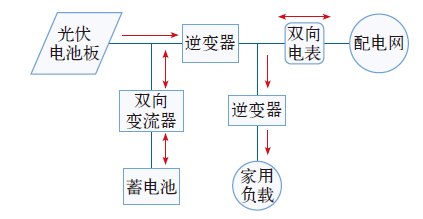
图1
主流户用光伏微电网结构及能量流动方向
Fig.1
Mainstream structure of household photovoltaic microgrid and energy flow direction
3 系统运行的经济评价模型
户用光伏系统的经济性能是影响用户决策的决定性因素,同时经济性也是户用光伏微电网系统能够被大力推广的必要条件。当前针对含光伏的发电系统的经济评价大多集中在微网层面和电站级层面。文献[5]中,基于工业光伏微网,综合单位电能成本、污染物减排收益和投资回收期作为经济性指标,建立了系统的优化配置模型,分析了不同运行模式下的优化控制策略。文献[6]中,作者利用平准化能源成本分析法(Levelized Cost Of Energy,LCOE)计算了传统火电厂、风电场和光伏电站的发电成本并对其进行敏感性分析,之后针对改进后的风电供暖系统和风储联合运行系统,计算了这两种系统的发电成本,分析了经济性的影响因素。文献[7]中,针对光伏上网补贴构建了新的净收益函数作为经济指标,以实际微网为例,从是否补偿电价、接入不同场景和经济效益的影响评估三个方面做了分析讨论。
可以看出,不同于针对光伏电站和微网的经济性,户用光伏微电网系统一方面户用光伏发电系统的能量供应单元较少,减小了评价的难度,但是不同于微网和电站,用户是整个系统的投资者和运营者,把应用于直供电模式和第三方投资运营模式的微电网(或光伏电站)经济评价方法应用在户用光伏微电网系统中未必合适,而且由于户用系统中负荷的控制更容易实现,特别是在补贴政策和分时电价的情况下,系统的经济运行就与负荷的控制更为密切。总体来看,为使户用光伏系统最大限度地经济运行,不仅要从发电侧综合考虑光伏和蓄电池的搭配,还要考虑使需求侧的智能化,因此就应当在对负荷侧进行实时调度的基础上构建合适的经济评价机制。
需要指出的是,对于户用光伏发电系统来说,居民作为使用主体,其使用舒适度也至关重要,所以除了要对系统运行经济性进行考量以外,用户对系统运行的用电满意度也应当予以考虑。
4 基于主动负荷的协调控制
4.1 居民负荷的类型
为了从负荷侧打开解决户用光伏微电网系统经济优化运行问题的新思路,首先就需要研究居民负荷的类型。居民的日常负荷主要来自家用HVAC(heating ventilation and air conditioning)系统,冰箱、热水器、照明、娱乐、厨用及其他生活电器等。如图2所示,根据用电模式和用户需求不同,用电负载可分为基线负荷、可计划负荷和可调控负荷,其中,基线负荷根据生活、工作方式的需求自然发生,规律性小波动性大,难以实施调控;通常长时间运行,受温度和气候因素的影响,但功率可调甚至可被间歇性中断的负荷为可调控负荷;起停时间相对固定且运行持续时间的负荷,一般功率不太方便调整,但运行时间可在一定范围内灵活安排,这类负荷为可计划负荷。
图2
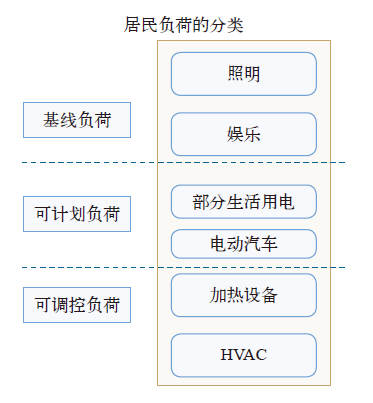
一般来说,计算机、打印机、家庭娱乐系统、照明系统和安保系统等使用随机性大,且功率不可调节,属于基线负荷;HVAC系统、热水器等具有一定的可中断性和储能性,可在牺牲较小舒适度的情况下,通过控制其功率和运行时段来满足用户需求,它们属于可调控负荷;而电动汽车、洗衣机等功率不可调节但工作时间可适当调整的负荷属于可计划负荷[9]。
在可计划负荷中电动汽车是一种特殊的负载,它既可以当负载也可以作为电源,当需要对其充电时,电网(或户用光伏微电网系统)为其充电G2V(grid to vehicle);当家庭中出现电力短缺的应急状况时,电动汽车可通过V2H(vehicle to home)向用户提供电力[9],因此电动汽车也可以用来实现用户电力负荷的峰谷调节或用于短时紧急电力的提供,从而使户用微电网系统运行更加可靠、经济。
由上述内容可知,在户用系统中,负荷的类型多种多样且可控特性各不相同,这些都为通过负荷控制来实现户用光伏微电网系统经济运行增加了难度,所以应当将更为智能的负荷控制方式、更为灵活的优化算法应用在针对智能家居环境下的能量优化中,同时面对多电源多负载的复杂情况,还要从硬件上提高负荷信息的采集能力和负荷和系统之间的通信能力,才能实现户用光伏微电网系统的经济协调控制。
4.2 主动负荷的应用
随着电器设备自动化控制水平的提高,智能家居以及智能交互式能量管理系统的开发,主动负荷随之而产生,在智能电网环境下,基于相关的通信和智能控制技术,主动配合发电能力和电价政策等需求响应机制,在不改变或较少改变用户需求的前提下,改变相应设备的工作时间和负荷大小,如此达到用电需求和用能需求的解耦,从而获得更高的经济效益[11]。
通过分析上述定义可以发现,基于主动负荷的能量优化应有以下特点:改变用电负荷和转移用电时间的前提是不改变或较小改变用户的用能习惯或使用满意程度;对负荷的调整可配合光伏等分布式能源的出力以实现分布式能源的经济吸纳;具有一定的供电能力,某些条件下可向其他系统输送一定的能量。
目前国内外的主动负荷主要包括专门制冷制冰的负荷系统、电动汽车充电系统和热电联产系统等系统[12,13,14],针对这些系统的相关研究表明,动态地整合用户侧的资源已成为智能电网中需求响应研究的主要方向。文献[15]提出了基于实时电价的居民负荷响应控制策略,并对系统的消费进行了计算。文献[16]中建立了HVAC系统的用电用能评估指标,并结合实例进行了仿真和计算。文献[17]中,作者介绍了一种名叫“MagicBox”的户用光伏并网系统,通过对储能合理控制和对可控负荷进行需求侧管理,实现系统的优化运行。文献[18]中,作者建立了针对主动负荷互动响应模型,提出了以响应行为为特征的评估指标,之后基于一个风电冰蓄能联合供冷主动负荷系统验证了模型和指标的有效性。
综合来看,随着智能电网研究的深入,需求响应使得终端用户参与到电力系统的运营中来。目前,在我国需求响应已有成功的案例,由霍尼韦尔公司和国家电网电力科学院共同开发的以商业建筑和工业企业为目标的智能电网需求响应项目,可在用电高峰时段快速响应,有效地减少总体能耗,而商业用户可以在不影响关键业务的情况下,降低能耗和成本[21]。主动负荷技术作为需求响应的细化应用,是优化能量交互的有效手段,在户用光伏微电网系统中,这项技术能使光伏的利用更高效更经济,而如何根据用户的习惯和电力系统的实际情况来设计主动负荷的控制机制,发挥需求响应的最大作用就需要结合实际情况构建更加智能的优化模型才能实现最终经济的、可靠地协调运行。
4.3 构建基于主动负荷的协调控制模型
相关研究表明,博弈论有望成为解决智能电网中面向复杂主体优化的有效工具[24,26-27]。博弈论也称对策论,是现代数学的一个重要分支,研究的内容是理性决策者之间存在竞争或合作等相互作用时,如何根据各决策主体自身能力及所掌握的信息,做出有利于自己或决策者群体的决策的一种数学模型。文献[28]以微网中的三种电源为博弈参与者建立了决策各自电源容量的博弈模型,以此求得风–光–储混合电力系统容量优化配置方案。文献[29]中,在基于实时电价的需求响应中,利用斯塔克伯格博弈模型解决了用户和电力供应商之间的电价制定问题。文献[30]则从用户和用户之间的博弈着手,在用户负荷可控的前提下,通过优化实现用户用电费用的降低和系统负荷峰值的降低。
对于户用光伏微电网系统来说,由于系统中存在光伏、负荷和电网之间三方面的互动,系统中的负荷数量多且特性各异,且很多情况下难以获得全部负荷的信息,同时电动汽车的加入增加了负荷调度的多样性,在这种情况下,博弈论可以更有效地解决主动负荷的控制问题[27]。
通过将系统中的不同负荷作为博弈参与者,同时构建合理的能反映经济运行的收益函数,结合各时段家庭负荷中可计划负荷和可调控负荷的运行特性,选择合适的博弈模型,可对负荷和微源的运行进行日前规划,找到满足约束的平衡点,从而得出最优的负荷调控方案,以此来指导用户用电,另一方面还要根据用户的反馈实时地重新调整控制策略,从而提高用户的满意度。具体的协调控制框架如图3所示。
图3
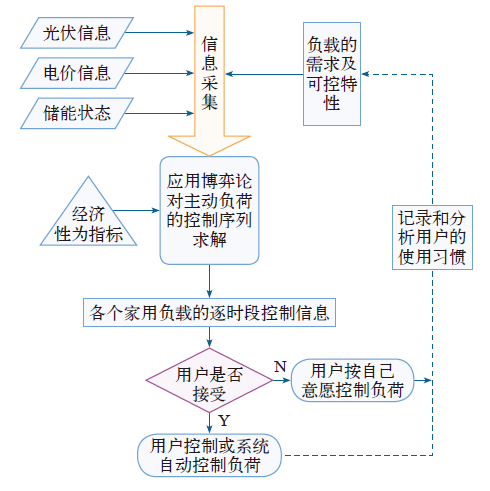
图3
利用博弈论解决主动负荷优化的框架
Fig.3
Framework of the optimization based on the control of active loads using game theory
5 结论及展望
光伏技术发展至今,其应用已逐渐向分布式光伏倾斜,户用光伏微电网(或用户侧微电网)将成为消纳光伏能源的主流方式,但目前的户用光伏微电网系统中缺乏经济运行的指导机制。主动负荷技术旨在通过需求侧的控制实现能量的经济利用,将该项技术引入到户用光伏微电网系统中,可以优化家庭负荷的控制,从而提高用户侧的智能化,节省了系统的运行成本。
本课题预期将实现在现有户用光伏微电网系统的基础上,整合光伏出力的预测信息、实时电价信息以及家庭中各类负荷的可调控特性,通过基于主动负荷的协调控制经济运行方案,得到系统优化运行的控制序列,进而自动地或指导用户对负荷进行控制,最后通过实验对比验证该方案的可实现性和经济高效性。
目前,家庭光伏系统已经能实现发电的检测,随着计量技术和通信技术的发展,将高级计量架构(Advanced Metering Infrastructure,AMI)应用到户用光伏微电网系统中,可实现家庭用电计量的智能化。另外,“智能电表”的出现,可将能效管理系统与实时计量功能结合,把该项技术整合到户用光伏微电网系统中,可实现对户用光伏微电网系统计量、监控及能效管理一体化的设计。
参考文献
基于储能系统的用户光伏并网发电系统经济性分析
[J].
Economic analysis of user's grid-connected PV system based on energy storage system
[J].
面向智能用电的家庭能量协同调度策略
[J].
Co-scheduling strategy of home energy for smart power utilization
[J].
Optimal design and management of a smart residential PV and energy storage system
工业用光伏微网运行策略优化与经济性分析
[J].An economic analysis method and optimal design model of the PV microgrids for industries are proposed in this paper. The economic indexes to evaluate the economic performance of the microgrids include levelized energy cost, emission reduction benefits and payback period. The optimal model considering local solar insolation level and detailed investment costs is established and applied to obtain the optimal configuration of the PV microgrids for four different operation strategies by Particle Swarm Optimization(PSO) method. The simulation results based on three months running data of a 500kW PV microgrid for industries in Guangdong, China, show that the optimal design by the proposed method can meet the technical indicators as well as the economic optimum, and thus effectively optimizing the microgrid with PVs for industries in both economic and environmental way. In addition, the proposed battery tank can not only be used to maximize the utilization of renewable energy, but also enhance the system’s ability of peak load shifting. Besides, the sensitivity of the impact of different parameters and different installed sites on the system is also performed. The results provide a reference for the application of similar projects and basis for the decision-makers of the microgrid with PVs for industries.
Optimization of operation strategies and economic analysis of PV microgrids for industries
[J].An economic analysis method and optimal design model of the PV microgrids for industries are proposed in this paper. The economic indexes to evaluate the economic performance of the microgrids include levelized energy cost, emission reduction benefits and payback period. The optimal model considering local solar insolation level and detailed investment costs is established and applied to obtain the optimal configuration of the PV microgrids for four different operation strategies by Particle Swarm Optimization(PSO) method. The simulation results based on three months running data of a 500kW PV microgrid for industries in Guangdong, China, show that the optimal design by the proposed method can meet the technical indicators as well as the economic optimum, and thus effectively optimizing the microgrid with PVs for industries in both economic and environmental way. In addition, the proposed battery tank can not only be used to maximize the utilization of renewable energy, but also enhance the system’s ability of peak load shifting. Besides, the sensitivity of the impact of different parameters and different installed sites on the system is also performed. The results provide a reference for the application of similar projects and basis for the decision-makers of the microgrid with PVs for industries.
考虑光伏余电上网的微网出力决策分析及经济效益评估
[J].
DOI:10.7500/AEPS20130531009
URL
[本文引用: 1]

Surplus distributed photovoltaic (PV) power sold to the grid with a new compensation price brings opportunities and challenges for optimal microgrid operation. This paper aims at maximizing the net operating earnings of a microgrid. Firstly, the impact of PV compensation price on the operation of microgrid is analyzed, and a decision-making scheduling model considering the subsidies of PV surplus power is established. Then the sequential quadratic programming (SQP) algorithm is utilized to solve the established model. Finally, some case studies are done based on the real data from an actual microgrid system, the differences of microgrid economic benefit with the gird accessed to residential, commercial and industrial areas are compared respectively. The sensitivity analysis is also performed to study the impact of PV capacity and on-grid price on the economic benefits of a microgrid.
Decision analysis and economic benefit evaluation of microgrid power output considering surplus photovoltaic power selling to grid
[J].
DOI:10.7500/AEPS20130531009
URL
[本文引用: 1]
Surplus distributed photovoltaic (PV) power sold to the grid with a new compensation price brings opportunities and challenges for optimal microgrid operation. This paper aims at maximizing the net operating earnings of a microgrid. Firstly, the impact of PV compensation price on the operation of microgrid is analyzed, and a decision-making scheduling model considering the subsidies of PV surplus power is established. Then the sequential quadratic programming (SQP) algorithm is utilized to solve the established model. Finally, some case studies are done based on the real data from an actual microgrid system, the differences of microgrid economic benefit with the gird accessed to residential, commercial and industrial areas are compared respectively. The sensitivity analysis is also performed to study the impact of PV capacity and on-grid price on the economic benefits of a microgrid.
基于动态负荷特性的家用光伏发电系统经济性评价
[J].
Economic assessment of residential photovoltaic system based on dynamic load characteristics
[J].
智能电网环境下家庭能源管理系统研究综述
[J].
DOI:10.1007/s00267-019-01216-0
URL
PMID:31732773
[本文引用: 2]
Cross-regional redeployment (or relocation) of government officials has a significant effect on the local economic development and environmental protection. Based on the panel data of 31 provinces (municipalities) in China from 2001 to 2016 and the environmental pollution index obtained by Entropy method, the dynamic panel regression model was applied to verify the relationship between the officials' cross-regional redeployment and environmental pollution. The results show that environmental pollution was positively correlated with officials' relocation and their tenure after the redeployment. As the officials' tenure increases to the critical value, the positive correlation between the official's tenure and environmental pollution would change. By measuring this threshold, we find that the average critical value for China was 5.14 years, which were the same as the average tenure of Chinese officials. Moreover, the result also illustrates the difference between central eastern China and western China, with the average threshold being 4.01 years and 5.89 years, respectively. In addition, the impact of officials' cross-regional redeployment on the environment would also be affected by the initial condition of the region. According to the result, the environmental governance within the central eastern regions was better than that in the western region. In the last part of this paper, we proposed measures and suggestions, such as changing the incentive policies of officials, perfecting the local policies and the cultivate and exchange system of cadres, as well as strengthen the power of social supervision, for the sake of facilitating the healthy and green development of the regional economy.
Review of home energy management system in smart grid
[J].
DOI:10.1007/s00267-019-01216-0
URL
PMID:31732773
[本文引用: 2]
Cross-regional redeployment (or relocation) of government officials has a significant effect on the local economic development and environmental protection. Based on the panel data of 31 provinces (municipalities) in China from 2001 to 2016 and the environmental pollution index obtained by Entropy method, the dynamic panel regression model was applied to verify the relationship between the officials' cross-regional redeployment and environmental pollution. The results show that environmental pollution was positively correlated with officials' relocation and their tenure after the redeployment. As the officials' tenure increases to the critical value, the positive correlation between the official's tenure and environmental pollution would change. By measuring this threshold, we find that the average critical value for China was 5.14 years, which were the same as the average tenure of Chinese officials. Moreover, the result also illustrates the difference between central eastern China and western China, with the average threshold being 4.01 years and 5.89 years, respectively. In addition, the impact of officials' cross-regional redeployment on the environment would also be affected by the initial condition of the region. According to the result, the environmental governance within the central eastern regions was better than that in the western region. In the last part of this paper, we proposed measures and suggestions, such as changing the incentive policies of officials, perfecting the local policies and the cultivate and exchange system of cadres, as well as strengthen the power of social supervision, for the sake of facilitating the healthy and green development of the regional economy.
电动汽车(V2G 技术)的节能减碳价值研究
[J].
三亚亚龙湾旅游度假区冰蓄冷区域供冷技术的应用
[J].海南三亚亚龙湾国家旅游度假区以冰蓄冷技术为依托,兴建区域供冷中心和区域供冷管网,由供冷中心通过供冷管网向区域范围内的酒店用户提供高质量的低价冷量,在不影响用户原有制冷系统、不需用户再投资的情况下,充分利用低谷电能实现集约化的区域能源供应和电力移峰填谷,从而实现节能和环保的目的,促进地区旅游产业与环境和谐发展.
Technology application of ice-storage district cooling in sanya yalong bay resort district
[J].海南三亚亚龙湾国家旅游度假区以冰蓄冷技术为依托,兴建区域供冷中心和区域供冷管网,由供冷中心通过供冷管网向区域范围内的酒店用户提供高质量的低价冷量,在不影响用户原有制冷系统、不需用户再投资的情况下,充分利用低谷电能实现集约化的区域能源供应和电力移峰填谷,从而实现节能和环保的目的,促进地区旅游产业与环境和谐发展.
实时电价下插电式混合动力汽车智能集中充电策略
[J].Under a spot pricing based electricity market environment,a centralized charging strategy of plug-in hybrid electric vehicles(PHEVs)is proposed based on demand side response.A mathematical model is established taking into account the valley-filling effect of supply side and the userscost.A dynamic estimation interpolation based algorithm is designed to optimize the mathematical model.Finally,a simulation based on an areas predicted data of year2020is made to show that,the proposed centralized charging strategy can not only lower the peak-valley difference,but also save userscost,and achieve a win-win result.
Centralized charging strategies of plug-in hybrid electric vehicles under electricity markets based on spot pricing
[J].Under a spot pricing based electricity market environment,a centralized charging strategy of plug-in hybrid electric vehicles(PHEVs)is proposed based on demand side response.A mathematical model is established taking into account the valley-filling effect of supply side and the userscost.A dynamic estimation interpolation based algorithm is designed to optimize the mathematical model.Finally,a simulation based on an areas predicted data of year2020is made to show that,the proposed centralized charging strategy can not only lower the peak-valley difference,but also save userscost,and achieve a win-win result.
Dynamic residential demand response and distributed generation management in smart microgrid with hierarchical agents
[J].DOI:10.1016/j.egypro.2011.10.035 URL [本文引用: 1]
Dynamic demand response controller based on real-time retail price for residential buildings
[J].
DOI:10.1109/TSG.2013.2264970
URL
[本文引用: 1]
Demand response and dynamic retail pricing of electricity are key factors in a smart grid to reduce peak loads and to increase the efficiency of the power grid. Air-conditioning and heating loads in residential buildings are major contributors to total electricity consumption. In hot climates, such as Austin, Texas, the electricity cooling load of buildings results in critical peak load during the on-peak period. Demand response (DR) is valuable to reduce both electricity loads and energy costs for end users in a residential building. This paper focuses on developing a control strategy for the HVACs to respond to real-time prices for peak load reduction. A proposed dynamic demand response controller (DDRC) changes the set-point temperature to control HVAC loads depending on electricity retail price published each 15 minutes and partially shifts some of this load away from the peak. The advantages of the proposed control strategy are that DDRC has a detailed scheduling function and compares the real-time retail price of electricity with a threshold price that customers set by their preference in order to control HVAC loads considering energy cost. In addition, a detailed single family house model is developed using OpenStudio and Energyplus considering the geometry of a residential building and geographical environment. This HVAC modeling provides simulation of a house. Comfort level is, moreover, reflected into the DDRC to minimize discomfort when DDRC changes the set-point temperature. Our proposed DDRC is implemented in MATLAB/SIMULINK and connected to the EnergyPlus model via building controls virtual test bed (BCVTB). The real-time retail price is based on the real-time wholesale price in the ERCOT market in Texas. The study shows that DDRC applied in residential HVAC systems could significantly reduce peak loads and electricity bills with a modest variation in thermal comfort.
Commercial building load modelling for demand response applications
PV self-consumption optimization with storage and active DSM for the residential sector
[J].DOI:10.1016/j.solener.2011.06.028 URL [本文引用: 1]
主动负荷互动响应行为分析
[J].
DOI:10.7500/AEPS201209024
URL
[本文引用: 1]
Based on the time process characteristic and economic efficiency characteristic of the civilian active load system's interaction demand response,a behavior analysis mode of active load's interaction response is proposed.A demand response operation-decision model is developed to maximize the profits of users and power industries,even with social welfare taken into account.Then an evaluation index system is proposed that can represent and identify the physical features of the interactive response behavior among usersenergy demands,electricity demands and the cooperation between distributed renewable energy and grid by the decoupling response behaviors between users' energy consuming load and electric load.Finally,the effectiveness of the model and index system proposed is verified by an analysis of the residential and commercial quarters active load system's response behavior in the heavy space cold load grid,respectively,the active load system consisting of cold storage air conditioning and distributed wind generation in the heavy air-conditioning cold load grid.
Analysis of active load's interaction response behavior
[J].
DOI:10.7500/AEPS201209024
URL
[本文引用: 1]
Based on the time process characteristic and economic efficiency characteristic of the civilian active load system's interaction demand response,a behavior analysis mode of active load's interaction response is proposed.A demand response operation-decision model is developed to maximize the profits of users and power industries,even with social welfare taken into account.Then an evaluation index system is proposed that can represent and identify the physical features of the interactive response behavior among usersenergy demands,electricity demands and the cooperation between distributed renewable energy and grid by the decoupling response behaviors between users' energy consuming load and electric load.Finally,the effectiveness of the model and index system proposed is verified by an analysis of the residential and commercial quarters active load system's response behavior in the heavy space cold load grid,respectively,the active load system consisting of cold storage air conditioning and distributed wind generation in the heavy air-conditioning cold load grid.
A customer-interactive electric water heater demand-side management strategy using fuzzy logic
[C].
Voltage control of aggregate electric water heater load for distribution system peak load shaving using field data
面向智能电网的用户需求响应特性和能力研究综述
[J].
DOI:10.13334/j.0258-8013.pcsee.2014.22.010
URL
[本文引用: 1]
区别于传统能效项目,需求响应项目的执行效果取决于项目的参与率和用户响应特性及能力。总结目前国内外各类需求响应项目中用户响应特性方面的研究进展,对其影响因素进行归类研究;介绍负荷价格弹性、替代弹性和弧弹性等3种定量用户价格响应特性的方式,并对其影响因素从时间跨度、行业类别和其他差异化特性等3方面进行分析;此外,从需求响应支撑技术、需求响应项目设计等两个大方面分析其对用户需求响应特性和能力的影响。最后,结合中国国情对于用户响应特性建模和需求响应项目设计方面提出设想和建议。
Research on consumers' response characterics and ability under smart grid: a liter atures survey
[J].
DOI:10.13334/j.0258-8013.pcsee.2014.22.010
URL
[本文引用: 1]
区别于传统能效项目,需求响应项目的执行效果取决于项目的参与率和用户响应特性及能力。总结目前国内外各类需求响应项目中用户响应特性方面的研究进展,对其影响因素进行归类研究;介绍负荷价格弹性、替代弹性和弧弹性等3种定量用户价格响应特性的方式,并对其影响因素从时间跨度、行业类别和其他差异化特性等3方面进行分析;此外,从需求响应支撑技术、需求响应项目设计等两个大方面分析其对用户需求响应特性和能力的影响。最后,结合中国国情对于用户响应特性建模和需求响应项目设计方面提出设想和建议。
A distributed algorithm of appliance scheduling for home energy management system
[J].
DOI:10.1109/TSG.2013.2291003
URL
[本文引用: 1]
Demand side management encourages the users in a smart grid to shift their electricity consumption in response to varying electricity prices. In this paper, we propose a distributed framework for the demand response based on cost minimization. Each user in the system will find an optimal start time and operating mode for the appliances in response to the varying electricity prices. We model the cost function for each user and the constraints for the appliances. We then propose an approximate greedy iterative algorithm that can be employed by each user to schedule appliances. In the proposed algorithm, each user requires only the knowledge of the price of the electricity, which depends on the aggregated load of other users, instead of the load profiles of individual users. In order for the users to coordinate with each other, we introduce a penalty term in the cost function, which penalizes large changes in the scheduling between successive iterations. Numerical simulations show that our optimization method will result in lower cost for the consumers, lower generation costs for the utility companies, lower peak load, and lower load fluctuations.
A survey of game theoretic approaches in smart grid
灵活互动的智能用电展望与思考
[J].
Outlook and thinking of flexible and interactive utilization of intelligent power
[J].
Game-theoretic methods for the smart grid: an overview of microgrid systems, demand-side management, and smart grid communications
[J].DOI:10.1109/MSP.2012.2186410 URL [本文引用: 1]
博弈论在电力系统中典型应用及若干展望
[J].
DOI:10.13334/j.0258-8013.pcsee.2014.29.002
URL
[本文引用: 2]
博弈论作为一种先进的优化工具,主要用于研究多个利益相关主体如何进行优化决策的问题。随着智能电网的快速发展,现代电力系统在发电、配电、用电等多个环节的参与者呈多样化特征。在此环境下,博弈论为多决策主体优化问题提供了新的解决途径。论文首先介绍了博弈论的基本概念和分类,然后从电力系统规划、电力市场、调度、控制等方面阐述并总结了博弈论的四项典型应用示例。最后,从可再生能源发电、微电网、需求响应、电网演化和博弈均衡求解方法等多个方面论述了值得深入研究的关键科学问题。希望该文的工作对推动博弈论在电力系统中的应用能够起到积极作用。
Typical applications and prospects of game theory in power system
[J].
DOI:10.13334/j.0258-8013.pcsee.2014.29.002
URL
[本文引用: 2]
博弈论作为一种先进的优化工具,主要用于研究多个利益相关主体如何进行优化决策的问题。随着智能电网的快速发展,现代电力系统在发电、配电、用电等多个环节的参与者呈多样化特征。在此环境下,博弈论为多决策主体优化问题提供了新的解决途径。论文首先介绍了博弈论的基本概念和分类,然后从电力系统规划、电力市场、调度、控制等方面阐述并总结了博弈论的四项典型应用示例。最后,从可再生能源发电、微电网、需求响应、电网演化和博弈均衡求解方法等多个方面论述了值得深入研究的关键科学问题。希望该文的工作对推动博弈论在电力系统中的应用能够起到积极作用。
风–光–储混合电力系统的博弈论规划模型与分析
[J].A planning model for the grid-connected hybrid power system based on the game theory is proposed through analysis of the characteristics of the wind power, photovoltaic generation and storage batteries in power industries. The players in the game model, i.e. wind power, photovoltaic generation and storage battery, maximize their own profits by choosing their capacities individually, taking into account the life cycle cost, the system reliability and the environment profits, etc. This paper discusses five different game scenarios, one non-cooperative game and four cooperative games, and illustrates the existence of their equilibriums. The analysis of the corresponding equilibriums indicates that the coalition values are all positive, and the payoffs of all the four cooperative games are larger than that of the non-cooperative game. It is also shown that the cooperation of wind power and photovoltaic generation is the best way to realize the reliable and cost effective generation.
A game theory based planning model and analysis for hybrid power system with wind generators-photovoltaic panels-storage batteries
[J].A planning model for the grid-connected hybrid power system based on the game theory is proposed through analysis of the characteristics of the wind power, photovoltaic generation and storage batteries in power industries. The players in the game model, i.e. wind power, photovoltaic generation and storage battery, maximize their own profits by choosing their capacities individually, taking into account the life cycle cost, the system reliability and the environment profits, etc. This paper discusses five different game scenarios, one non-cooperative game and four cooperative games, and illustrates the existence of their equilibriums. The analysis of the corresponding equilibriums indicates that the coalition values are all positive, and the payoffs of all the four cooperative games are larger than that of the non-cooperative game. It is also shown that the cooperation of wind power and photovoltaic generation is the best way to realize the reliable and cost effective generation.
Demand response based on stackelberg game in smart grid
Autonomous demand-side management based on game-theoretic energy consumption scheduling for the future smart grid
[J].DOI:10.1109/TSG.2010.2089069 URL [本文引用: 1]


