
1 引言
为实现低碳、环保、绿色以及可持续发展的能源战略,近几年我国大力发展可再生能源,特别是在风电能源的开发与利用领域有了长足发展。预计到2020年,我国风电总装机容量将超过2亿kW,其中海上风电装机容量达到3 000万kW,风电年发电量达到3 900亿kW·h,风电发电量在全国发电量中的比重超过5%[1,2]。根据“十二五”规划,我国已在河北、蒙东、蒙西、吉林、甘肃、山东、江苏、新疆和黑龙江建立九大风电基地[2]。上述风电基地中除山东和江苏外,其余七大风电基地所属地区电网规模有限,必须通过远距离输电,扩大风电消纳范围,才能进一步增加风电开发规模[3]。为解决大规模风电外送问题,一般采用串补交流输电技术与高压直流输电技术。但串联补偿与高压直流输电(High Voltage Direct Current,HVDC)技术可能会诱发风电机组的次同步振荡(Sub-Synchronous Oscillation,SSO)问题,影响风电场以及外送系统的安全稳定运行[4,5,6,7,8,9,10]。
在大规模风电外送过程中,经串补与HVDC送出均有可能引发风电机组的次同步振荡,但发生机理与相关特性并不相同。本文首先介绍了三种典型风电机组的基本结构,进而分别归纳了大规模风电经串补与HVDC送出过程中次同步振荡的发生机理、相关特性以及抑制措施,总结了适用于大规模风电送出系统次同步振荡问题的分析方法,最后对于大规模风电外送过程中的次同步振荡问题未来的研究思路予以展望。
2 典型风电机组结构介绍
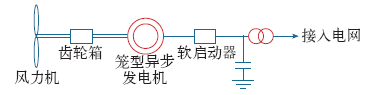
目前,在风力发电领域广泛应用的风力发电机组主要有三种类型,即固定转速的笼型异步风电机组、可调速的双馈异步风电机组和永磁直驱同步风电机组[15]。
2.1 笼型异步风电机组
图1
2.2 双馈异步风电机组(DFIG)
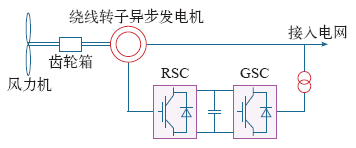
如图2所示,DFIG采用绕线转子异步发电机,其定子直接与电网相连,转子侧通过换流器与电网相连,是目前主流的风力发电机组。其中,与发电机相连的换流器称为转子侧换流器(Grid Side Converter,GSC),与电网相连的换流器称为网测换流器(Rotor Side Converter,RSC)。发电机向电网输出的总功率由定子侧输出功率和转子侧通过换流器输出的转差功率组成,因此称为双馈电机。通过换流器的动态调节作用,可实现风电机组的变速运行,有功、无功解耦控制[17]。DFIG的主要优点包括:可以连续变速运行,风能转换率高;换流器容量为风力发电机组额定容量的25%〜30%,换流器成本相对较低;功率因数高,并网简单,无冲击电流[15]。由于存在齿轮箱,DFIG的维护保养费用要高于无齿轮箱的永磁直驱风电机组。
图2
2.3 永磁直驱同步风电机组
永磁直驱同步风电机组结构如图3所示,主要由风力机、永磁同步发电机、全功率电力电子换流器等设备以及控制系统构成。全功率换流器传递所有来自风电机组的功率,起到有效隔离发电机与电网的作用。因此,发电机的电气频率可以随着风速的变化而变化,而电网频率恒定,实现风电机组的变速运行。永磁直驱同步发电机组的主要优势包括:风力机与发电机直接相连,省去齿轮箱,降低了风电机组的维护成本,提高了机组工作寿命和可靠性;接入电网稳定性好,具有较好的低电压穿越能力,当电网电压突然跌落时,能够不间断并网运行,有利于维持电网稳定;采用无齿轮直驱技术,减少了机组零部件数量,缩短了生产周期[18]。永磁直驱风电机组采用全功率换流器、永磁材料等成本较高的材料,同时发电机结构复杂、重量较大,这些因素都限制了其发展。
图3
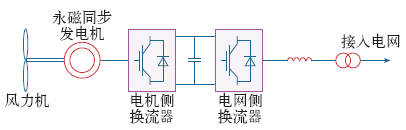
图3
永磁直驱同步风电机组结构图
Fig.3
Structure of direct-drive permanent magnet synchronous wind generator
3 大规模风电经串补送出时的次同步振荡问题
在大规模风电经串补送出过程中,由于风机的轴系自然扭振频率较低(1〜2Hz),需很高的串补度才能激发轴系扭振模态,工程实际中的串补度难以满足其激发条件,风电机组发生SSR的概率较小[8]。而SSTI指风电机组控制器或者相邻的FACTS装置控制器与风电机组轴系之间的作用,在经串补送出过程不会发生。因此,大规模风电经串补送出过程中的SSR和SSTI问题并不严重,发生概率较大的是由风电机组控制器和固定串补相互作用引起的SSCI。
3.1 SSCI问题
SSCI问题是随着风电发展出现的不同与火电机组次同步振荡类型的新型振荡形式。SSCI由风电机组控制器与固定串补相互作用引起,主要由风电机组控制器参数和输电系统参数共同决定,与轴系固有模态频率无关[19]。
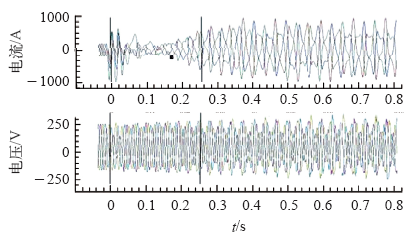
2009年9月,在美国德克萨斯州的某风电场发生了一起SSCI事故,造成风力发电机组大量跳机以及内部撬棒电路损坏[20]。这是目前公布的第一起SSCI事故,事故起因是该风电场附近一条线路发生接地故障并断开[12],导致系统接线方式发生变化,形成该风电场与系统经带固定串补的单回线路相连的辐射状供电方式。故障发生后,风力发电机组控制系统与固定串补间出现持续增大的振荡现象,电压电流畸变严重[21,22]。事故发生时发电机端口电压、输出电流录波如图4所示,可以看出,故障发生后0.25s时,电流增大到额定值的300%左右,电压增大到150%左右,故障发生3s后,固定串补保护装置将线路的固定串补旁路,振荡逐渐被抑制[20]。
图4
对于SSCI的特性分析,在控制器参数方面,文献[26]研究表明,随着转子侧电流控制回路的内环比例增益的增大,系统趋向于不稳定。文献[13]认为转子侧电流控制回路的快速、直接特性是引起SSCI的主要原因。文献[27]通过频率扫描和特征值分析认为SSCI的参与因子主要是电网和发电机的状态变量,而与控制有关的状态变量对振荡影响较小,驱动系统状态变量则没有参与。文献[28]通过特征值分析,结果表明转子侧变换器内环电流控制对振荡模态影响较小。在系统参数方面,研究表明风速与串补度均会对SSCI产生影响。文献[26,28]通过特征值分析,得到风速对系统稳定性的影响。结果表明,随着风速减小,系统趋向于不稳定。文献[26]研究认为随着串补度的提高,系统趋向于不稳定。串补度小于70%,线路电抗X的变化对稳定性影响不大;串补度大于70%,随着X的增大,系统趋向于不稳定。
3.2 典型风电机组的SSCI特性
三种典型风电机组,笼型异步风电机组、双馈异步风电机组和永磁直驱同步风电机组,由于结构和控制策略不同,其SSCI特性也不同。
笼型异步风电机组中,发电机直接与电网相连,不存在电力电子控制装置,所以不存在SSCI问题。文献[23]利用多机系统模型在PSCAD中进行仿真,当转子有功突然变化时,定子输出电压、有功和串补上的电流经过短时间的小幅振荡后变得稳定,说明笼型异步型风电机组不存在SSCI问题。文献[8,29]的研究也认为笼型异步型风电机组不存在SSCI问题。
3.3 SSCI抑制措施
自发生第一起SSCI问题以来,国内外的相关机构意识到此问题的重要性,并取得了一些初步的研究成果,提出了一些抑制SSCI的措施。目前提出的解决SSCI问题的措施如下:
(2)改变系统运行方式。第一次SSCI事故是在风电场电力输出经固定串补送出的情况下,而在其他运行方式下则没有出现该问题。因此,在规划系统运行方式时,可以基于电磁暂态程序分析各个运行方式下系统发生SSCI的可能性,避免有可能引发SSCI的运行方式出现。但目前由于风电机组厂家所采用的控制策略不同,并且出于知识产权问题通常不公开其代码,对风力发电机组建立其电磁暂态模型存在一定的困难。文献[30,32]对系统多种紧急情况进行了仿真,得到了可能发生SSCI的运行方式,在实际运行时应尽量避免。
(3)合理安排各个类型风电机组的比例。文献[23]研究结果表明,永磁同步型风电机组不仅不会引发SSCI问题,而且能够提供正阻尼,在一定程度上抑制SSCI。在风电场的规划设计阶段,合理安排DFIG和永磁同步型风电机组所占的比例,利用永磁同步型风电机组对SSCI的正阻尼特性抵消DFIG机组的负阻尼,能够在一定程度上缓解SSCI问题。
(4)将固定串补替换为TCSC。可控串补(TCSC)是串联补偿装置的典型代表,具有快速灵活的调节性能。TCSC采用主动阻尼控制后,能明显提高系统阻尼,工程上已用来抑制火电机组的SSR[33]。因此,可以考虑在风电送出时采用TCSC补偿,但这种措施成本较固定串补高。
(5)安装SSCI 保护继电器。与火电机组装设的扭应力继电器(Torsional Stress Relay,TSR)设备类似,风力发电机组生产厂家要考虑到SSCI的危害性,装设SSCI继电器。当SSCI发生时,要及时跳开风力发电机组,防止对风力发电机组造成损害。文献[34]设计了一种用于检测SSCI的继电器,当SSCI发生时,继电器检测到后动作报警或跳闸。
4 大规模风电经HVDC送出时的次同步振荡问题
4.1 国内外研究现状
目前,SSTI问题主要出现在火电机组经HVDC送出系统中。由于风电发展较晚,在实际工程中,风电经HVDC送出尚未发生SSTI问题。国内外主要研究多集中在火电机组的SSTI问题。文献[37]建立了定速风机风电场与LCC-HVDC输电线路相连的数学模型,通过参与因子和灵敏度分析发现,该类型风电场与HVDC之间不会发生SSTI。文献[38]建立了基于永磁直驱同步发电机风电场经HVDC送出的数学模型,使用模态控制理论设计PID整流侧电流调节器和PID逆变侧电流调节器,有效抑制了系统的低频振荡。文献[39]初步研究了笼型异步风力发电机经HVDC送出时的次同步振荡问题。虽然针对大规模风电经HVDC送出系统的次同步振荡问题研究较少,但是相对于火电机组,风电机组更容易发生次同步振荡,这是因为双馈异步风电机组和永磁直驱风电机组轴系自然扭振频率相对较低(0〜10Hz),而直流输电对较低的扭振频率更容易引起电气负阻尼作用[8]。
4.2 风电场等值方法
由于HVDC系统复杂的调节特性,采用时域仿真法研究风电经HVDC送出时的次同步振荡问题是合理有效的。然而,时域仿真会受到计算机内存和仿真时间的限制,仿真规模不能过大,对于含大量风电机组的风电场直接进行时域仿真在现阶段是不可行的。因此,需要采用适当的风电场等值方法对规模庞大的风电场进行等值,相关研究如下。
用一台风电机组模拟风电场中所有风电机组的方法[39,40]。这种方法中,所有风电机组通过出口变压器接于同一母线,忽略风速分布、功率损耗等因素,简单易行,但只能用于理想风电场的等值建模中。考虑风速差异影响的方法[41,42]。该方法考虑了不同区段因尾流效应造成的风速差异,将每个区段的风电机组用一台风电机组等值,但忽略了一些约束并且以风力机群运行条件一致为前提,这与实际情况中风电机组类型不尽相同的现状不符。参数辨识等值建模法[43],这种方法借鉴同步发电机同调等值中传递函数的概念,基于异步机模型,使用频域响应辨识法的改进算法对异步发电机的同步电抗、暂态电抗、转子时间常数和初始转差进行最小二乘法拟合求取风电场的等值参数。
上述方法对于风电机组与高压直流输电系统的相互作用缺乏关注,且外送直流模型结构简单,与实际工程有一定差距。文献[44]建立了大规模“风火打捆”经直流外送数模混合仿真系统,但主要用于研究外送过程中的协调控制策略,不针对于风电机组的次同步振荡问题。
4.3 SSTI抑制措施
由于目前在风电经HVDC送出过程中尚未发生过SSTI问题,对SSTI抑制措施的研究主要集中于火电机组的SSTI抑制措施。文献[17]提出在转子侧换流器控制中加入一个阻尼环节抑制风电机组的SSTI,其PI控制器参数须与轴系固有频率以及其他变频器控制参数相协调。文献[45]提出,当HVDC系统需要降压运行时,应相应降低直流功率或维持与强交流系统的连接,以避免扭振不稳定问题。传统的火电经HVDC送出工程中,在HVDC 控制器中附加次同步阻尼控制器(Sub-Synchronous Damping Controller,SSDC)与在机端附加机端阻尼控制器等方法,对于火电机组的SSTI问题起到了一定的抑制效果[46,47]。
5 大规模风电送出系统的次同步振荡问题分析方法
对于次同步振荡问题的分析方法,通常根据使用方式和分析结果详略的不同,分为“筛选法”和“精确分析法”[4]。“筛选法”包括机组作用系数分析法、阻抗扫描分析法,主要用于定性分析和筛选,从众多发电机组中选出存在次同步振荡风险的机组及运行工况,计算方法简单,但结果的误差较大。“精确分析法”包括特征值法、复转矩系数法和时域仿真法,可以比较精确和定量地研究系统次同步振荡的详细特性,但计算复杂、速度慢,主要用于次同步振荡问题的深入分析。由于机组作用系数分析法针对于火电机组的SSTI问题,本文将不再赘述。
5.1 阻抗扫描分析法
阻抗扫描分析法,又称频率扫描分析法,是一种用于串补系统次同步振荡分析的工具,可以筛选出具有潜在谐振风险的系统运行条件[50]。使用该方法时,需将研究的系统用正序网络来模拟;除了待研究发电机之外,网络中其他发电机用次暂态电抗等值,而待研究发电机采用其异步发电机等效模型等值。针对各个频率,计算从待研究发电机转子向系统侧看过去的次同步振荡等值阻抗,并根据其实部和虚部随频率变化的曲线,对次同步振荡风险进行初步估计。
次同步等值阻抗频率特性曲线扫描模型如图5 所示,在加入单位电流源后,其两端电压的实部就是等值电阻,虚部就是等值电抗,当单位电流源频率从0变化到50Hz时,就得到了等值阻抗频率特性曲线。对于单机串联补偿系统,找到等效电抗为零时的串联谐振频率,研究该谐振频率点的特性即可判别系统是否存在发生次同步振荡的可能性。对于多机系统或者有并联的其他线路时,等值阻抗频率特性曲线中可能不存在电抗过零点,但在曲线中将出现电抗跌落现象。等效电抗跌折达到极小值的频率点与机组轴系扭振自然频率接近互补并且跌折度大于5% , 就有可能存在扭转相互作用或扭矩放大作用。
图5
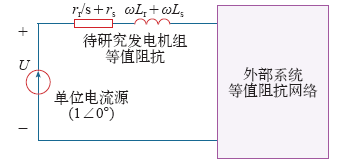
图5
等效阻抗频率特性计算模型
Fig.5
Calculation model of equivalent impedance-frequency charateristic
阻抗扫描法所需成本低,方法简单,多用于定性筛选有次同步振荡风险的机组[51]。但该方法存在以下缺点:该方法只适用于线性元件的计算,系统中存在电力电子元件时,该方法将遇到困难;该方法不考虑运行工况变化以及控制器动态特性的影响,难以分析机电扭转相互作用问题;同步发电机模型被简化,分析结果精度受到影响。
5.2 特征值法
特征值分析法又称模态分析法,是通过建立系统的小扰动线性化模型,求解特征值、特征向量等来分析系统的动态响应的方法。特征值分析法是控制理论中最基础的分析方法,构成了动态系统分析的理论基础,是校验其他分析方法正确性的基本工具,其优点是理论严密,物理概念清晰,分析准确度高,可得到大量有用信息,容易进行控制对策研究,通过比较控制对策施加前后特征根的变化确定其效果,而且有多种通用的特征根分析软件工具,便于分析工作的开展[36]。特征根分析法是小扰动分析方法,可以用于分析除暂态转矩放大作用之外的各种次同步振荡问题,对于简单系统非常有效,在次同步振荡研究中已经得到了广泛应用,一般在工程上可将多机系统化简后用特征值法进行分析。
特征值法主要缺点为:存在严重的“维数灾”问题,例如n质量块轴系模型的动态方程为2n维,“维数灾”问题甚至严重于低频振荡分析,并且随着电力系统的规模越来越大;只能得到若干孤立点的动态特性,不能进行连续频率的特性分析,且特征值与元件参数、运行参数的关系难以进行显式表达。
5.3 复转矩系数法
复转矩系数分析法是I. M. Canay先生于1982年提出的一种次同步振荡分析方法[52]。I.M.Canay将起源于电气系统的概念推广到轴系机械系统,首次提出了“机械系统复转矩系数”概念,同时采用了机械力学中常用的名称,将其实部、虚部分别称为弹性转矩系数和阻尼转矩系数,建立了包括电气、机械两部分作用的扭振方程和稳定判据,从而形成了复转矩系数分析法,在次同步振荡研究中得到广泛的应用,成为了次同步振荡的经典分析方法之一。
对于电气复转矩系数,既可以通过系统的传递函数模型推导得到,也可以通过时域响应曲线计算得到,而机械系统复转矩系数通常采用传递函数模型计算得到,然后再根据前面的稳定判据来分析轴系的稳定性[53]。而电气转矩时域响应曲线可以通过物理系统的测试得到,也可以通过仿真软件进行时域计算得到,其中仿真方法速度快、成本低,得到了越来越多的应用。
5.4 时域仿真法
时域仿真分析法就是用数值积分的方法来逐步求解系统动态特性的微分方程组,得到系统状态变量的时域响应曲线,从而分析系统动态特性的方法。时域仿真包括电磁暂态仿真、机电暂态仿真和中长期动态仿真。由于次同步振荡频率远离工频,在次同步振荡中所说的时域仿真法都是指基于电磁暂态仿真的方法。
电磁暂态仿真需要对元件从数微秒至数秒之间的电磁暂态过程进行仿真模拟,可以考虑输电线路分布参数特性和参数的频率特性、发电机的电磁和机电暂态过程以及一系列元件(如:避雷器、变压器、电抗器等)的非线性特性。普遍采用的电磁暂态仿真程序有:电磁暂态程序(EMTP),以及由中国电力科学研究院在EMTP基础上开发的EMTPE,加拿大Manitoba直流研究中心开发的PSCAD/ EMTDC等。这些软件在电力系统分析中得到了大量的应用,其准确性、稳定性得到了比较全面的验证。
与频域分析法相比,时域仿真法主要有以下优点:广泛的模型适用性;可详细模拟各种控制和故障过程;可分析不同强度的扰动响应;能得到精确的时域计算结果,直观、准确地反映系统各个参量随时间变化的轨迹;可通过时域仿真计算复转矩系数、次同步等效电抗等,分析系统次同步振荡特性[54]。
6 研究展望
目前,我国具备建设大型风电基地厂址条件的区域主要集中在内蒙古、吉林西部、甘肃酒泉地区、新疆哈密地区、河北张家口地区以及江苏和山东沿海区域。其中大部分位于较偏远地区,区域内风电消纳能力有限,迫切需要建设跨区输电通道,进行大规模风电外送[3]。针对大规模风电送出系统的次同步振荡问题研究尚不全面,相关机理与影响因素分析不准确,未来在如下几方面亟待深入研究:
(1)大规模风电经串补送出系统的多机次同步振荡问题分析。现有针对风电机组SSCI问题研究大多以单机无穷大系统为背景,未考虑不同风电机组间的相互作用。对于导致SSCI问题的关键参数,大多研究仅进行了定性分析,无法定量得到相关参数。相应的抑制措施同样未考虑对风电机组种类和数量较多的大规模风电场的适用性。
(2)大规模风电经HVDC送出系统的多机次同步振荡问题分析。现有研究多针对火电机组经HVDC送出时的次同步振荡问题,对风电的关注较少,特别是对目前应用最广的DFIG在经HVDC送出系统中可能出现的次同步振荡问题。由于大规模风电经HVDC送出时一般与火电捆绑外送,风火打捆比例、风电火电相互作用等因素均可能影响外送系统的次同步振荡特性。关于这方面的研究基本处于空白。
参考文献
通过特高压直流实现大型能源基地风,光,火电力大规模高效率安全外送研究
[J].
DOI:10.13334/j.0258-8013.pcsee.2014.16.001
URL
[本文引用: 2]

化石能源消耗引起的环境问题日益突出,风力发电作为技术最成熟的清洁能源在全球范围内得到迅速的发展和应用。近10年来,我国风电发展迅猛,风电装机已跃居全球第一。目前,风电资源富集的西北、东北和华北地区消纳风电的空间趋于饱和,光伏发电也进入大规模发展阶段,迫切需要跨区外送。文章分析我国风电运行面临的主要问题,对位于我国东北和西北地区的大型能源基地通过特高压直流工程实现风、光、火电力大规模、高效率、安全外送的可行性进行系统的分析研究。提出基于年度输电量和典型风、光发电曲线的配套电源装机容量优化计算方法和调度生产模拟方法及其安全经济运行的必要条件。并结合新疆哈密至河南郑州特高压直流工程进行分析计算,优化配套的装机容量,提出重大电网安全技术措施。研究结果表明,在保障电力系统安全稳定的基础上,通过优化风、光、火电装机容量可以最大限度地减少弃风、弃光容量,从而实现我国大型能源基地及其风电、光伏等清洁能源的集约高效开发和利用。对优化调整我国电源结构、加快治理大气污染、实现节能减排目标具有重要意义。
Efficient and security transmission of wind, photovoltaic and thermal power of large-scale energy resource bases through UHVDC projects
[J].
DOI:10.13334/j.0258-8013.pcsee.2014.16.001
URL
[本文引用: 2]
化石能源消耗引起的环境问题日益突出,风力发电作为技术最成熟的清洁能源在全球范围内得到迅速的发展和应用。近10年来,我国风电发展迅猛,风电装机已跃居全球第一。目前,风电资源富集的西北、东北和华北地区消纳风电的空间趋于饱和,光伏发电也进入大规模发展阶段,迫切需要跨区外送。文章分析我国风电运行面临的主要问题,对位于我国东北和西北地区的大型能源基地通过特高压直流工程实现风、光、火电力大规模、高效率、安全外送的可行性进行系统的分析研究。提出基于年度输电量和典型风、光发电曲线的配套电源装机容量优化计算方法和调度生产模拟方法及其安全经济运行的必要条件。并结合新疆哈密至河南郑州特高压直流工程进行分析计算,优化配套的装机容量,提出重大电网安全技术措施。研究结果表明,在保障电力系统安全稳定的基础上,通过优化风、光、火电装机容量可以最大限度地减少弃风、弃光容量,从而实现我国大型能源基地及其风电、光伏等清洁能源的集约高效开发和利用。对优化调整我国电源结构、加快治理大气污染、实现节能减排目标具有重要意义。
混合串联补偿装置抑制次同步谐振的研究
[J].This paper analyzes the principle of hybrid series compensator (HSC), which is composed by static synchronous series compensator (SSSC) and fixed series capacitor (FSC). The impact of installation location and compensation ratio of HSC on electrical damping is studied. Results show HSC can weaken but can’t damp out the SSR problems without active damping. The principle of SSSC to actively damp sub-synchronous resonance (SSR) is proposed, which is realized by modulating the voltage (reactance) reference value of SSSC sub-synchronously, and then injecting voltage with appropriate amplitude and phase so as to generate the current components of the complementary frequencies and produce corresponding damping torque of generator. Based on this principle, active damping controller is designed. Complex torque coefficient method and time domain simulation results show that HSC can damp SSR effectively with active damping strategy.
Study of HSC on sub-synchronous resonance damping
[J].This paper analyzes the principle of hybrid series compensator (HSC), which is composed by static synchronous series compensator (SSSC) and fixed series capacitor (FSC). The impact of installation location and compensation ratio of HSC on electrical damping is studied. Results show HSC can weaken but can’t damp out the SSR problems without active damping. The principle of SSSC to actively damp sub-synchronous resonance (SSR) is proposed, which is realized by modulating the voltage (reactance) reference value of SSSC sub-synchronously, and then injecting voltage with appropriate amplitude and phase so as to generate the current components of the complementary frequencies and produce corresponding damping torque of generator. Based on this principle, active damping controller is designed. Complex torque coefficient method and time domain simulation results show that HSC can damp SSR effectively with active damping strategy.
基于实时数字仿真器的SVC抑制次同步振荡的研究
[J].DOI:10.7667/j.issn.1674-3415.2010.23.002 URL [本文引用: 1]
Study on mitigation of SSO with SVC based on RTDS
[J].DOI:10.7667/j.issn.1674-3415.2010.23.002 URL [本文引用: 1]
无功发生源抑制次同步振荡的机理分析
[J].The mechanism of static var source depressing power system subsynchronous oscillations(SSO) is analyzed detailedly, and then the mathmatical expression of supplementary electrical damping along with its influencing factors are put forward. A multiple mass-lumped model of a generating unit and its decoupled equations of motion are established too. Furthermore, the effectiveness of static var source connected to the network to improve subsynchronous oscillation damping characteristics is testified analytically. Finally, the electromagnetic transient model of single machine power system including a fixed series compenstion capacitor is established by real-time digital simulator (RTDS). The simulation results show that it is effective for static var source to depress the subsynchronous oscillations of the generator.
Mechanism analysis of static var source depressing subsynchronous oscillations
[J].The mechanism of static var source depressing power system subsynchronous oscillations(SSO) is analyzed detailedly, and then the mathmatical expression of supplementary electrical damping along with its influencing factors are put forward. A multiple mass-lumped model of a generating unit and its decoupled equations of motion are established too. Furthermore, the effectiveness of static var source connected to the network to improve subsynchronous oscillation damping characteristics is testified analytically. Finally, the electromagnetic transient model of single machine power system including a fixed series compenstion capacitor is established by real-time digital simulator (RTDS). The simulation results show that it is effective for static var source to depress the subsynchronous oscillations of the generator.
大规模风电外送中的次同步振荡问题
[J].
Review of sub-synchronous oscillation with large-scale wind power transmission
[J].
呼辽直流工程次同步振荡的数模混合仿真
[J].HVDC system may cause sub-synchronous oscillation (SSO) occurred in thermal power units near rectifier station. To ensure secure and stable operation of AC/DC power transmission system from Hulun Buir to Liaoning, the possibly occurred subsynchronous oscillation (SSO) of turbogenerating units in Hulun Buir League, which might be caused by HVDC power transmission system from Hulun Buir to Liaoning, is studied by digital-analog hybrid simulator, and the risk of occurring SSO under different operation modes of AC/DC power transmission system from Hulun Buir to Liaoning is analyzed in depth, besides, the impacts of operating conditions of HVDC power transmission system on SSO are studied. The effectivity of adopting SSO damping controller in control system of HVDC power transmission project is verified by results of hybrid digital-analog hybrid simulation, and corresponding suggestions are given.
Digital-analog hybrid simulation study on subsynchronous oscillation of ±500kV DC transmission project from Hulun Buir to Liaoning
[J].HVDC system may cause sub-synchronous oscillation (SSO) occurred in thermal power units near rectifier station. To ensure secure and stable operation of AC/DC power transmission system from Hulun Buir to Liaoning, the possibly occurred subsynchronous oscillation (SSO) of turbogenerating units in Hulun Buir League, which might be caused by HVDC power transmission system from Hulun Buir to Liaoning, is studied by digital-analog hybrid simulator, and the risk of occurring SSO under different operation modes of AC/DC power transmission system from Hulun Buir to Liaoning is analyzed in depth, besides, the impacts of operating conditions of HVDC power transmission system on SSO are studied. The effectivity of adopting SSO damping controller in control system of HVDC power transmission project is verified by results of hybrid digital-analog hybrid simulation, and corresponding suggestions are given.
贵广二回直流输电系统次同步振荡问题分析
[J].To investigate the subsynchronous oscillation(SSO) problem of the steam turbine generators near the rectifier station of Guizhou-GuangdongⅡ±500 kV DC transmission link, the unit interaction factor(UIF) analysis and the time domain simulation methods are adopted. NETOMAC program is used and detailed system model suitable for SSO study is built for time domain transient simulations. Based on the analysis considering different operation modes and load flow situations, it is concluded that the unstable SSO can occur at islanded operation of rectifier station or if only a weak interconnection existing between rectifier station and the rest of the AC system. The design of a supplementary SSO damping controller of the HVDC transmission link is recommended.
Analysis of the SSO problem caused by Guizhou-Guangdong II HVDC transmission system
[J].To investigate the subsynchronous oscillation(SSO) problem of the steam turbine generators near the rectifier station of Guizhou-GuangdongⅡ±500 kV DC transmission link, the unit interaction factor(UIF) analysis and the time domain simulation methods are adopted. NETOMAC program is used and detailed system model suitable for SSO study is built for time domain transient simulations. Based on the analysis considering different operation modes and load flow situations, it is concluded that the unstable SSO can occur at islanded operation of rectifier station or if only a weak interconnection existing between rectifier station and the rest of the AC system. The design of a supplementary SSO damping controller of the HVDC transmission link is recommended.
串联补偿技术在远距离高电压交流输电系统中的应用
[J].
Series compensation for a long distance AC transmission system
[J].
Sub-synchronous control interactions between type 3 wind turbines and series compensated AC transmission lines
[C].
Sub-Synchronous Control Interaction studies between full-converter wind turbines and series-compensated AC transmission lines
[C].
ERCOT experience with sub-synchronous control interaction and proposed remediation
[C].
Event of 10-22-09
[C].
Transmission operator perspective of sub-synchronous interaction
[C].
Susceptibility of wind turbines to sub-synchronous control and torsional interaction
[C].
Sub-synchronous interactions with wind turbines
[C].
Modeling and stability analysis of a DFIG-based wind-power generator interfaced with a series-compensated line
[J].DOI:10.1109/TPWRD.2009.2013667 URL [本文引用: 2]
A procedure to study sub-synchronous interactions in wind integrated power systems
[J].DOI:10.1109/TPWRS.2012.2204283 URL [本文引用: 1]
大规模风电外送次同步振荡机理研究
[D].
Sub-synchronous interaction in wind power plants-part II: an ercot case study
[C].
Simulation requirements for analysis and mitigation of SSCI phenomena in wind farms
[C].
Sub-synchronous interaction in wind power plants-part II: an ercot case study
[C].
抑制次同步谐振的TCSC主动阻尼控制
[J].采用同步电压反转(synchronous voltage reversal,SVR)触发控制的可控串联补偿电容(thristor controlled series compensator,TCSC)本身不会诱发系统的次同步谐振(sub- synchronous resonance SSR),而且因为其在次同步频率范围内固有的感性阻抗特性,一直以来工程中都把TCSC作为一种缓解SSR的有效措施。虽然采用SVR触发的TCSC可缓解系统SSR的压力,但其本身却无法主动抑制SSR,该文提出一种TCSC的附加控制--主动阻尼控制,通过调节TCSC的触发,可使系统在危险振荡模式下向机组提供正值的电气阻尼,从而更好地抑制SSR。时域及频域的仿真也验证了该主动阻尼控制的有效性。
Active damping control of TCSC for subsynchronous resonance mitigation
[J].采用同步电压反转(synchronous voltage reversal,SVR)触发控制的可控串联补偿电容(thristor controlled series compensator,TCSC)本身不会诱发系统的次同步谐振(sub- synchronous resonance SSR),而且因为其在次同步频率范围内固有的感性阻抗特性,一直以来工程中都把TCSC作为一种缓解SSR的有效措施。虽然采用SVR触发的TCSC可缓解系统SSR的压力,但其本身却无法主动抑制SSR,该文提出一种TCSC的附加控制--主动阻尼控制,通过调节TCSC的触发,可使系统在危险振荡模式下向机组提供正值的电气阻尼,从而更好地抑制SSR。时域及频域的仿真也验证了该主动阻尼控制的有效性。
Sub-synchronous grid conditions: new event, new problem and new solutions
[C].
Experience with HVDC-turbine-generator torsional interaction at square butte
[J].
Modal analysis of type-1 wind farm connected to series compensated transmission line and LCC HVDC transmission line
[C].
Comparisons of damping controllers for stability enhancement of an offshore wind farm fed to an OMIB system through an LCC-HVDC link
[J].DOI:10.1109/TPWRS.2012.2231705 URL [本文引用: 1]
Aggregated wind turbine models for power system dynamic studies
[J].DOI:10.1260/030952406778606205 URL [本文引用: 2]
Fixed-speed wind-generator and wind-park modeling for transient stability studies
[J].DOI:10.1109/TPWRS.2004.836204 URL [本文引用: 1]
An aggregate model of a grid-connected, large-scale, offshore wind farm for power stability investigations—importance of windmill mechanical system
[J].
DOI:10.1016/j.jneumeth.2019.108562
URL
PMID:31862376
[本文引用: 1]
Peripheral nerve interfacing has many applications ranging from investigation of neural signals to therapeutic intervention for varied diseases. This need has driven technological advancements in the field of electrode arrays and wireless systems for in-vivo electrophysiological experiments. Hence we present our fully implantable, programmable miniaturized wireless stimulation and recording devices.
Transient stability of a fixed speed wind farm
[J].DOI:10.1016/S0960-1481(02)00251-3 URL [本文引用: 1]
风电场发电机动态等值问题的研究
[J].
Research on multi-machine dynamic aggregation in wind farm
[J].
大规模“风火打捆” 经直流外送数模混合仿真系统
[J].To research the feasibility of long-distance massive power transmission from large-scale new energy base via HVDC transmission system to load center and the technical problems possibly occur during the transmission, an effective simulation platform is essential. Combining respective advantages of digital realtime simulation and physical simulation and taking electromagnetic transient digital realtime simulation system HYPERSIM as the research platform, the physical simulation device of DC power transmission is utilized to simulate the UHVDC power transmission system, via which the wind power is sent out, and the digital-analog hybrid simulation based on bi-directional power connection is utilized to simulate the power exchange between digital and physical models, thus a digital-analog hybrid simulation system to research sending out large-scale wind power via UHVDC transmission system is established. Through transient and steady-state simulation the dynamic response characteristics of the established simulation system is validated, therefore, the technological problem of accurately simulating the dynamic response characteristics of UHVDC transmission system, via which the wind power is transmitted, when the grid-connection of large-scale wind farms is being simulated is solved. The established simulation system is suitable for the researches on grid-connection of large-scale wind farms, the adaptability of UHVDC power transmission to large-scale wind farms and AC/DC coordinated control.
A digital-analog hybrid simulation system for sending out massive thermal-generated power bundled with wind power via HVDC transmission system
[J].To research the feasibility of long-distance massive power transmission from large-scale new energy base via HVDC transmission system to load center and the technical problems possibly occur during the transmission, an effective simulation platform is essential. Combining respective advantages of digital realtime simulation and physical simulation and taking electromagnetic transient digital realtime simulation system HYPERSIM as the research platform, the physical simulation device of DC power transmission is utilized to simulate the UHVDC power transmission system, via which the wind power is sent out, and the digital-analog hybrid simulation based on bi-directional power connection is utilized to simulate the power exchange between digital and physical models, thus a digital-analog hybrid simulation system to research sending out large-scale wind power via UHVDC transmission system is established. Through transient and steady-state simulation the dynamic response characteristics of the established simulation system is validated, therefore, the technological problem of accurately simulating the dynamic response characteristics of UHVDC transmission system, via which the wind power is transmitted, when the grid-connection of large-scale wind farms is being simulated is solved. The established simulation system is suitable for the researches on grid-connection of large-scale wind farms, the adaptability of UHVDC power transmission to large-scale wind farms and AC/DC coordinated control.
The study of SSTI between Guizhou-Guangdong II ±500 kV DC transmission link and steam-turbine-generators near the rectifier terminal
[C].
高压直流输电系统附加次同步振荡阻尼控制器的设计与实现
[J].
Design and implementation of SSDC for HVDC
[J].
基于电力电子变流器的机端次同步阻尼控制器研究与测试
[J].
DOI:10.13334/j.0258-8013.pcsee.2014.04.019
URL
[本文引用: 1]
针对大型汽轮发电机接入串补输电系统面临的次同步谐振问题,研制出一种基于电力电子变流器的机端次同步阻尼控制器(generator terminal subsynchronous damping controller,GTSDC)。它由多模态次同步阻尼控制器和基于链式结构的高压大容量电流跟踪变流器构成,通过向机组定子侧注入幅值和相位可控的扭振模态互补频率的电流,实现抑制轴系扭振的目标。阐述GTSDC的工作原理和设计方法,研发一套等效容量为10 MVA、输出电压为22 kV的装置,并在上都电厂660 MW机组上进行现场参数整定和效果试验,结果表明:所研发的GTSDC能大幅提高扭振模态阻尼并有效抑制持续激励引发的强迫性轴系扭振,为解决次同步谐振和振荡问题提供了一种新颖而有效的技术手段。
Research and test of a generator terminal subsynchronous damping controller based on power electronic converter
[J].
DOI:10.13334/j.0258-8013.pcsee.2014.04.019
URL
[本文引用: 1]
针对大型汽轮发电机接入串补输电系统面临的次同步谐振问题,研制出一种基于电力电子变流器的机端次同步阻尼控制器(generator terminal subsynchronous damping controller,GTSDC)。它由多模态次同步阻尼控制器和基于链式结构的高压大容量电流跟踪变流器构成,通过向机组定子侧注入幅值和相位可控的扭振模态互补频率的电流,实现抑制轴系扭振的目标。阐述GTSDC的工作原理和设计方法,研发一套等效容量为10 MVA、输出电压为22 kV的装置,并在上都电厂660 MW机组上进行现场参数整定和效果试验,结果表明:所研发的GTSDC能大幅提高扭振模态阻尼并有效抑制持续激励引发的强迫性轴系扭振,为解决次同步谐振和振荡问题提供了一种新颖而有效的技术手段。
抑制次同步谐振的可控串补底层附加阻尼控制算法
[J].基于可控串补(thyristor controlled series compensation,TCSC)控制器的分层控制结构,提出一种抑制次同步谐振(sub-synchronous resonance,SSR)的底层附加阻尼控制结构,并设计了一种实现算法。该算法采用从线路电流信号中提取次同步频率振荡模式特征的方法,从而避免采用远方量作为控制输入的种种不便。通过分析附加控制环节产生阻尼转矩的传递过程,基于相位补偿原理提出附加阻尼控制的参数设计方法。以IEEE第一基准模型为测试系统进行仿真分析,结果表明所提附加阻尼控制结构是合理的,通过线路电流提取次同步频率振荡模式特征的方法是可行的,基于相位补偿原理的参数设计方法是有效的。
Additional SSR damping control method of TCSC cernier controller
[J].基于可控串补(thyristor controlled series compensation,TCSC)控制器的分层控制结构,提出一种抑制次同步谐振(sub-synchronous resonance,SSR)的底层附加阻尼控制结构,并设计了一种实现算法。该算法采用从线路电流信号中提取次同步频率振荡模式特征的方法,从而避免采用远方量作为控制输入的种种不便。通过分析附加控制环节产生阻尼转矩的传递过程,基于相位补偿原理提出附加阻尼控制的参数设计方法。以IEEE第一基准模型为测试系统进行仿真分析,结果表明所提附加阻尼控制结构是合理的,通过线路电流提取次同步频率振荡模式特征的方法是可行的,基于相位补偿原理的参数设计方法是有效的。
可控串补次同步频率等效阻抗特性的机理分析
[J].利用小信号分析法,在可控串补(thyristor controlled series compensation,TCSC)的工频电流源上叠加一个微小次同步频率分量的电流源,采用数值分析方法获得次同步频率电容电压的时域仿真曲线;在此基础上分析次同步频率电容电压在晶闸管导通前后的变化规律,推导TCSC次同步频率等效阻抗的解析表达式。结果表明通过解析法求得的次同步频率等效电抗与数值方法获得的特性曲线变化趋势基本吻合;根据对解析表达式的分析,研究晶闸管导通对次同步频率电压的调制作用随导通角增大的变化过程,从周期调制作用角度解释TCSC次同步频率等效阻抗特性形成的机理。
Mechanism analysis of sub-synchronous frequency impedance characteristic of TCSC
[J].利用小信号分析法,在可控串补(thyristor controlled series compensation,TCSC)的工频电流源上叠加一个微小次同步频率分量的电流源,采用数值分析方法获得次同步频率电容电压的时域仿真曲线;在此基础上分析次同步频率电容电压在晶闸管导通前后的变化规律,推导TCSC次同步频率等效阻抗的解析表达式。结果表明通过解析法求得的次同步频率等效电抗与数值方法获得的特性曲线变化趋势基本吻合;根据对解析表达式的分析,研究晶闸管导通对次同步频率电压的调制作用随导通角增大的变化过程,从周期调制作用角度解释TCSC次同步频率等效阻抗特性形成的机理。
电力系统次同步振荡问题的分析方法概述
[J].
Review on methods of analysis for subsynchronnous oscillations of power systems
[J].
A procedure to study sub-synchronous interactions in wind integrated power systems
[J].
DOI:10.1109/TPWRS.2012.2204283
URL
[本文引用: 1]
This paper presents a comprehensive analysis of sub-synchronous interactions in a wind integrated power system to understand and mitigate them. The proposed procedure has two steps. In the first step, a frequency scan is performed to determine the presence of resonant frequencies in the sub-synchronous range. In the second step, a detailed small signal analysis is performed. Participation factors are used to identify the state variables that are involved in the interaction, and the controllability indices are used to determine the mitigation method. It is shown that the sub-synchronous interaction present in Type 3 wind turbine-generators connected to the grid through series compensated lines is an electrical resonance between the generator and the series compensated line which is highly sensitive to the rotor side converter current controller gains.
A novel approach to the torsional interaction and electrical damping of the synchronous machine part I: theory
[J].
基于PSCAD/EMTDC的复转矩系数法的实现
[J].
Realization of PSCAD/EMTDC based complex torque coefficient approach
[J].


